Orangutan's spontaneous whistling opens new chapter in study of evolution of speech
December 11th, 2008 Whistling Orangutan

Enlarge

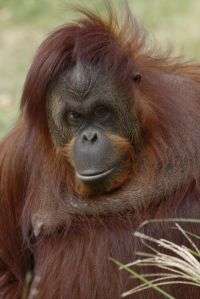
This orangutan's spontaneous whistling is providing scientists at Great Ape Trust of Iowa new insights into the evolution of speech and learning. Credit: Smithsonian National Zoological Park

Throughout history, human beings have used the whistle for everything from hailing a cab to carrying a tune. Now, an orangutan's spontaneous whistling is providing scientists at Great Ape Trust of Iowa new insights into the evolution of speech and learning.

In a paper published this month in Primates, an international journal of primatology that provides a forum on all aspects of primates in relation to humans and other animals, Great Ape Trust scientist Dr. Serge Wich and his colleagues provide the first-ever documentation of a primate mimicking a sound from another species without being specifically trained to do so. Bonnie, a 30-year-old female orangutan living at the Smithsonian National Zoological Park in Washington, D.C., began whistling – a sound that is in a human's, but not an orangutan's, repertoire – after hearing an animal caretaker make the sound.

"This is important because it provides a mechanism to explain documented between-population variation in sounds for wild orangutans," Wich said. "In addition, it counters a long-held assumption that non-human primates have fairly fixed sound repertoires that are not under voluntary control. Being able to learn new sounds and use these voluntarily are also two important aspects of human speech and these findings open up new avenues to study certain aspects of human speech evolution in our closest relatives."

Previous studies have indicated that orangutans and chimpanzees are capable of species-atypical sounds and vocalizations, but only under the strong influence of human training. Bonnie, however, was not explicitly trained to whistle, according to Wich and his co-authors – Great Ape Trust scientists Dr. Karyl Swartz and Dr. Rob Shumaker; Madeleine E. Hardus and Adriano R. Lameira, doctoral candidates at the Utrecht University in The Netherlands assigned to the Ketambe Research Center in Sumatra, where Wich is research co-manager; and Erin Stromberg, an animal caretaker at the National Zoo.

Scientists have long known that orangutans copy physical movements of humans, but Bonnie's whistling indicates that the learning capacities of orangutans and other great apes in the auditory domain might be more flexible than previously believed, Wich said. The behavior goes against the argument that orangutans have no control over their vocalizations and the sounds are purely emotional – that is, an involuntary response to stimuli such as predators.

Bonnie appears to whistle for the sake of making a sound rather than to receive a food reward or some other incentive. If asked to whistle, she is likely to oblige, another indication to scientists that she makes the sound voluntarily.

In their paper, Wich and his colleagues also shared anecdotal information about Indah, a female orangutan who lived with Bonnie at the National Zoo before moving to Great Ape Trust in 2004. Indah also began to whistle some years after Bonnie was first observed making the sound in the late 1980s, but Indah died before recordings could be made of her whistles. Scientists believe that Indah's whistling was a vocalization learned from Bonnie.

That compares with what scientists assume about social learning in wild orangutan populations. For example earlier work by Dr. van Schaik and colleagues showed that wild orangutans in one population make a "raspberry" sound during nest-making, while orangutans in another population make a "nest smack" sound when engaged in the same activity. Wich said it's unlikely that purely genetic or ecological factors explain the differences in sounds of different orangutan populations. Rather, it's more likely others copy one orangutan's innovative sound because the sound serves a function.

"This is a very strong indication that different sounds among wild populations are learned and are not purely genetically or ecologically based," Wich said. "This is a great indication that orangutans can learn sounds not in their repertoire from another species, and they are flexible in using them."

The scientific investigation with Bonnie at the National Zoo was supported in part by a grant from the David Bohnett Foundation and complements field studies of wild orangutans, where differences have been noted in the call repertoires between populations. A strength at Great Ape Trust is the ability of its scientists to conduct simultaneous studies on both captive orangutans and wild orangutans on the Indonesian island of Sumatra at the Ketambe Research Center, where Wich is research co-manager.

"Bringing captive and field research together is an unharvested field," Wich said, "and it offers great potential to Great Ape Trust."

The research also builds on earlier investigations by ape language pioneer Dr. Sue Savage-Rumbaugh a scientist with special standing at Great Ape Trust, and others on the ability of great apes to imitate human speech. Specifically, Savage-Rumbaugh's 1991 investigation centered on whether the bonobo Kanzi, a member of the colony of bonobos now living at Great Ape Trust, might have structurally different vocalizations than bonobos in another group. In a 2004 study, Savage-Rumbaugh looked at whether Kanzi was attempting to imitate human speech.

The results of these studies did enlarge scientists' appreciation of the plasticity in primate sound and vocal learning and indicated that primates might have some plasticity to produce completely new sounds, Wich and his colleagues wrote.

The new findings reopen the door on such research.

"One of the main things we do not understand yet is the evolution of speech," Wich said.

Wich will present the findings on Dec. 18 at a scientific symposium on orangutan genetics at the University of Zürich, Switzerland.

Source: Great Ape Trust of Iowa


print this article email this article download pdf blog this article bookmark this article     Digg this Stumble it share on Facebook share on Reddit add to delicious save to Yahoo! bookmarks
4.8/5 after 24 votes

Rank Filter

Move the slider to adjust rank threshold, so that you can hide some of the comments.


Display comments: newest first

  • Hoarsesenz - Dec 11, 2008
    • Rank: not rated yet
    I guess I'm serious when I say that zoos need to protect orangutans from observing human behavior. If they are "domesticated", then they lose contact with their normal behavior? Thoughts?
  • Velanarris - Dec 12, 2008
    • Rank: 3 / 5 (2)
    I guess I'm serious when I say that zoos need to protect orangutans from observing human behavior. If they are "domesticated", then they lose contact with their normal behavior? Thoughts?
    Would you prefer that no one taught you to read when you were younger to protect you from losing contact with your normal behavior?
  • Roach - Dec 12, 2008
    • Rank: 5 / 5 (1)
    Someone needs to protect humans from observing Orangutan behaviour. When I saw the picture I thought, "Hey, I know that guy!!"
  • D666 - Dec 12, 2008
    • Rank: not rated yet
    Someone needs to protect humans from observing Orangutan behaviour. When I saw the picture I thought, "Hey, I know that guy!!"


    He actually looks a lot better after he's had coffee.
  • QubitTamer - Dec 12, 2008
    • Rank: not rated yet
    Sounds like the labor shortage in construction workers has a new possible supply...

  • ofidiofile - Dec 13, 2008
    • Rank: 5 / 5 (1)
    I guess I'm serious when I say that zoos need to protect orangutans from observing human behavior. If they are "domesticated", then they lose contact with their normal behavior? Thoughts?
    Would you prefer that no one taught you to read when you were younger to protect you from losing contact with your normal behavior?


    i'd have to agree with velanarris. if anything, we want to allow for *all kinds* of enrichment for zoo primates, including interaction with visitors, to keep them healthy and happy.

    besides, if anything is true of big-brained animals like apes and monkeys, social learning is what is "natural" for them.

December 11th, 2008 all stories
Biology /

Comments: 6
Rank: 4.8/5 after 24 votes

  • Stumble this up

  • Digg this

  • Share it:
  • share on Facebook
  • share on MySpace
  • share on Slashdot
  • rss-newsfeed
  • share on Google
  • share on Reddit
  • add to delicious
  • save to Yahoo! bookmarks
  • share on Windows Live
  • Add to Mixx!
Rating: 4.8/5 after 24 votes

  • Related Stories

  • Palm oil putting orangutans at risk
    created Oct 22, 2007 | popularity not rated yet | comments 0
  • New Tools for a Nanotechnology Workshop
    created May 25, 2006 | popularity not rated yet | comments 0


  • Physicists Demonstrate Quantum Memory with Matter Qubits
    Physicists Demonstrate Quantum Memory with Matter Qubits
    Physics / General Physics
    created Jul 03, 2009 | popularity 4.4 / 5 (17) | comments 1
  • 'Holey' Nanosheets for Wastewater Dye Removal
    Nanotechnology / Nanomaterials
    created Jul 01, 2009 | popularity 5 / 5 (5) | comments 1
  • Jellyfish Robot Swims Like its Biological Counterpart
    Jellyfish Robot Swims Like its Biological Counterpart
    Electronics / Robotics
    created Jun 26, 2009 | popularity 4.4 / 5 (8) | comments 1
  • Could Maxwell's Demon Exist in Nanoscale Systems?
    Could Maxwell's Demon Exist in Nanoscale Systems?
    Physics / General Physics
    created Jun 24, 2009 | popularity 4.4 / 5 (18) | comments 29
  • Living Safely with Robots, Beyond Asimov's Laws
    Living Safely with Robots, Beyond Asimov's Laws
    Electronics / Robotics
    created Jun 22, 2009 | popularity 4.6 / 5 (52) | comments 40
  • Other News

    California water plan aims to save Puget Sound orcas

    Biology / Ecology

    created 15 hours ago | popularity not rated yet | comments 0

    A plan to restore salmon runs on California's Sacramento River also could help revive killer whale populations 700 miles to the north in Puget Sound, as federal scientists struggle to protect endangered species in a complex ...


    Scientists 'rebuild' giant moa using ancient DNA

    Biology / Plants & Animals

    created Jul 01, 2009 | popularity 5 / 5 (10) | comments 12

    (PhysOrg.com) -- Scientists have performed the first DNA-based reconstruction of the giant extinct moa bird, using prehistoric feathers recovered from caves and rock shelters in New Zealand.


    Pacific Giant Salamander (Dicamptodon tenebrosus)

    Salamanders, regenerative wonders, heal like mammals, people

    Biology / Microbiology

    created Jul 01, 2009 | popularity 5 / 5 (20) | comments 11

    The salamander is a superhero of regeneration, able to replace lost limbs, damaged lungs, sliced spinal cord -- even bits of lopped-off brain. But it turns out that remarkable ability isn't so mysterious after ...


    Genetically modified trees

    Anti-biotech groups obstruct forest biotechnology

    Biology / Biotechnology

    created Jun 30, 2009 | popularity 3.7 / 5 (7) | comments 5

    The potential of forest biotechnology to help address significant social and environmental issues is being "strangled at birth" by the rigid opposition of some groups and regulations that effectively preclude ...


    Super-sleepers could help super-sizers!

    Super-sleepers could help super-sizers!

    Biology / Plants & Animals

    created Jun 29, 2009 | popularity 5 / 5 (2) | comments 4

    Burrowing frogs can survive buried for several years without food or water. Scientists have discovered that the metabolism of their cells changes radically during the dormancy period allowing the frogs to ...