Boy or girl? It's in the father's genes
December 11, 2008 Boy or girl? It's in the father's genes

Enlarge

(PhysOrg.com) -- A Newcastle University study involving thousands of families is helping prospective parents work out whether they are likely to have sons or daughters.

The work by Corry Gellatly, a research scientist at the university, has shown that men inherit a tendency to have more sons or more daughters from their parents. This means that a man with many brothers is more likely to have sons, while a man with many sisters is more likely to have daughters.

The research, published online today by the journal Evolutionary Biology, involved a study of 927 family trees containing information on 556,387 people from North America and Europe going back to 1600.

"The family tree study showed that whether you're likely to have a boy or a girl is inherited. We now know that men are more likely to have sons if they have more brothers but are more likely to have daughters if they have more sisters. However, in women, you just can't predict it," Mr Gellatly explains.

Men determine the sex of a baby depending on whether their sperm is carrying an X or Y chromosome. An X chromosome combines with the mother's X chromosome to make a baby girl (XX) and a Y chromosome will combine with the mother's to make a boy (XY).

The Newcastle University study suggests that an as-yet undiscovered gene controls whether a man's sperm contains more X or more Y chromosomes, which affects the sex of his children. On a larger scale, the number of men with more X sperm compared to the number of men with more Y sperm affects the sex ratio of children born each year.

Sons or daughters?

A gene consists of two parts, known as alleles, one inherited from each parent. In his paper, Mr Gellatly demonstrates that it is likely men carry two different types of allele, which results in three possible combinations in a gene that controls the ratio of X and Y sperm;

-- Men with the first combination, known as mm, produce more Y sperm and have more sons.
-- The second, known as mf, produce a roughly equal number of X and Y sperm and have an approximately equal number of sons and daughters.
-- The third, known as ff produce more X sperm and have more daughters.

"The gene that is passed on from both parents, which causes some men to have more sons and some to have more daughters, may explain why we see the number of men and women roughly balanced in a population. If there are too many males in the population, for example, females will more easily find a mate, so men who have more daughters will pass on more of their genes, causing more females to be born in later generations," says Newcastle University researcher Mr Gellatly.

More boys born after the wars

In many of the countries that fought in the World Wars, there was a sudden increase in the number of boys born afterwards. The year after World War I ended, an extra two boys were born for every 100 girls in the UK, compared to the year before the war started. The gene, which Mr Gellatly has described in his research, could explain why this happened.

As the odds were in favour of men with more sons seeing a son return from the war, those sons were more likely to father boys themselves because they inherited that tendency from their fathers. In contrast, men with more daughters may have lost their only sons in the war and those sons would have been more likely to father girls. This would explain why the men that survived the war were more likely to have male children, which resulted in the boy-baby boom.

In most countries, for as long as records have been kept, more boys than girls have been born. In the UK and US, for example, there are currently about 105 males born for every 100 females.

It is well-documented that more males die in childhood and before they are old enough to have children. So in the same way that the gene may cause more boys to be born after wars, it may also cause more boys to be born each year.

How does the gene work?

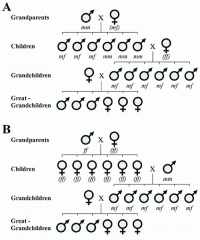
The trees (below) illustrate how the gene works. It is a simplified example, in which men either have only sons, only daughters, or equal numbers of each, though in reality it is less clear cut. It shows that although the gene has no effect in females, they also carry the gene and pass it to their children.

In the first family tree (A) the grandfather is mm, so all his children are male. He only passes on the m allele, so his children are more likely to have the mm combination of alleles themselves. As a result, those sons may also have only sons (as shown). The grandsons have the mf combination of alleles, because they inherited an m from their father and an f from their mother. As a result, they have an equal number of sons and daughters (the great grandchildren).

In the second tree (B) the grandfather is ff, so all his children are female, they have the ff combination of alleles because their father and mother were both ff. One of the female children has her own children with a male who has the mm combination of alleles. That male determines the sex of the children, so the grandchildren are all male. The grandsons have the mf combination of alleles, because they inherited an m from their father and f from their mother. As a result, they have an equal number of sons and daughters (the great-grandchildren).

Citation: Evolutionary Biology, DOI 10.1007/s11692-008-9046-3

Source: Newcastle University


print this article email this article download pdf blog this article bookmark this article     Stumble it Digg this share on Facebook retweet share on Reddit add to delicious
Rate this story - 4.2 /5 (20 votes)

Rank Filter

Move the slider to adjust rank threshold, so that you can hide some of the comments.


Display comments: newest first

  • thales - Dec 11, 2008
    • Rank: 3.7 / 5 (3)
    This is especially interesting to me. I know two families, one with four sons and no daughters, and the other with four daughters and no sons. The firstborn of both families married but as yet have had no children. Now I can let them know that they are almost certain to have mostly sons.
  • x646d63 - Dec 11, 2008
    • Rank: 5 / 5 (1)
    There must be more at work here. Specifically, the tendency to produce female offspring must come from somewhere other than inheritance since you would expect that trait to be bred out of males. Men who produce only female offspring don't pass that tendency on to other males.
  • defunctdiety - Dec 11, 2008
    • Rank: 5 / 5 (1)
    Of course there's more at work, it's called random chance (not the Austin Powers character). An increased proclivity towards spawing males does not guarantee males. My mom's brother had 6 sisters, he had twin sons.

    Not to mention it's probably the same passive mechanism that perpetuates genes like the ones that cause homosexuality or any number of congenital, early-onset diseases, traits that "should" be bred out but cannot be.
  • superhuman - Dec 11, 2008
    • Rank: 1 / 5 (1)
    As the odds were in favour of men with more sons seeing a son return from the war, those sons were more likely to father boys themselves because they inherited that tendency from their fathers


    Yes, fathers with more sons were more likely to have at least one son survive but that doesn't prove anything as on the level of population they have to be outnumbered by fathers with more daughters or else there would be much more sons then daughters during peace.

    So such argumentation is wrong and the effect of war can't be explained by this gene alone unless men who would have more daughters were more likely to die.

    OTOH a rule like in the movie Private Ryan that you are sent home if all (at least 2 for example) your brothers already died would slightly increase chances of those who have more brothers (and therefore are more likely to have sons according to this study) to survive the war. I have no idea how widespread such rules were though.
  • defunctdiety - Dec 11, 2008
    • Rank: not rated yet
    I should add, he had 6 sisters, zero brothers.
  • superhuman - Dec 11, 2008
    • Rank: 1 / 5 (1)
    Yes, fathers with more sons were more likely to have at least one son survive but that doesn't prove anything as on the level of population they have to be outnumbered by fathers with more daughters


    Correction, they have to be outnumbered by fathers who don't have more sons, ie those who have more daughters and those who are as likely to have each together.
    In other words in terms of pop. freq
    mm < mf plus ff
  • ijuset - Dec 11, 2008
    • Rank: not rated yet
    I was expecting involving XY chromosomes and a randomly processing meiosis. So it was not that simple. Great research.
  • makotech222 - Dec 12, 2008
    • Rank: 1 / 5 (2)
    lol no shit i learned this in biology class in HS. Female always donates X, Male donates either X or Y
    DUHH give me millions of dollars for a grant.
  • Velanarris - Dec 12, 2008
    • Rank: 1 / 5 (1)
    Of course there's more at work, it's called random chance (not the Austin Powers character). An increased proclivity towards spawing males does not guarantee males. My mom's brother had 6 sisters, he had twin sons.

    Not to mention it's probably the same passive mechanism that perpetuates genes like the ones that cause homosexuality or any number of congenital, early-onset diseases, traits that "should" be bred out but cannot be.


    Random chance doesn't result in a 50%:50% mixture when you include a genetic tendency.
  • defunctdiety - Dec 12, 2008
    • Rank: not rated yet
    But when you consider that some (.333?) have a tendency for boys, some (.333?) a tendency for girls and some (.333?)a tendancy for neither (or both), you get 50/50. The question is how does the girls tendency perpetuate if it's dependent on the male to pass this trait along? The answer is random chance giving that male a male (instead of the "assumed" girls) and could be also passive gene expression. That's all I was saying, Velnarris.
  • Velanarris - Dec 12, 2008
    • Rank: 1 / 5 (1)
    But when you consider that some (.333?) have a tendency for boys, some (.333?) a tendency for girls and some (.333?)a tendancy for neither (or both), you get 50/50. The question is how does the girls tendency perpetuate if it's dependent on the male to pass this trait along? The answer is random chance giving that male a male (instead of the "assumed" girls) and could be also passive gene expression. That's all I was saying, Velnarris.
    Right but as you asked, the tendency towards one or the other would evolve to be a larger than .333 chance.

    Realisticall you're looking at a 4 way diagram.

    .25 male mm
    .25 female ff
    .25 neither mf
    .25 neither fm

    With dominance and recessive taken into account the actual population should skew towards one or the other, especially in closed populations.

    Dominance in this case leading to males from predominantly male families fathering more male children while males from predominantly female families create more women who do not pass on a male dominant gene expression.

    Eventually you'd wind up with more women than men with 3/4ths of the chart precluding a mm gene expression.
  • defunctdiety - Dec 12, 2008
    • Rank: 5 / 5 (1)
    Realisticall you're looking at a 4 way diagram.

    .25 male mm
    .25 female ff
    .25 neither mf
    .25 neither fm


    By your model, there should be no phenotypic difference between mf or fm, so does that mean:

    .25 mm
    .25 ff
    .50 mf/fm?

    I think this makes it even clearer, how little of a role the gender-specific tendency plays. Especially if you consider that females passively carry the ff tendency and pass it on to their male offspring, even if the father is mm or mf/fm. Which the article states can happen.

    "It shows that although the gene has no effect in females, they also carry the gene and pass it to their children."
  • superhuman - Dec 13, 2008
    • Rank: 1 / 5 (1)
    Eventually you'd wind up with more women than men with 3/4ths of the chart precluding a mm gene expression.


    No, it won't preclude mm gene expression, you don't know what you are talking about as usual.
    'mm' means two copies of 'm' allele but both 'm' and 'f' relate to the same gene, so the gene will be expressed and both m and f alleles will be expressed.
  • Velanarris - Dec 14, 2008
    • Rank: not rated yet
    Eventually you'd wind up with more women than men with 3/4ths of the chart precluding a mm gene expression.


    No, it won't preclude mm gene expression, you don't know what you are talking about as usual.
    'mm' means two copies of 'm' allele but both 'm' and 'f' relate to the same gene, so the gene will be expressed and both m and f alleles will be expressed.
    At what point in time did I say they won't be expressed in an individual.

    I'm speaking about in the group. Societies pick their image and the individuals within those societies that better fit the image have more oppotunities to mate. Most civilizations exalt the ability to have multiple sons. So why would society not make a rather large push towards individuals with the mm allele combo.

December 11, 2008 all stories

Comments: 14

4.2 /5 (20 votes)
  • Stumble this up

  • Digg this

  • share this

  • hide
  • Related Stories


Other News

Computational microscope peers into the working ribosome

Computational microscope peers into the working ribosome (w/ Video)

Biology / Cell & Microbiology

created 16 hours ago | popularity 4.9 / 5 (7) | comments 0

Two new studies reveal in unprecedented detail how the ribosome interacts with other molecules to assemble new proteins and guide them toward their destination in biological cells. The studies used molecular ...


Spider secrets decoded in world-first database

Biology / Plants & Animals

created 11 hours ago | popularity not rated yet | comments 0

(PhysOrg.com) -- Queensland scientists have developed a world-first database that catalogues the venom components from hundreds of spiders.


New chameleon species discovered in East Africa

New chameleon species discovered in East Africa (w/ Podcast)

Biology / Plants & Animals

created 18 hours ago | popularity 5 / 5 (1) | comments 0

A new species of chameleon has been discovered in Tanzania by a team of scientists.


Indian engineer invents device to stop rampaging elephants

Biology / Plants & Animals

created 21 hours ago | popularity 4.3 / 5 (3) | comments 0

An Indian inventor has created a device to stop rampaging elephants in their tracks, amid concern about human injuries and deaths when they run amok, his company said Monday.


A year after discovery, Congo's 'mother lode' of gorillas remains vulnerable

A year after discovery, Congo's 'mother lode' of gorillas remains vulnerable

Biology / Plants & Animals

created 14 hours ago | popularity 5 / 5 (1) | comments 0

A new study by the Wildlife Conservation Society says that western lowland gorillas living in a large swamp in the Republic of Congo—part of the "mother lode" of more than 125,000 gorillas discovered last ...