Bit of bling adds new dimension to laser beam technology
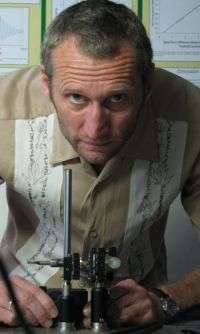
December 11, 2008 Richard Mildren works with a CVD diamond.

Enlarge

Richard Mildren works with a CVD diamond.

(PhysOrg.com) -- No longer just an expensive ornament, diamonds are now of a sufficient size and quality to attract the eye of a team of physicists at Macquarie University, who are using them to develop a new more powerful laser.

And, says leader of the research, Richard Mildren, despite their size and impressive appearance, the diamonds used in the laser experiments are surprisingly affordable.

"Using natural diamonds in this type of work is problematic - the quality is not consistent and, as everybody knows, they're very expensive," Mildren said.

"In the last two to three years the production method has really ramped up - diamonds can now be grown using a method called chemical vapour deposition (CVD) and a one centimetre-long crystal can be purchased for around $2000."

Diamonds can transmit heat and light very effectively, creating the potential for very powerful lasers and making them of extreme interest to scientists.

Their excellent optical properties have long been known, and there have been significant efforts around the globe to demonstrate diamond (diode) lasers for more than 15 years.

Mildren's team has now built the first diamond laser using a technique based on the Raman effect. Not only has this demonstrated a new more effective method for generating a powerful beam, it has also shown that CVD diamonds are of adequate size and quality to enable exploration of a new class of laser devices.

"This research could pave the way for new laser sources over a wide range of wavelengths and with very high power levels," Mildren said.

"The next step is to see how effectively CVD diamond lasers operate at even higher power levels. We'd also like to investigate the potential for diamond Raman lasers in the ultraviolet and long wave infrared regions where other materials can't operate."

If his future experiments are again successful, Mildren said there was potential for diamond Raman lasers to be used in everything from terahertz threat detection (eg. body scanning devices at airports) and ultra high precision laser surgery, to defence applications (eg. directed energy weapons).

Provided by Macquarie University


print this article email this article download pdf blog this article bookmark this article     Stumble it Digg this share on Facebook retweet share on Reddit add to delicious
Rate this story - 4.2 /5 (21 votes)

Rank Filter

Move the slider to adjust rank threshold, so that you can hide some of the comments.


Display comments: newest first

  • theophys - Dec 11, 2008
    • Rank: 2.4 / 5 (5)
    lasers to be used in everything from terahertz threat detection (eg. body scanning devices at airports) and ultra high precision laser surgery, to defence applications (eg. directed energy weapons).


    Cool. Quicker lines at airport security (just vaporize the guy whose shoes keep setting off the metal detector), surgicaly remove tumors with a high power laser that could potentialy cause more cancer in any cells it doesn't kill, and of course, phasers!
  • MrGrynch - Dec 11, 2008
    • Rank: 4 / 5 (4)
    Aren't phasers actually charged particle weapons (in theory)?
  • mattytheory - Dec 11, 2008
    • Rank: 4.3 / 5 (3)
    yes, they are.
  • theophys - Dec 11, 2008
    • Rank: 4.3 / 5 (3)
    Ok, fine. No phasers.
  • dirk_bruere - Dec 11, 2008
    • Rank: 3 / 5 (1)
    Must be thinking of the diamond laser built by Blofeld in Diamonds Are Forever.
  • nkalanaga - Dec 11, 2008
    • Rank: 3 / 5 (1)
    Phasers supposedly work by "modulating the strong nuclear force", causing atomic nuclei to debond. In theory, it would be a fantastic weapon, but so far as I know there is no experimental evidence that the force can be modulated.
  • theophys - Dec 11, 2008
    • Rank: 2 / 5 (2)
    Phasers supposedly work by "modulating the strong nuclear force", causing atomic nuclei to debond. In theory, it would be a fantastic weapon, but so far as I know there is no experimental evidence that the force can be modulated.

    I don't see why not. I have no idea how to go about doing it, but i'm sure in a century or two we should have developed some modicum of control over the strong nuclear force just like we have with electromagnatism.
  • Ashibayai - Dec 12, 2008
    • Rank: 3 / 5 (1)
    ^ Well as for manipulating the strong nuclear force...can you say fission?
  • gmurphy - Dec 12, 2008
    • Rank: not rated yet
    this is a description of a raman laser

    http://en.wikiped...an_laser
  • theophys - Dec 12, 2008
    • Rank: not rated yet
    ^ Well as for manipulating the strong nuclear force...can you say fission?


    Fission doesn't manipulate the strong nuclear force, it overcomes it. Much in the same way that space shuttles overcome gravity rather than attempting to manipulate it.
  • Ramael - Jan 19, 2009
    • Rank: not rated yet
    theophys, why would a laser beam cause cancer? That's not how light works and that's not how chemo works. The beam from a laser would be focused enough to effect matter in its immediate contact. Of course light can be manipulated to more permeate a substance, somewhat like how a microwave cooks your food, but that's somewhat contradictory to the function of a laser. Laser surgery would function both as a super fine scalpel and a cauterizing tool to seal wounds. Laser technology can even effectively reduce scaring. But you risk more cancer by microwaving your food than being operated under a laser scalpel.
    Besides, countless EM frequencies pass through our body every day, even before the invention of cell phones. Our planet has a magnetic field, as does the sun, and though some forms of UV light among others are hazardous, many light scanning technologies have proven to be completely harmless.

December 11, 2008 all stories

Comments: 11

4.2 /5 (21 votes)
  • Stumble this up

  • Digg this

  • share this

  • hide
  • Related Stories

  • Diamonds are a laser's best friend
    created Sep 18, 2009 | popularity not rated yet | comments 0
  • Generating pressures at the cores of giant planets
    created May 02, 2007 | popularity not rated yet | comments 0
  • New book highlights status of research into carbon nanotubes
    created Jun 24, 2005 | popularity not rated yet | comments 0
  • UNL to improve thin diamond film technology
    created Apr 14, 2005 | popularity not rated yet | comments 0
  • Ultra-Powerful Laser Reproduces How Star's Jets Travel through Interstellar Space
    created Nov 20, 2009 | popularity not rated yet | comments 0


  • hide
  • Relevant PhysicsForums posts

  • Ionization vs. photo-generation - what is the difference?
    created 3 hours ago
  • Ising model
    created Nov 24, 2009
  • Photon replica
    created Nov 24, 2009
  • Planck's Radiation Law and Stefan's Law
    created Nov 24, 2009
  • More from Physics Forums - Atomic, Solid State, Comp. Physics

Other News

Researchers develop virtual streams to help restore real ones

Physics / General Physics

created 20 hours ago | popularity not rated yet | comments 0

Researchers at the University of Minnesota have developed a unique new computer model called the Virtual StreamLab, designed to help restore real streams to a healthier state. The Virtual StreamLab, which demonstrates the ...


Scientists react as they stand in front of a screen at CERN

First atoms reported smashed in Large Hadron Collider (Update)

Physics / General Physics

created Nov 23, 2009 | popularity 4.6 / 5 (29) | comments 21

Two circulating beams on Monday produced the first particle collisions in the world's biggest atom smasher, the Large Hadron Collider (LHC), three days after its restart, scientists announced.


Restored machine to explore mysteries of Big Bang (AP)

Restored machine to explore mysteries of Big Bang

Physics / General Physics

created Nov 21, 2009 | popularity 4.6 / 5 (18) | comments 26

(AP) -- Scientists are preparing the world's largest atom smasher to explore the depths of matter after successfully restarting the $10 billion machine following more than a year of repairs.


In the Brain, Seven Is A Magic Number

In the Brain, Seven Is A Magic Number

Physics / General Physics

created Nov 23, 2009 | popularity 4.5 / 5 (31) | comments 9

Having a tough time recalling a phone number someone spoke a few minutes ago or forgetting items from a mental grocery list is not a sign of mental decline; in fact, it's natural.


nuclear power plant

Doubts raised on nuclear industry viability

Physics / General Physics

created Nov 19, 2009 | popularity 3.1 / 5 (21) | comments 19

(PhysOrg.com) -- The investment in nuclear power has been growing around the world over the last few years, being viewed as a means for countries to control their energy security, avoid the price fluctuations ...