Research finds koalas are no dwarves
December 11, 2008 Research finds koalas are no dwarves

Enlarge

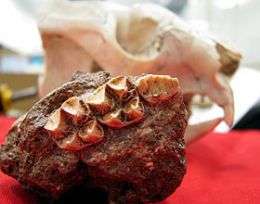
Giant koala jaw from a 53 thousand year deposit in front of a modern koala skull

(PhysOrg.com) -- University of Queensland research has found one of Australia's iconic animals is not a shadow of its former self.

Palaeontologist Dr Gilbert Price, from UQ's Centre for Microscopy & Microanalysis, said there was a long-held view modern koalas were a dwarf version of a giant koala that lived between 30,000 and 700,000 years ago.

But Dr Price said his research into the fossil record of koalas didn't support that theory and modern koalas can stand tall in the knowledge they are their own separate species.

“By looking at the fossil record of both types of koalas, I found that they existed together for hundreds of thousands of years through prehistory,” Dr Price said.

“This contrasts with the previous idea that the modern koala originated only after the loss of the giant koala, following the megafauna extinction event some 30 to 50,000 years ago.

“Also there are distinct differences in the appearance of both forms, other than simply size. Together these results suggest the two forms are distinct species and the modern koala is not a dwarf descendent of the giant koala.”

Dr Price said the two species would have even lived in the same areas at the same time, which would have made an interesting sight.

“On the one hand we have a 20-30kg giant koala, the largest tree-dwelling marsupial ever to have lived,” he said.

“And then we have the modern koala weighing in at 10kg, so there would have been quite a contrast.”

But he said study left some unanswered questions about the evolution of the koala how it had adapted to life in Australia over hundreds of thousands of years.

“The results beg the question, where on earth did the modern koala come from?” he said.

“A lack of well-dated fossil records means determining the true ancestor of the modern koala is most difficult.”

“Another question is, what is it about the little guy that allowed it to persist through such intense periods of environmental changes and survive until today, when the big fella decided to drop out over 50,000 years ago?”

“It's absolutely critical that we can find the answers to such questions, and that we find them soon as it'll go a long way in the planning of management strategies to conserve the modern koala well into the future.”

Dr Price's research has recently been published in the journal Quaternary Science Reviews.

Provided by UQ


print this article email this article download pdf blog this article bookmark this article     Stumble it Digg this share on Facebook retweet share on Reddit add to delicious
Rate this story - 4 /5 (2 votes)


December 11, 2008 all stories

Comments: 0

4 /5 (2 votes)
  • Stumble this up

  • Digg this

  • share this

  • hide
  • Related Stories

  • Researcher uncovers koalas' creature comforts
    created Mar 10, 2009 | popularity not rated yet | comments 0
  • Aussie koala that survived fires dies in surgery
    created Aug 06, 2009 | popularity not rated yet | comments 0
  • Most koalas in Japan carry leukemia virus: report
    created Apr 12, 2009 | popularity not rated yet | comments 0
  • Orphaned koala becomes first-time mother
    created Nov 14, 2008 | popularity not rated yet | comments 0
  • Koalas calling
    created Oct 07, 2008 | popularity not rated yet | comments 0


Other News

Beyond sunlight: Explorers census 17,650 ocean species between edge of darkness and black abyss

Beyond sunlight: Explorers census 17,650 ocean species between edge of darkness and black abyss (w/ Video)

Biology / Plants & Animals

created 7 hours ago | popularity 5 / 5 (4) | comments 0

Census of Marine Life scientists have inventoried an astonishing abundance, diversity and distribution of deep sea species that have never known sunlight - creatures that somehow manage a living in a frigid ...


Rare Charles Darwin book found on toilet bookshelf (AP)

Rare Charles Darwin book found on toilet bookshelf

Biology / Other

created 6 hours ago | popularity 5 / 5 (1) | comments 0

(AP) -- An auction house says it is selling a rare first edition of Charles Darwin's "On the Origin of Species" found in a family's guest lavatory in southern England.


Bigger not necessarily better, when it comes to brains

Bigger not necessarily better, when it comes to brains

Biology / Plants & Animals

created Nov 17, 2009 | popularity 4.5 / 5 (19) | comments 11

(PhysOrg.com) -- Tiny insects could be as intelligent as much bigger animals, despite only having a brain the size of a pinhead, say scientists at Queen Mary, University of London.


Extinct goat Myotragus balearicus

Extinct goat was cold-blooded

Biology / Plants & Animals

created Nov 18, 2009 | popularity 4.9 / 5 (34) | comments 10

(PhysOrg.com) -- An extinct goat that lived on a barren Mediterranean island survived for millions of years by reducing in size and by becoming cold-blooded, which has never before been discovered in mammals.


Right-handed chimpanzees provide clues to the origin of human language

Biology / Plants & Animals

created Nov 16, 2009 | popularity 3 / 5 (1) | comments 7

Most of the linguistic functions in humans are controlled by the left cerebral hemisphere. A study of captive chimpanzees at the Yerkes National Primate Research Center (Atlanta, Georgia), reported in the January 2010 issue ...