Flapping wing vehicle improves on the a helicopter
December 11th, 2008 By Bill Steele Flapping wing vehicle improves on the a helicopter

Enlarge

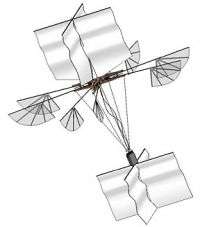
Four sets of small flapping wings and stabilizing sails give the vehicle the ability to right itself from any position, something even helicopters can't do.

(PhysOrg.com) -- Since the days of Leonardo da Vinci people have tried to build machines that fly with flapping wings like a bird or an insect. Even in the jet age the idea remains attractive because such machines could be more maneuverable than fixed-wing aircraft, and at small sizes would use less energy to hover than helicopters.

Many of these so-called "ornithopters" have been built. Some of them fly well when moving forward, but so far, few do a good job of hovering in place. Our computers still can't match the complex feedback and control systems in the tiny brains of birds and bugs.

But Cornell researchers have come up with a simple, inexpensive flapping wing vehicle that hovers as well as a hummingbird or a bumblebee -- and might eventually be made just as small. Potential applications include surveillance, artificial pollination and even toys.

The vehicle -- built by students Floris Van Breugel and William Regan, working with Hod Lipson, Cornell associate professor of mechanical and aerospace engineering -- needs no complex control system because it is "passively stable." Tip it over and it naturally rights itself like a buoy in water. It can even be started upside down and will recover, something few conventional aircraft, including helicopters, can do. The device is described in an article in the December 2008 issue of IEEE Robotics & Automation Magazine.

The prototype, about 2 feet high, uses four pairs of flexible flapping wings arranged at the corners of a box-kite-shaped stabilizing sail, driven by tiny rotary motors that move bent crankshafts to produce a flapping motion. The wings are made of thin polyethylene film stretched over a veined plastic frame of slightly thicker polyethylene, not unlike the structure of many insect wings. The wings are attached by carbon fiber rods that flex to increase the length of each flap and store elastic energy like springs. With a body made of laser-cut balsa wood and packing foam, the vehicle weighs just 24.2 grams (a bit less than one ounce), including batteries.

The design is highly scalable, according to Lipson, and the next step will be to make smaller versions, perhaps down to fly size, where motors might be replaced by piezoelectric actuators.

It was once a standing joke that according to aerodynamic theory bumblebees can't fly. What this really meant was that the theory needed to be refined, and a number of scientists have been working on it, allowing for the complex vortices that form at the leading and trailing edges of insect wings as they move both up and down and forward and back. Studies of live insects have shown that their wings change shape as they move to take advantage of these effects. Van Breugel took all this into account in his design, creating flexible wings with a carefully tailored shape that warps through the flapping cycle in response to air pressure and inertia to get maximum lift with minimum battery power.

Van Breugel is now a Ph.D. candidate at the California Institute of Technology, and Regan is a Ph.D. candidate at the University of California-Berkeley.

Along with practical applications of the technology, the researchers said they hoped the work would provide further insight into the mechanisms underlying the flight of insects and hummingbirds.

Provided by Cornell University


print this article email this article download pdf blog this article bookmark this article     Digg this Stumble it share on Facebook share on Reddit add to delicious save to Yahoo! bookmarks
4.6/5 after 24 votes

Rank Filter

Move the slider to adjust rank threshold, so that you can hide some of the comments.


Display comments: newest first

  • makotech222 - Dec 12, 2008
    • Rank: 1 / 5 (2)
    the problem with flapping wings is that they arent efficient, which is why rotary wings are used, they dont have to break and restablish kinetic engery with every flap of the wing.
  • Corvidae - Dec 12, 2008
    • Rank: 5 / 5 (5)
    There is a trick that humming birds and a few others use. The wings actually move in a figure 8 pattern and create lift on the upswing, and the rounded bottoms of the flapping motion preserves a lot of the momentum of the wing.

    Very efficient for an animal, still not so much for a mechanical system.
  • wsbriggs - Dec 12, 2008
    • Rank: not rated yet
    If I'm not mistaken the battery is at the bottom, naturally leading to stability. The question of lift is whether or not vortex capturing systems can be made efficient. I'm not sure that we know everything about the subject yet, nor am I sure that, ipso facto, moving wings are inefficient when properly designed. There's so much more to be discovered in the Universe.
  • Eky - Dec 15, 2008
    • Rank: not rated yet
    Helicopters and hummingbirds take advantage of a spike in aerodynamic lift created by a transient angle of attack(the oscillating wing/rotor rapidly change angle of attack) i think wsbriggs was referring the the vortex's shed during this transient lift process.

December 11th, 2008 all stories
Technology / Engineering

Comments: 4
Rank: 4.6/5 after 24 votes

  • Stumble this up

  • Digg this

  • Share it:
  • share on Facebook
  • share on MySpace
  • share on Slashdot
  • rss-newsfeed
  • share on Google
  • share on Reddit
  • add to delicious
  • save to Yahoo! bookmarks
  • share on Windows Live
  • Add to Mixx!
Rating: 4.6/5 after 24 votes


Tags

wings

  • Transform a ball into a rock -- or make it invisible -- using transformation optics
    Transform a ball into a rock -- or make it invisible -- using transformation optics
    Physics / General Physics
    created 10 hours ago | popularity 3.7 / 5 (3) | comments 0
  • Could a quantum motor do work?
    Physics / General Physics
    created Jul 07, 2009 | popularity 4 / 5 (12) | comments 0
  • Physicists Demonstrate Quantum Memory with Matter Qubits
    Physicists Demonstrate Quantum Memory with Matter Qubits
    Physics / General Physics
    created Jul 03, 2009 | popularity 4.5 / 5 (20) | comments 1
  • 'Holey' Nanosheets for Wastewater Dye Removal
    Nanotechnology / Nanomaterials
    created Jul 01, 2009 | popularity 5 / 5 (5) | comments 1
  • Jellyfish Robot Swims Like its Biological Counterpart
    Jellyfish Robot Swims Like its Biological Counterpart
    Electronics / Robotics
    created Jun 26, 2009 | popularity 4.4 / 5 (9) | comments 1
  • Other News

    synthetic tree

    Synthetic Tree Captures Carbon 1,000 Faster Than Real Trees

    Technology / Engineering

    created 4 hours ago | popularity 3.4 / 5 (5) | comments 5

    (PhysOrg.com) -- Scientists have designed a synthetic tree that traps carbon dioxide from the air in an attempt to combat growing emissions. The device looks less like a tree and more like a small building, ...


    Electric Raptor

    Raptor: An Electric Car Nearly Anyone Would Want to Drive

    Technology / Energy

    created 4 hours ago | popularity 5 / 5 (3) | comments 4

    I love my Prius, it's true. But sometimes, I look at the Dodge Charger (I'm watching Burn Notice this summer) and think, "What a cool car." And when we think of cool cars, it's hard to keep the image of a ...


    NY official: Tagged site stole identities

    Technology / Internet

    created 3 hours ago | popularity 5 / 5 (1) | comments 0

    (AP) -- New York's attorney general charged Thursday that Tagged.com stole the identities of more than 60 million Internet users worldwide - by sending e-mails that raided their private accounts.


    Google, Microsoft chairmen share laugh together (AP)

    Google, Microsoft chairmen share laugh together

    Technology / Business

    created 3 hours ago | popularity not rated yet | comments 0

    (AP) -- The escalating tension between Google and Microsoft didn't prevent the companies' chairmen from sharing a moment of levity Thursday at an exclusive media conference in the Idaho mountains.


    See your photos in 3D on new website

    See your photos in 3D on new website

    Technology / Computer Sciences

    created 11 hours ago | popularity 4.3 / 5 (7) | comments 5

    (PhysOrg.com) -- You could turn your holiday snaps or favourite figurines into three-dimensional images with new free software developed by a researcher from Queensland University of Technology and the Australasian ...