Celebrating the man who invented the mouse
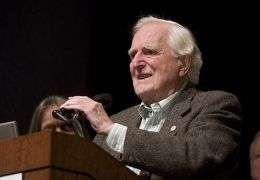
(PhysOrg.com) -- Forty years ago, Stanford researcher Doug Engelbart got a standing ovation in a San Francisco auditorium after dramatically introducing the computer mouse, hyperlinks, live text editing and interactive computing in an historic demo at the 1968 Fall Joint Computer Conference. Tuesday, in Stanford's Memorial Auditorium, the gray-haired, 83-year-old electrical engineer received another round of applause.
But between the accolades at Tuesday's celebration, there was some disappointment that Engelbart's vision, developed at the Stanford Research Institute in the 1960s, has still not been fully implemented. A big-picture thinker who also knew the technical details (he helped invent the Internet), Englebart envisioned a world where universal collaborative computing would augment human thinking, raising the collective IQ and solving important problems.
Today collaborative computing exists, but has not yet reached the masses. Instead, we work with a collection of software tools that "don't play nice together," said Andries van Dam, a computer science professor at Brown University who attended the original 1968 demo in San Francisco and called it an "other-worldly experience."
The mouse was merely a byproduct of Engelbart's larger vision, said his daughter, Christina Engelbart, executive director of the Doug Engelbart Institute. "That was what the public recognizes as a great innovation that's really had a huge impact on everyone. But truly his greatest innovation of all was the vision and the strategic organizing principles that catapulted the innovation of his lab and that could catapult the work today if it was applied and harnessed in teams and organizations," she said.
"It's frustrating in a way," said Jeff Rulifson, a research director at Sun Microsystems Laboratories and a witness to the original demo. "Doug had these grand ideas. And we've realized some of them, in what's happened with computers. But he also had grand ideas about how we could be able to work cooperatively using computers to solve large problems."
Sometimes, Engelbart was so far ahead of the curve that even his colleagues had trouble understanding the future he was trying to describe. His way of seeing the world was profoundly influenced by a single magazine article he read while stationed in the Philippines as an electronics technician at the end of World War II.
"As We May Think'' was written for Atlantic by Vannevar Bush, who directed science research for the war effort. In the article, Bush searched for ways to make human knowledge broadly accessible. Engelbart imagined something like a radar screen, in which information could be displayed in three dimensions, perhaps making it possible to fly through the data with great speed and flexibility.
Rulifson recalled Engelbart challenging his co-workers to break out of linear thinking. He asked, for example, why human language was the model for computers; perhaps computers should employ a different syntax or sentence structure. "There's nothing natural about natural language," Rulifson said.
When Englebart got his own lab at SRI in 1963 (which he later dubbed the Augmentation Research Center,) computers were mainframes, programmed with stacks of paper punch cards. "Computing in those days was believed to be for arithmetic," said Robert Taylor, the 1960s director of the Pentagon's Advanced Research Projects, which funded Engelbart's work. When Taylor suggested connecting several research centers together in a network, some declined, saying it was foolish to share expensive computing time. Not Engelbart. "Doug, almost standing alone, said, 'This is a great idea,' " making SRI one of the founding nodes in 1969 of what would become the Internet.
SRI was founded by Stanford University as the Stanford Research Institute in 1946. It became independent of the university in 1970. Based in Menlo Park, it is a nonprofit research institute conducting contract research and development for government agencies, businesses and foundations.
Provided by Stanford University


