Earth has warmed 0.4 C in 30 years
December 11, 2008
World Map
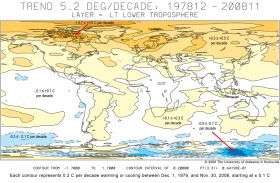
(PhysOrg.com) -- Half of the globe has warmed at least one half of one degree Fahrenheit (0.3 C) in the past 30 years, while half of that -- a full quarter of the globe -- warmed at least one full degree Fahrenheit (0.6 C), according to Dr. John Christy, a professor of atmospheric science and director of the Earth System Science Center (ESSC) at The University of Alabama in Huntsville.
Globally, Earth's atmosphere warmed an average of about 0.4 C (or about 0.72 degrees Fahrenheit) in 30 years, according to data collected by sensors aboard NOAA and NASA satellites. More than 80 percent of the globe warmed by some amount.
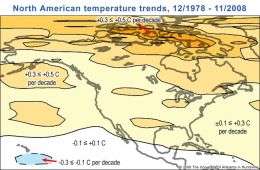
North America Map - local temperature anomalies.
A map of Earth's climate changes since December 1, 1978, (when satellite sensors started tracking the climate) doesn't show a uniform global warming. It looks more like a thermometer: Hot at the top, cold at the bottom and varying degrees of warm in the middle.This is a pattern of warming not forecast by any of the major global climate models.
The area of fastest warming is clustered around the Northern Atlantic and Arctic oceans, stretching from Arctic Canada across Greenland to Scandinavia. The greatest warming has been on opposite ends of Greenland, where temperatures have jumped as much as 2.5 C (about 4.6 degrees F) in 30 years.
During the same time, however, much of the Antarctic has cooled, with parts of the continent cooling as much as Greenland has warmed. But areas of cooling were isolated: Only four percent of the globe cooled by at least half of one degree Fahrenheit.
"If you look at the 30-year graph of month-to-month temperature anomalies, the most obvious feature is the series of warmer than normal months that followed the major El Nino Pacific Ocean warming event of 1997-1998," said Christy. "Right now we are coming out of one La Nina Pacific Ocean cooling event and we might be heading into another. It should be interesting over the next several years to see whether the post La Nina climate 're-sets' to the cooler seasonal norms we saw before 1997 or the warmer levels seen since then."
Virtually all of the warming found in the satellite temperature record has taken place since the onset of the 1997-1998 El Nino. Earth's average temperature showed no detectable warming from December 1978 until the 1997 El Nino.
Provided by University of Alabama in Huntsville


The real world is ignoring the models!
That would suggest that the source of Earth's gravity lies somewhere around Antartica. There is no physical way to determine a top or bottom of the globe, we just arbitrarily decided to put the North on the top and the South on the bottom.
I then fell over laughing.
One thing to notice in the article is that even though the editor is claiming that this speaks to the issue of the "globe" (I assume meaning the earth), it actually addresses only the lower troposphere (which is the lower layer of the atmosphere). While tropospheric temperatures are closely coupled to surface temperatures, they are not, necessarily, identical. The paper appears to be very specific while the review in the article seems to miss that point. It would have been better to make sure the article stuck to the issue of low-level atmospheric temperatures (which are important because that is where we live).
Having said that, the observations in the article are extremely interesting including both the South to North warming and the fact that most of the warming seems to have happened after the last El Nino. Since the oceans hold an enormous amount of energy it makes sense that changes in oceanic temperature would directly affect the atmospheric temperatures - but the mechanism is not clear at all. I consider this to be an important paper. Now we have to wait to see what explanations might come forth.
As for GrayMouser's observation that this, in some way, invalidates the models; it does not. The models are an important tool for understanding changes in the atmosphere and are getting better all of the time. An anomaly like this to showing up only helps to strengthen the models as they are modified to take this difference into consideration (after the reason is recognized and accounted for). I use modeling all of the time to predict heat transfer in combustion systems. Sometimes the models and experiment do not agree and it helps me improve the models so I can use them to predict yet more complex systems. Science is a series of approximations and adjustments to the approximations as we learn more. The present models are not perfect, and never will be. However, they are still useful and will continue to be improved (just as I hope mine are).
if you look at the carbon out put of man and the carbon out put of the Volcanoes and other sources of natural carbon, they far out stretch us. Also what do you think has a bigger impact on the environment... a bunch of human driving our cars on less than 1/3 of the Earth or a Giant ball of plasma that has heated the Earth for billions of years.
" E X A C T L Y "
Anomalies happen when you have a faulty model....
theophys: The "top-to-bottom warming" is called polar amplification.
http://bobtisdale...ing.html
"Cooling of the Arctic and Antarctic Polar Stratospheres due to Ozone Depletion. WJ Randel, F Wu - Journal of Climate, 1999"
Just to add something i remembered. Since the Earth is crossing the galactic equator, (it takes about 30 years to cross it completely and the half way point is the year 2012) that the earth is subject to different gravitational fields then it has in the past. So with this there could be a tectonic movement that has increased Volcanic activity and other geo- related increases or decreases. Leading to an increased out put of carbon. Of course with increased Carbon Di-oxide there is the boost plants get from basically a better air for them to breath. Like putting a human on oxygen.
We will soon see what effect the sun has had on global climate change. The sun is currently beging a long period of low sun spot activity. This means that for the next century or so, the sun will send less radiation toward Earth than it normaly does. If everything starts cooling dramaticaly, it was all the sun's fault, no problem. If temperatures stay where they are right now, there are factors that the reduced radiation is now countering, and if things keep getting hotter, we're in trouble.
I'm impressed with your precognition. How is it that you know how the sun will behave for the next century?
True, we're in a solar minimum that may be an extended one, but nobody is expecting another Maunder minimum. If we get one, we'll all be pretty cold.
method used repeat evryday the scam until most
will belive in it
Ah ha, the models are wrong. They will be better after they're corrected. For now we keep finding new climate effects all the time, until (if ever) all these effects are known the models will never be right. AGW models show a small CO2 concentration forcing huge temperature changes, well then we better find every little effect of climate before we rely on them and spend trillions of dollars. Far better to adapt to climate change, if necessary. How could human beings be so naive as to think they can control the climate of this planet.
I'm having trouble with the links, so you'll have to cut and paste the website address to your browsers.
bobtisdale.blogspot.com/2008/11/recharging-pacific-warm-pool.html
And since the link in my earlier comment didn't work, here's the address again. Cut and paste to your browser.
bobtisdale.blogspot.com/2008/07/polar-amplification-and-arctic-warming.html
Just a thought, comments please. (as if I need to ask!)
Presently, no weather model predicts El Niño or La Niña, two of the most powerful contributors to Climate worldwide. These models in fact are in their infancy but there are great interests to use them to get grants...money, money money!
It is very easy to conquer the minds and the hearts of lay people when you say that the Great Barrier Reef will be damaged by temperature change...however these people have only an emotional view of the situation and no whatsoever knowledge about geological time span.
Where do you think the Alps were 160 million years ago?
They were bigger than the Great Barrier Reef in Australia. Now they are 3000m over the sea level.
How much CO2 is trapped there? Where all C presently trapped in coal and oil was 500million years ago?
To think about the Earth we have to have a geological perspective, not a psychological or emotional one.
Unfortunately, some influential guys use the immense ignorance available in the planet for their personal gains.
Greed and ignorance move the public opinion, not facts nor science.
Im not a climatologist, just a
retired doc with an enduring
penchant for things scientific..
But i can imagine reasons perhaps
worthy of exploration:
1) the planet's factories and
industries are located at 'top',
with a likely higher concentration
of CO2
2) a greater portion of the south
is ice-covered: which could reflect
significantly more of the sun's
energy
3) and i just wonder if the tilt
of the earth might be involved
4) more land-mass is exposed in
the north
tkjtkj
There is value in the comments that the northern hemisphere has more land mass, but, typically in a heterogeneous system warming is felt first and most at the coolest regions of the system. The warming is anomalous and does not fit the profile of GHG induced warming as most GHGs are homogenous in the atmosphere.
As for more industry being focused in the northern hemisphere, that may be true of the western world, in the East, certainly not so much.
Simple, I'm magic. Ha, Ha!
Actually my proffesor, an astrophysisist, told me that the current observations suggested that we are starting an extended minima period that is beleived to last for around a century (give or take).
You missed the part about "Virtually all of the warming found in the satellite temperature record has taken place since the onset of the 1997-1998 El Nino."
This explains the cooling adequately and the ocean currents following El nino and La nina seem adequate to explain the warming in the north.
Its been cooling for the past decade, so they just grab more graph to even that out, yet relatively time wise not enough data is available to understand earths climate to the degree that pronouncements can be justified about one pixel up or down! Politically motivated ($$$) bad science!!
Thanks for the laugh.
Barakn:
What makes you think that 30 years is a "long term average", you are way more guilty of what you accuse Brant of doing than he was.
You are a moron