Cost of hatchling turtles' dash for freedom
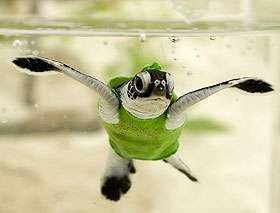
A newly hatched sea turtle's first swim is the most critical of its life. Having run the gauntlet of air and land predators to make it to the sea, the tiny voyager must also evade hungry fish patrolling the beaches in its bid for freedom. For youngsters hatching on the Great Barrier Reef's coral cays the risks are high: as many as 30% perish as they head for safe deep waters. But how much does this headlong dash through the waves cost the intrepid hatchlings?
Curious to know, David Booth from the University of Queensland decided to measure hatchling turtles' oxygen consumption rates as they swam for safety. Booth publishes his results in The Journal of Experimental Biology on 12th December 2008 at http://jeb.biologists.org.
Travelling north to the university's research station on Heron Island, Booth was fortunate enough to have a laboratory within metres of a green turtle nesting beach. Visiting the beach as the mothers-to-be lumbered up on to the sand, Booth was able to collect several clutches of eggs and move them to the edge of the nesting site for safety from other egg-laying mothers. Returning to the site several months later as the eggs were about to hatch, Booth intercepted several youngsters before they reached the sea.
Transporting them 100metres up the beach to the research station, he fitted each hatchling with a lycra swim suit with a chord attached to a force transducer, before setting the youngster free in a seawater aquarium. As soon as they entered the water, the youngsters began swimming frantically with their large front flippers, pulling against the force transducer as if they were swimming out to sea. Meanwhile, Booth measured the youngsters' oxygen consumption as they swam for 18hours to find out how hard they were working.
Watching the youngsters' swimming style, Booth could see that initially the animals swam very hard using their front flippers with their heads down, only switching to a 'doggy paddle' as they came up for air before returning to frenzied front-flipper swimming. But as time drew on, the youngsters' activity slowed. They spent more time doggy paddling and less time pulling with their front flippers until they eventually began taking the odd break after about 12 hours.
The youngsters' progress was also reflected in the force with which they tugged on the force transducer. Setting off with a thrust of 45milliNewtons, the swimmers' thrust rapidly dropped to 35milliNewtons during the first half hour, continuing to fall more gradually over the next 10 hours before levelling off at 20milliNewtons about 12 hours after embarking.
Analysing the hatchlings' oxygen consumption, Booth found the same trend with oxygen consumption falling rapidly during the first half hour, before declining more slowly and eventually levelling off after 12 hours. So what does this mean for a young turtle as it thrashes to safety?
Ref. Booth, D. T. (2009). Swimming for your life: locomotor effort and oxygen consumption during the green turtle (Chelonia mydas) hatchling frenzy. J. Exp. Biol. 212, 50-55.
Source: The Company of Biologists


