$12.5 Million in Subcontracts Awarded for Fusion Experiment
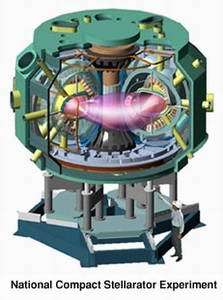
The U.S. Department of Energy's (USDOE) Princeton Plasma Physics Laboratory (PPPL) has awarded two subcontracts for the fabrication of major components for the National Compact Stellarator Experiment (NCSX), now under construction at the Laboratory. NCSX will explore the physics of an innovative concept for fusion energy production and will advance the understanding of the related basic science. PPPL is building the new experiment in partnership with the USDOE's Oak Ridge National Laboratory in Tennessee.
A team led by Energy Industries of Ohio, Inc., of Independence, Ohio, has been selected to manufacture the winding forms upon which unique, modular electromagnetic coils will be mounted. Team members include the C.A. Lawton Company, Pattern Division, of DePerre, Wis.; MetalTek International, Carondelet Division, of Pevely, Mo.; and Major Tool and Machine, Inc., of Indianapolis, Ind. In addition to being part of the winding form team, Major Tool and Machine was awarded a subcontract to manufacture the NCSX vacuum chamber. These components will form the heart of NCSX, which will use a magnetic field to confine a hot ionized gas (plasma) fuel. The modular electromagnets will help shape the magnetic field confining the NCSX plasma within the vacuum chamber.
"These are the most challenging and critical components of NCSX, and we are delighted to award these contracts to such superbly qualified industrial subcontractors," said PPPL Director Robert J. Goldston. The key innovative feature of NCSX is its complex shape, designed through advanced computer simulations, that is predicted to be able to support a high-efficiency, fully steady-state fusion system. The complex shape makes construction of its components especially challenging.
Energy Industries' contract is valued at approximately $8 million and Major Tool's at approximately $4.5 million. Funded entirely by the USDOE's Office of Science, the construction of NCSX will cost an estimated $86.3 million. It is scheduled to begin operation in 2008.
NCSX's modular coils are among the most complex, innovative electromagnets ever designed. The 18 winding forms will consist of non-magnetic stainless steel castings with the winding surfaces machined to a tolerance of plus or minus 0.020 inch. The largest will be 110 inches tall. Each will weigh approximately 6,000 pounds. The winding forms will provide the backbone of the modular coil system and will be strong enough to support electromagnetic loads in the range of 7,000 pounds per inch. Energy Industries will manufacture six identical sets, each comprised of three types of intricately shaped forms. Delivery of the first winding form is expected in May, 2005. PPPL engineers will then wind layers of insulated copper conductor around the forms to create the modular coils.
The 25,000-pound NCSX vacuum vessel resembles a twisted doughnut. It will be made of Inconel 625, an alloy that is hard to form, but has high electrical resistivity that will suppress electrical currents that might interfere with plasma confinement. The vessel will be press formed with 0.375-inch walls and have an overall profile tolerance of plus or minus 0.188 inch. It will be fabricated in three identical segments, which will be welded together end-to-end at PPPL during final assembly. The subcontract also includes fabrication of the 90 vacuum vessel ports that will provide plasma heating and diagnostic access. Major Tool will deliver the vessel in the fall of 2005.
Fusion is the energy source of the stars. It involves the joining, or fusing, of the atoms of light elements, such as hydrogen, to produce heavier elements, such as helium. In the process, mass is converted into energy according to the Einstein formula E = mc2.
To produce useful amounts of energy from fusion on earth, scientists must produce a plasma with the required temperature, density, and heat retention. To achieve this, fusion researchers must find the best shape for the hot reacting plasma and the magnetic fields that keep it in place. Dramatic advances in magnetic confinement physics and computational capabilities have yielded a promising new configuration — the compact stellarator. NCSX will be the first device in this class anywhere in the world.
Currently the most developed plasma configuration is produced in the doughnut-shaped tokamak. Record levels of fusion power have been achieved in large tokamak devices, such as the Tokamak Fusion Test Reactor, which operated at PPPL between 1983 and 1997. The cross section of a tokamak is circular and remains the same all around the doughnut. The cross section of a stellarator varies, depending on where the doughnut is sliced. This additional degree of freedom allows physicists to select the best plasma cross section for optimal performance.
The first magnetic fusion devices explored at Princeton were stellarators, or "star generators," a term coined by Princeton Professor Lyman Spitzer, who initiated fusion research in the U.S. The NCSX will create a plasma which is more compact than traditional stellarators, including those now operational in Europe and Japan. NCSX will combine the best features of the traditional stellarator with those of the tokamak. The smaller size may lead to a more economical fusion power plant.
The Helically Symmetric eXperiment (HSX) at the University of Wisconsin, Madison, is the only existing stellarator in the United States. Foreign experiments include the Large Helical Device in Japan and the Wendelstein 7-AS in Germany. The Wendelstein 7X is now under construction in Germany as well.
As an alternative energy source, fusion has many advantages, including worldwide long-term availability of low-cost fuel, no contribution to acid rain or greenhouse gas emissions, no possibility of a runaway or chain reaction, by-products unsuitable for weapons development, and minimum problems of waste disposal.
PPPL, funded by the U.S. Department of Energy's Office of Science and managed by Princeton University, is a collaborative national center for science and innovation leading to an attractive fusion energy source.
The Laboratory is on Princeton's James Forrestal Campus, off U.S. Route 1 in Plainsboro, New Jersey.
Source: DOE/Princeton Plasma Physics Laboratory


