Planet formation could lie in stellar storms rather than gravitational instability

December 12, 2008

New research suggests that turbulence plays a critical role in creating ripe conditions for the birth of planets. The study, to be published in The Astrophysical Journal, challenges the prevailing theory of planet formation.

Using three-dimensional simulations of the dust and gas that orbits young stars, the study demonstrates that turbulence is a significant obstacle to gravitational instability, the process that scientists have used since the 1970s to explain the early stage of planet formation.
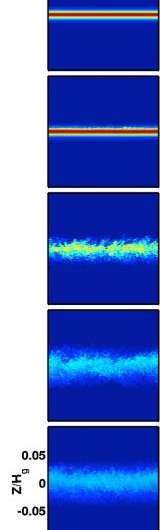
Barranco's Model of Turbulence in Protoplanetary Disks
Enlarge

A sequence of images showing how turbulent forces (the Coriolis Effect and vertical shear) mix up the layers of dust and gas orbiting young stars. Images depict a 2-d slice through Joseph Barranco's 3-d simulations. Deep red indicates dust-rich gas. Deep blue indicates pure gas. The simulation is based on dust and gas that is the same distance away from its star as earth is from the sun. The time interval between frames is 3.4 years. Credit: Joseph Barranco

Gravitational instability proposes that dust will settle into the middle of the protoplanetary disk around a newly-formed star. It is thought that the dust will gradually become denser and thinner until it reaches a critical point and collapses into kilometer-size clumps, which later collide to form planets. But new research by San Francisco State University professor Joseph Barranco shows that turbulent forces keep the dust and gas swirling and prevent it from forming a dense and thin enough layer for gravitational instability to occur.

"These results defy the proposed solution of how planets are formed," Barranco said. "Scientists have long been using gravitational instability theory to explain how millimeter-size particles grow to kilometer-size, but these new simulations open new avenues of investigation. Perhaps massive storms, similar to hurricanes found on the Earth or Jupiter, provide clues about how tiny dust grains clump together to become kilometer-size boulders."

While previous studies have used two-dimensional models to simulate the orbiting dust and gas around young stars, these failed to take account of a crucial force that causes turbulence: the Coriolis Effect. The first to use three-dimensional models, Barranco investigated the Coriolis Effect, the same mechanism that produces cyclones and tornadoes on earth, and vertical shear. Vertical shear occurs because the faster-moving dust settles into the middle of the orbiting plane with the slower-moving gas above and below it. The velocity difference between the dust and gas causes waves to form, similar to when wind blows over the surface of water.

"What happens to the dust and gas after a period of turbulence is still an open question," Barranco said. "But it could be that in the quiet center of a hurricane-like storm, dust can collect and get trapped, seeding the beginnings of planet formation."

Source: San Francisco State University


print this article email this article download pdf blog this article bookmark this article     Stumble it Digg this share on Facebook retweet share on Reddit add to delicious
Rate this story - 4.5 /5 (16 votes)

Rank Filter

Move the slider to adjust rank threshold, so that you can hide some of the comments.


Display comments: newest first

  • MrGrynch - Dec 12, 2008
    • Rank: 3.4 / 5 (5)
  • seanpu - Dec 13, 2008
    • Rank: 3.7 / 5 (3)
    very very important investigation. well done. knowing that tornadoes are electrical in nature and that aggregates form due to the z-pinch effect finally planetary formation can be brought into the plasma cosmos.
  • earls - Dec 13, 2008
    • Rank: 2 / 5 (3)
    Quacks! Nut jobs! Idiots!! Gravity is the end all be all! The Universe is electrically neutral on large scales.
  • theophys - Dec 15, 2008
    • Rank: not rated yet
    very very important investigation. well done. knowing that tornadoes are electrical in nature and that aggregates form due to the z-pinch effect finally planetary formation can be brought into the plasma cosmos.

    Saying that tornadoes are electrical in nature suggests that they are electromagnetic entities caused by electromagnetic effects. They are not. They gain electromagnetic properties after forming due to rapid spinning and rubbing of molecules. It's basically a large scale version of the static electricity your socks pick up on the carpet. This has absolutely no thing to do with plasma cosmology.
    Quacks! Nut jobs! Idiots!! Gravity is the end all be all! The Universe is electrically neutral on large scales.

    Couldn't put it better myself.
  • seanpu - Jan 14, 2009
    • Rank: 1 / 5 (1)
    tornadoes are thermodynamic and electromagnetic systems.

    the first driver is thermodynamics, this sets up the updrafts. then electromagnetic set in as the ions and electrons start to flow (aka plasma), enhancing, enforcing, augmenting, stabilizing the whole system. as long as enough thermal energy is being supplied the system will become tornadic.

    A week thermal force generates a substantial electromagnetic organising force.

    sound familiar?

    gravity, a very weak force, makes plasma atoms move, generating a much larger electromagnetic response. which becomes an organising force and produces the universe we see around us.

    http://www.charles-chandler.org/Geophysics/Tornadoes Main.php

December 12, 2008 all stories

Comments: 5

4.5 /5 (16 votes)
  • Stumble this up

  • Digg this

  • share this

  • hide
  • Related Stories

  • Dirty stars make good solar system hosts (w/ Video)
    created Oct 06, 2009 | popularity not rated yet | comments 0
  • Hubble Witnesses Spectacular Flaring in Gas Jet from M87's Black Hole
    created Apr 14, 2009 | popularity not rated yet | comments 0
  • Astronomers find baby planet
    created Apr 02, 2008 | popularity not rated yet | comments 0
  • Double-star systems cycle between big and small blasts
    created Mar 07, 2007 | popularity not rated yet | comments 0
  • Ideas on gas-giant planet formation take shape
    created Mar 22, 2006 | popularity not rated yet | comments 0


  • hide
  • Relevant PhysicsForums posts

  • The shape of our solar system's orbits.
    created Nov 07, 2009
  • Above or Below the Line of Nodes
    created Nov 07, 2009
  • Supernova vs. Nova?
    created Nov 07, 2009
  • Supernova's Gamma Rays and Comets
    created Nov 06, 2009
  • More from Physics Forums - General Astronomy

Other News

Antarctica glacier retreat creates new carbon dioxide store

Antarctica glacier retreat creates new carbon dioxide store

Space & Earth / Earth Sciences

created 57 minutes ago | popularity 5 / 5 (1) | comments 0

Large blooms of tiny marine plants called phytoplankton are flourishing in areas of open water left exposed by the recent and rapid melting of ice shelves and glaciers around the Antarctic Peninsula. This ...


Deep creep means milder, more frequent earthquakes along Southern California's San Jacinto fault

Deep creep means milder, more frequent earthquakes along Southern California's San Jacinto fault

Space & Earth / Earth Sciences

created 22 hours ago | popularity 4.5 / 5 (4) | comments 0

With an average of four mini-earthquakes per day, Southern California's San Jacinto fault constantly adjusts to make it a less likely candidate for a major earthquake than its quiet neighbor to the east, the ...


Success in 'space elevator' competition (AP)

Success in 'space elevator' competition (Update 3)

Space & Earth / Space Exploration

created Nov 05, 2009 | popularity 4.3 / 5 (33) | comments 51

(AP) -- A robot powered by a ground-based laser beam climbed a long cable dangling from a helicopter on Wednesday to qualify for prize money in a $2 million competition to test the potential reality of the ...


In a Galaxy Far, Far Away...

In a Galaxy Far, Far Away...

Space & Earth / Astronomy

created Nov 06, 2009 | popularity 4.8 / 5 (5) | comments 15

(PhysOrg.com) -- Astronomers have published the discovery of the farthest known object in the cosmos: a star that exploded when the universe was only 630 million years old -- only 4.6% of its current age. ...


'Dropouts' pinpoint earliest galaxies

'Dropouts' pinpoint earliest galaxies

Space & Earth / Astronomy

created Nov 06, 2009 | popularity 4.2 / 5 (10) | comments 13

Astronomers, conducting the broadest survey to date of galaxies from about 800 million years after the Big Bang, have found 22 early galaxies and confirmed the age of one by its characteristic hydrogen signature ...