Dwarf crocodiles split into three species
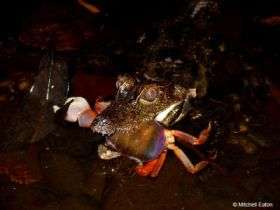
You'd think that if scientists were to discover a new species, it would be in some remote, uncharted tropical forest, not a laboratory in New York. But a team from the Sackler Institute for Comparative Genomics at the American Museum of Natural History has done the unexpected. Looking at the genes of the African dwarf crocodile, researchers found that the group—genetically speaking—comprises three distinct species rather than one. This not only ends a long debate about the taxonomy of this group, previously thought to consist of two closely related subspecies, but also defines a new, distinct species from genetic samples.
"In the past, the two morphologically distinct crocodile populations were believed to be different genera, then later different species, and then finally different subspecies," explains first-author Mitchell Eaton. Eaton conducted the research at the Sackler Institute and is finishing his doctoral degree at the University of Colorado. "We collected samples in Africa to explore this taxonomic question, and we found a great deal of evolutionary divergence between populations in the Congo Basin and on the west coast of Central Africa. We also—quite unexpectedly—found a completely new species from far West Africa; there may be even more species that we haven't sampled yet!"
African dwarf crocodiles, genus Osteolaemus, live in the tropical forests of Central and West Africa. Adults typically grow to no more than 5 feet in length and are the smallest living members of the crocodilian family. The three groups identified in this current research include a species from the Congo Basin (O. osborni), another from Central Africa's Ogooué Basin (O. tetraspis), and the new, yet unnamed species from West Africa. All of these crocodiles look very similar, and all are widely hunted by local people as a source of food. In fact, these animals provide up to a quarter of the non-fish bush meat consumed in some areas of Central Africa, but over-hunting to supply commercial 'bushmeat' markets may threaten many populations with extinction. Dwarf crocodiles are listed as vulnerable on the International Union for Conservation of Nature's Red List.
In the laboratory, the researchers sequenced more than 4,000 base pairs of both mitochondrial and nuclear DNA from as many as 82 individuals sampled across Central and West Africa. The results confirmed species-level separations between three different groups of dwarf crocodiles. Crocodiles from the Congo Basin appear to be the oldest of the three species, with some morphological characteristics placing them closer to a shared ancestor of the Nile crocodile. The dwarf crocodiles of the Ogooué and West Africa, on the other hand, are more recently evolved and are more closely related to each other than either is to the Congo Basin species.
"These species have been on their own evolutionary trajectory for a long time," says George Amato, Director of the Sackler Institute. "They are diagnostically distinct—every individual in one species has characteristics that are not found in the other species, and the number of diagnostic characteristics is large."
The new taxonomic discovery has implications for the conservation strategy of African dwarf crocodiles. "Without these genetic results, the level of biodiversity was cryptic, hidden," Amato continues. "Accurate taxonomy is necessary for conservation management of each species, and now we can calculate subsistence hunting levels that are manageable."
In addition to Amato and Eaton, coauthors include Andrew Martin of the University of Colorado and John Thorbjarnarson of the Wildlife Conservation Society (WCS). The research was funded in part by AMNH, the National Geographic Society, WCS, Lincoln Park Zoo, the Rufford Foundation, and the University of Colorado's Natural History Museum and Rozella Smith Fellowship. It is published in the early online edition of Molecular Phylogenetics and Evolution.
Source: American Museum of Natural History


