December 15, 2008 feature
Spinning Water Droplets Could Provide Insights into Black Holes, Atomic Nuclei
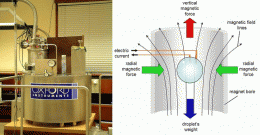
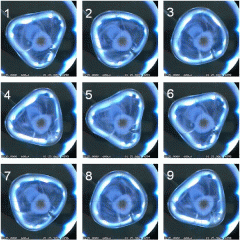
By magnetically levitating water droplets, and using a “liquid electric motor” technique to spin them, researchers can investigate how the droplets change shape. Rather than being just a curious experiment, the results could provide insights into systems that cannot be controlled in the laboratory, such as black holes and atomic nuclei.
Researchers Richard Hill and Laurence Eaves of the University of Nottingham in the UK have recently designed an experiment that exploits the possibilities of a spinning water droplet to the fullest. Their technique overcomes previous challenges, such as completely removing the effects of gravity, and minimizing the viscous drag caused by spinning in order to stabilize the droplet. Their study is published in the December 5th issue of Physical Review Letters.
"Firstly, for us, it's interesting to observe water – familiar to everyone – in unusual circumstances: here we have a water droplet floating weightless on Earth, and we spin it by passing an electric current through it, effectively turning the droplet into an electric motor,” Hill told PhysOrg.com. “We're excited about these results because the behavior of a 1-cm-diameter spinning weightless droplet, an object on the 'human' scale, can give insights into objects at nuclear length scales and also at astronomical sizes. We hope that by studying a spinning weightless water droplet, something easily observable with the naked eye, we may help other researchers trying to understand much stranger objects such as black holes and atomic nuclei."
Scientists have been intrigued with spinning water droplets going back to 1863, when the Belgian physicist Joseph-Antoine-Ferdinand Plateau suspended a drop of olive oil in a water-alcohol mixture of the same density. He used a rotating shaft to spin the oil droplet and found that the droplet changed shape: it became flattened at the poles, and bulged at the equator (which, incidentally, is similar to the shape of the Earth due to its rotation).
More recently, theoretical investigations have revealed that a droplet’s shape should change depending on its rotational velocity, assuming a series of shapes as it spins faster and faster. The reason for this distortion, the scientists explain, is that a droplet seeks the lowest energy state for a given rotational frequency. Specifically, it begins as a sphere when at rest, and then progresses into a two-lobed “peanut” shape.
Theory predicts triangular (three-lobed) and square (four-lobed) shapes at higher rotational velocity, but these shapes should be unstable and should decay into the ellipsoid shape. Yet previous experiments on acoustically levitated droplets have shown that it’s possible to stabilize a spinning triangular shape. However, in these experiments, the droplet’s shape oscillates strongly as it spins, so the equilibrium shape is not clearly observed in these demonstrations.
In the current study, Hill and Eaves used techniques that, for the first time, allowed them to see the equilibrium three-lobed shape clearly. To do this, they first found an innovative way to create a gravity-free environment, by using diamagnetic levitation. Because water is diamagnetic, the electrons in the water molecules rearrange themselves in the presence of an applied magnetic field, creating small currents. These currents oppose the applied magnetic field by Lenz’s Law, and generate a strong enough magnetic repulsion to balance the force of gravity, so that the droplet levitates.
Once the droplet is weightless, the researchers used a novel “liquid electric motor” technique to spin the droplet. They inserted two thin wire electrodes in the droplet, and passed a current through the wires, creating a torque on the droplet that causes it to rotate. By adjusting the current, the researchers could easily control the frequency. More importantly, the flow of water past one of the electrodes sets up small waves on the surface of the droplet, and these side currents can help stabilize the droplet, preventing the many-sided shapes from decaying into an ellipsoid. The researchers found that the behavior of the peanut and triangular shapes agreed well with theoretical predictions.
The researchers hope that understanding spinning water droplets could provide insights into other systems that have analogies with fluids. For instance, gravity and the strong nuclear force behave in a similar way to surface tension in that they are all cohesive forces. Understanding the surface tension in a spinning water droplet, then, could help scientists understand how astronomical bodies, as well as atomic nuclei, are held together.
“Cosmologists believe that the event horizon of a black hole behaves as if it possesses surface tension, like a droplet,” Hill explained. “The stability of the shapes of a spinning droplet could tell us some new things about the stability of the event horizon of a spinning black hole.
“The shapes of other more familiar astronomical objects such as planets and asteroids, which are held together by their own gravity, rather than by surface tension, also follow a similar pattern to that of the droplet,” he continued. “For example, recent observations of asteroids in the Kuiper belt beyond Neptune have revealed objects with an ellipsoidal shape, probably due to their rapid spin, similar to that observed in our experiments.”
The scientists added that, in the liquid drop model of the atomic nucleus, recent work has been done investigating the stability of very rapidly spinning atomic nuclei. Researchers can use the behavior of a liquid droplet to gain insights into this problem, as well.
In the future, the scientists plan to further investigate the possibilities of magnetic levitation.
"We're investigating whether magnetic levitation can be used to explore what happens to biological organisms, such as plants, in a weightless environment like that of space,” Hill said. “We can keep objects levitating for months using our magnet – the information we get from long-term experiments could be extremely useful for future missions to the Moon or Mars. However, like Plateau, studying floating oil droplets in 1863, we may have to wait several decades before this work finds applications!"
Watch videos of the spinning water droplet as it changes shape at netserver.aip.org/cgi-bin/epap … =E-PRLTAO-101-065848 (Supplementary movies.zip).
More information: Hill, R.J.A. and Eaves, L. “Nonaxisymmetric Shapes of a Magnetically Levitated and Spinning Water Droplet.” Physical Review Letters 101, 234501 (2008).
Cardoso V. “The many shapes of spinning drops.” Physics 1, 38 (2008) physics.aps.org/articles/v1/38
Copyright 2008 PhysOrg.com.
All rights reserved. This material may not be published, broadcast, rewritten or redistributed in whole or part without the express written permission of PhysOrg.com.


