Does global warming lead to a change in upper atmospheric transport?
December 15, 2008 Stratospheric Balloon

Enlarge

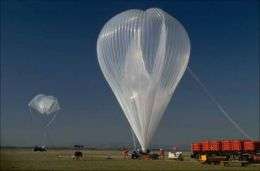
With stratospheric balloons researchers derive the 'age' of the air from trace-gas measurements. Their results indicate that air masses are moving more slowly than predicted by climate models. Credit: Andreas Engel

Most atmospheric models predict that the rate of transport of air from the troposphere to the above lying stratosphere should be increasing due to climate change. Surprisingly, Dr. Andreas Engel together with an international group of researchers has now found that this does not seem to be happening. On the contrary, it seems that the air air masses are moving more slowly than predicted. This could also imply that recovery of the ozone layer may be somewhat slower than predicted by state-of-the-art atmospheric climate models.

The researchers have published their results in Nature Geoscience (10.1038/NGEO388). They investigate the time it takes to transport the atmospheric trace gases sulfurhexafluoride (SF6) and carbon dioxide (CO2) from the troposphere (the atmospheric layer between the ground and about 10 km) to the stratosphere (the atmospheric layer between about 10 and 50 km altitude). They derive this "age" of the air from trace-gas measurements performed with large research balloons carrying measurement instrumentation up to altitudes of 35 km . As these measurements are quite complex and expensive, they can only be performed sporadically.

In cooperation with German, American and Japanese colleagues, the group gathered all measurements of these trace gases available world-wide. For this purpose, archived air samples which were collected more than 30 years ago in the stratosphere above North American, have been analysed in Frankfurt. Andreas Engel explains that „Sulfurhexafluoride is amongst the most stable gases in the atmosphere, meaning that using today's analytical techniques, it is possible to analyse even extremely small amounts present in the 30 year-old air samples."

While state-of-the-art climate models predict an increase in stratospheric transport and thus younger ages, the measurements indicate that the age seems to have increased slightly, meaning that the transport rates have not increased.

The Frankfurt research group wants to continue the long-term measurement series in order to provide further measurements which can help to evaluate the model predictions and document the long-term evolution of the atmosphere. Due to the results presented now, the predictions of atmospheric models must be re-evaluated. Andreas Engel emphasises that „our results do not contradict the principal global change predicted by the models, yet the exact mechanisms of how this influences transport of air in the upper atmosphere do not seem to be fully understood. More research is needed here."

Source: Goethe University Frankfurt


print this article email this article download pdf blog this article bookmark this article     Stumble it Digg this share on Facebook retweet share on Reddit add to delicious
Rate this story - 3.7 /5 (6 votes)

Rank Filter

Move the slider to adjust rank threshold, so that you can hide some of the comments.


Display comments: newest first

  • agg - Dec 15, 2008
    • Rank: 3 / 5 (4)

    Confused article and stupid title.

December 15, 2008 all stories

Comments: 1

3.7 /5 (6 votes)
  • Stumble this up

  • Digg this

  • share this

  • hide
  • Related Stories

  • Oceans' Uptake of Manmade Carbon May Be Slowing
    created 22 hours ago | popularity not rated yet | comments 0
  • Don't Blame Cows for Climate Change
    created Dec 08, 2009 | popularity not rated yet | comments 0
  • Safe journey for works of art
    created Dec 04, 2009 | popularity not rated yet | comments 0
  • Oceans' uptake of manmade carbon may be slowing
    created Nov 18, 2009 | popularity not rated yet | comments 0
  • Climate studies to benefit from 12 years of satellite aerosol data
    created Nov 10, 2009 | popularity not rated yet | comments 0


  • hide
  • Relevant PhysicsForums posts

  • Question about Thermohaline Circulation
    created 4 hours ago
  • Weather - not climate - extremes
    created 8 hours ago
  • Another climate update
    created 10 hours ago
  • Meteor crater discoveries
    created 11 hours ago
  • More from Physics Forums - Earth

Other News

Galaxy Collision Switches on Black Hole

Galaxy Collision Switches on Black Hole

Space & Earth / Astronomy

created 54 minutes ago | popularity not rated yet | comments 0

(PhysOrg.com) -- This composite image of data from three different telescopes shows an ongoing collision between two galaxies, NGC 6872 and IC 4970.


The Meandering Channels of Mars

The Meandering Channels of Mars

Space & Earth / Space Exploration

created 10 minutes ago | popularity not rated yet | comments 0

Sinuous channels on the Martian surface may be evidence of relatively recent rainfall. Researchers plan to test this hypothesis by studying sinuous streams on Earth.


Stolen e-mails embolden climate change skeptics

Space & Earth / Environment

created 41 minutes ago | popularity 2 / 5 (1) | comments 1

(AP) -- At a critical time, the uproar over stolen e-mails suggesting scientists suppressed contrary views about climate change has emboldened skeptics - including congressional Republicans looking to scuttle President Barack ...


Earth

Earth's atmosphere came from outer space, find scientists

Space & Earth / Earth Sciences

created 2 hours ago | popularity 3.9 / 5 (7) | comments 1

(PhysOrg.com) -- The gases which formed the Earth's atmosphere - and probably its oceans - did not come from inside the Earth but from outer space, according to a study by University of Manchester and University ...


New approach to emissions makes climate and air quality models more accurate, major study finds

Space & Earth / Earth Sciences

created 2 hours ago | popularity not rated yet | comments 0

It's no secret that the emissions leaving a car tailpipe or factory smokestack affect climate and air quality. Even trees release chemicals that influence the atmosphere. But until now, scientists have struggled to know where ...