As Ice Melts, Antarctic Bedrock Is on the Move
December 15, 2008 As Ice Melts, Antarctic Bedrock Is on the Move

Enlarge

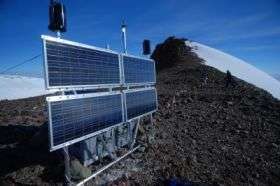
A POLENET GPS site in West Antarctica. The GPS antenna is shown in the background (white cylinder topped by gray dome), with solar panels, batteries, wind generators, the GPS receiver, and Iridium satellite modem antenna in the foreground. Photo courtesy of Ohio State University

As ice melts away from Antarctica, parts of the continental bedrock are rising in response -- and other parts are sinking, scientists have discovered.

The finding will give much needed perspective to satellite instruments that measure ice loss on the continent, and help improve estimates of future sea level rise.

"Our preliminary results show that we can dramatically improve our estimates of whether Antarctica is gaining or losing ice," said Terry Wilson, associate professor of earth sciences at Ohio State University.

Wilson reported the research in a press conference Monday, December 15, 2008 at the American Geophysical Union meeting in San Francisco.

These results come from a trio of global positioning system (GPS) sensor networks on the continent.

Wilson leads POLENET, a growing network of GPS trackers and seismic sensors implanted in the bedrock beneath the West Antarctic Ice Sheet (WAIS). POLENET is reoccupying sites previously measured by the West Antarctic GPS Network (WAGN) and the Transantarctic Mountains Deformation (TAMDEF) network.

In separate sessions at the meeting, Michael Bevis, Ohio Eminent Scholar in geodyamics and professor of earth sciences at Ohio State, presented results from WAGN, while doctoral student Michael Willis presented results from TAMDEF.

Taken together, the three projects are yielding the best view yet of what's happening under the ice.

When satellites measure the height of the WAIS, scientists calculate ice thickness by subtracting the height of the earth beneath it. They must take into account whether the bedrock is rising or falling. Ice weighs down the bedrock, but as the ice melts, the earth slowly rebounds.

Gravity measurements, too, rely on knowledge of the bedrock. As the crust under Antarctica rises, the mantle layer below it flows in to fill the gap. That mass change must be subtracted from Gravity Recovery and Climate Experiment (GRACE) satellite measurements in order to isolate gravity changes caused by the thickening or thinning of the ice.

Before POLENET and its more spatially limited predecessors, scientists had few direct measurements of the bedrock. They had to rely on computer models, which now appear to be incorrect.

"When you compare how fast the earth is rising, and where, to the models of where ice is being lost and how much is lost -- they don't match," Wilson said. "There are places where the models predict no crustal uplift, where we see several millimeters of uplift per year. We even have evidence of other places sinking, which is not predicted by any of the models."

A few millimeters may sound like a small change, but it's actually quite large, she explained. Crustal uplift in parts of North America is measured on the scale of millimeters per year.

POLENET's GPS sensors measure how much the crust is rising or falling, while the seismic sensors measure the stiffness of the bedrock -- a key factor for predicting how much the bedrock will rise in the future.

"We're pinning down both parts of this problem, which will improve the correction made to the satellite data, which will in turn improve what we know about whether we're gaining ice or losing ice," Wilson said. Better estimates of sea level rise can then follow.

POLENET scientists have been implanting sensors in Antarctica since December 2007. The network will be complete in 2010 and will record data into 2012. Selected sites may remain as a permanent Antarctic observational network.

Source: Ohio State University


print this article email this article download pdf blog this article bookmark this article     Stumble it Digg this share on Facebook retweet share on Reddit add to delicious
Rate this story - 4 /5 (10 votes)

Rank Filter

Move the slider to adjust rank threshold, so that you can hide some of the comments.


Display comments: newest first

  • MikeB - Dec 15, 2008
    • Rank: 3 / 5 (4)
    As the ice melts? The old station is under 30 feet of new ice. Also the sea ice which melts and refreezes every year is above the historic average.

    http://arctic.atm...outh.jpg

    The Ice on the continent is up to three miles thick. At the South Pole the ice is almost two miles thick. The ice builds slowly there, but there is thirty feet of ice over the old South Pole Station, so it IS building.
    Interestingly, as the ice cap builds the temperatures become colder since the elevation is increasing. Look at the last thirty years in the Antarctic.

    http://www.physor...rbig.jpg

    So it is getting colder there and there is more ice.

    Still we need to do more to document the ice loss??? Huh?

    From the article:

    "The finding will give much needed perspective to satellite instruments that measure ice loss on the continent, and help improve estimates of future sea level rise."

    My head is spinning.
  • mikiwud - Dec 16, 2008
    • Rank: 5 / 5 (2)
    "my head is spinning"
    That is because we have had to absorb years or AGW spin. We used to get dizzy in the UK from NuLiebour spin, but after a (long) while you get partialy immune to it.
  • Velanarris - Dec 17, 2008
    • Rank: 5 / 5 (2)
    Shifting bedrock is a sign of near surface volcanism. Similar to Malta, there is a high probability that there are either large volcanoes located under the ice or huge magma pools just under that bedrock.

    Geothermal heating would lead to ice loss. Interesting possibility. CSIRO said something about this a few months ago.

December 15, 2008 all stories

Comments: 3

4 /5 (10 votes)
  • Stumble this up

  • Digg this

  • share this

  • hide
  • Related Stories


  • hide
  • Relevant PhysicsForums posts

  • cycles
    created Nov 08, 2009
  • The Origin of the term 'fossil' fuels
    created Nov 05, 2009
  • co2
    created Nov 03, 2009
  • Early Earths Sulfidic Ocean Conditions
    created Oct 30, 2009
  • More from Physics Forums - Earth

Other News

Planetary Society plans new 'solar sail'

Space & Earth / Space Exploration

created 3 hours ago | popularity 5 / 5 (1) | comments 0

(AP) -- Four years after its first solar sail ended up in the ocean instead of orbit, The Planetary Society announced Monday that by the end of 2010 it will try again to launch a spacecraft that will be propelled by the ...


L-R: Chiwetel Ejiofor, Amanda Peet and John Cusack at the premiere of "2012"

NASA on crusade to debunk 2012 apocalypse myths

Space & Earth / Space Exploration

created 9 hours ago | popularity 4 / 5 (1) | comments 1

The world is not coming to an end on December 21, 2012, the US space agency insisted Monday in a rare campaign to dispel widespread rumors fueled by the Internet and a new Hollywood movie.


Antarctica glacier retreat creates new carbon dioxide store

Antarctica glacier retreat creates new carbon dioxide store

Space & Earth / Earth Sciences

created 13 hours ago | popularity 3.5 / 5 (4) | comments 0

Large blooms of tiny marine plants called phytoplankton are flourishing in areas of open water left exposed by the recent and rapid melting of ice shelves and glaciers around the Antarctic Peninsula. This ...


Australian scientists call for urgent 'global cooling' to save coral reefs

Space & Earth / Environment

created 4 hours ago | popularity 3 / 5 (2) | comments 0

(PhysOrg.com) -- Australian marine scientists have issued an urgent call for massive and rapid worldwide cuts in carbon emissions, deep enough to prevent atmospheric CO2 levels rising to 450 parts per million (ppm).


NASA satellites see Ida spreading out before landfall

NASA satellites see Ida spreading out before landfall

Space & Earth / Earth Sciences

created 4 hours ago | popularity not rated yet | comments 0

NASA's Aqua and Terra satellites are keeping a close eye on Tropical Storm Ida, and both have instruments aboard that show her clouds and rains are already widespread inland over the U.S. Gulf coast states. ...