Warming climate signals big changes for ski areas, says University of Colorado study
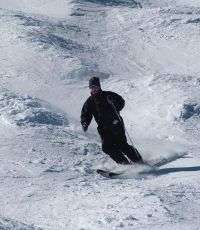
Rocky Mountain ski areas face dramatic changes this century as the climate warms, including best-case scenarios of shortened ski seasons and higher snowlines and worst-case scenarios of bare base areas and winter rains, says a new Colorado study.
The study indicates snowlines -- elevations below which seasonal snowpack will not develop -- will continue to rise through this century, moving up more than 2,400 feet from the base areas of Colorado's Aspen Mountain and Utah's Park City Mountain by 2100, said University of Colorado at Boulder geography Professor Mark Williams. Williams and Brian Lazar of Stratus Consulting Inc. of Boulder combined temperature and precipitation data for Aspen Mountain and Park City Mountain with general climate circulation models for the study.
The pair came up with three scenarios for each of the two ski havens for the years 2030, 2075 and 2100. The low-emissions scenario is based on the presumption that the world begins reducing CO2 emissions, said Williams. The "business-as-usual" scenario assumes the future rate of CO2 increase will be similar to the current rate, while the high-emissions scenario assumes future CO2 emissions will increase over the present rate.
Their forecasts indicate the "business as usual" scenario will cause average temperatures to rise by nearly 4 degrees Fahrenheit at Aspen and Park City by 2030 and 8.6 degrees F in Aspen and 10.4 degrees F for Park City by 2100, said Williams. A paper by Williams and Lazar was presented at the Fall Meeting of the American Geophysical Union held Dec. 15-19 in San Francisco.
"Ski industry officials know that warming is real, and that small changes in climate have substantial effects on ski areas," said Williams, also a fellow at CU-Boulder's Institute of Arctic and Alpine research. "The bad news is that the past five years of global CO2 emissions have exceeded our high-emissions scenario."
Under each of the emissions scenarios, the length of the ski seasons in Aspen and Park City by 2030 "will be squeezed on each shoulder," with delayed snowpack and earlier melting seasons, he said. Under the high-emissions scenario, Park City will have no snowpack at its base by 2100 and winter precipitation will come in the form of rain.
While the modeling by Williams and Lazar targeted Aspen Mountain and Park City, other ski areas in the Rockies and beyond are likely to be similarly or more drastically affected, said Williams. Many ski areas in California's Sierra Nevada, the Cascade Mountains in Oregon and Washington, and smaller ski areas in the mid-eastern portion of America like Pennsylvania and West Virginia, for example, could be forced out of business in the coming decades as air temperatures continue to warm, he said.
The key to the survival of the larger ski areas in the Rockies is adaptation, said Williams. Ski resorts must expand operations to higher elevations and more northerly parcels of land. They also must beef up gondola transportation systems to shuttle large loads of skiers efficiently from base areas with scant or no snow to snow-packed facilities located at higher elevations, he said.
At most Rocky Mountain ski areas, snowmaking will have to be stepped up considerably in the coming decades, said Williams. Increases in man-made snow will require the diversion and storage of large amounts of water, a challenging and expensive proposition since water rights are already over-appropriated throughout much of the West, he said.
Aspen Mountain, for example, may have to triple its snowmaking efforts in the coming decades because of warming temperatures, meaning an additional 50 cubic feet per second of water must be obtained per month, said Williams. But since appropriating significant amounts of winter water from streams adjacent to most ski areas would leave insufficient flows to maintain healthy aquatic ecosystems, resort operators are looking further and further afield for available water, he said.
"The bottom line is that in order to survive, these ski areas will need to find the necessary water wherever they can and hold it in storage to satisfy future snowmaking needs," Williams said. "Ski resort operators are really scrambling."
The new study was sponsored by Aspen Mountain and the Park City Mountain Resort said Lazar, who noted that two nonprofits -- the Aspen Global Change Institute and the Park City Foundation -- are working with the ski areas to better understand environmental climate change. "The results from studies like ours allow ski areas to try and better plan for the future, including how to be proactive on climate change in the community and region," said Lazar.
Williams and Lazar said many U.S. ski areas will likely follow the lead of ski areas in the European Alps by moving water from basin to basin over long distances and storing it at high elevations to satisfy future snowmaking needs. Ski areas could generate their own hydropower by pumping water into and out of narrow, deep artificial lakes and small dams lined with plastic to minimize evaporation in the summers.
"It would be a win-win situation," Williams said. "The ski areas could recover some of their costs incurred from purchasing expensive water rights, providing some of their own hydropower to help run the resorts."
Snowmaking has been on the increase in the Alps for decades, where air temperatures have increased nearly 4 degrees F in the past 30 years, said Williams. In the Italian Alps, 70 percent of the skiable terrain is covered by artificial snow, and ski areas in the French Alps now make about 30 percent of their snow, he said.
Studies have shown that private jets that fly celebrities and vacationers in and out of Aspen for winter ski jaunts and summer recreation trips are by far the biggest CO2 emitters in the Roaring Fork Valley.
Source: University of Colorado at Boulder


