Nature, nanotechnology fuse in electric yarn that detects blood
December 15, 2008
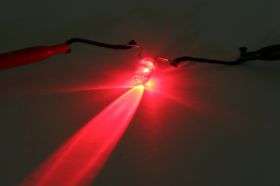
This carbon-nanotube coated smart yarn can conduct enough electricity from a battery to power a light-emitting diode device. Researchers can use its conductivity to design garments that detect blood.
(PhysOrg.com) -- A carbon nanotube-coated "smart yarn" that conducts electricity could be woven into soft fabrics that detect blood and monitor health, engineers at the University of Michigan have demonstrated.
"Currently, smart textiles are made primarily of metallic or optical fibers. They're fragile. They're not comfortable. Metal fibers also corrode. There are problems with washing such electronic textiles. We have found a much simpler way---an elegant way---by combining two fibers, one natural and one created by nanotechnology," said Nicholas Kotov, a professor in the departments of Chemical Engineering, Materials Science and Engineering and Biomedical Engineering.
Kotov and Bongsup Shim, a doctoral student in the Department of Chemical Engineering, are among the co-authors of a paper on this material currently published online in Nano Letters.
To make these "e-textiles," the researchers dipped 1.5-millimeter thick cotton yarn into a solution of carbon nanotubes in water and then into a solution of a special sticky polymer in ethanol. After being dipped just a few times into both solutions and dried, the yarn was able to conduct enough power from a battery to illuminate a light-emitting diode device.
"This turns out to be very easy to do," Kotov said. "After just a few repetitions of the process, this normal cotton becomes a conductive material because carbon nanotubes are conductive."
The only perceptible change to the yarn is that it turned black, due to the carbon. It remained pliable and soft.
In order to put this conductivity to use, the researchers added the antibody anti-albumin to the carbon nanotube solution. Anti-albumin reacts with albumin, a protein found in blood. When the researchers exposed their anti-albumin-infused smart yarn to albumin, they found that the conductivity significantly increased. Their new material is more sensitive and selective as well as more simple and durable than other electronic textiles, Kotov said.
Clothing that can detect blood could be useful in high-risk professions, the researchers say. An unconscious firefighter, ambushed soldier, or police officer in an accident, for example, couldn't send a distress signal to a central command post. But the smart clothing would have this capability.
Kotov says a communication device such as a mobile phone could conceivably transmit information from the clothing to a central command post.
"The concept of electrically sensitive clothing made of carbon-nanotube-coated cotton is flexible in implementations and can be adapted for a variety of health monitoring tasks as well as high performance garments," Kotov said.
It is conceivable that clothes made out of this material could be designed to harvest energy or store it, providing power for small electronic devices, but such developments are many years away and pose difficult challenges, the engineers say.
The paper published online in Nano Letters is titled, "Smart Electronic Yarns and Wearable Fabrics for Human Biomonitoring Made by Carbon Nanotube Coating with Polyelectrolytes."
Provided by University of Michigan
-
Researchers Grow 7 mm Carbon Nanotube Array
Nov 29, 2006 |
4.2 / 5 (27) |
0
-
Carbon nanotube muscles generate giant twist for novel motors
Oct 13, 2011 |
5 / 5 (6) |
5
-
Supramolecules get time to shine
Jul 12, 2011 |
5 / 5 (6) |
0
-
Chemistry with sunlight: Combining electrochemistry and photovoltaics to clean up oxidation reactions
Jun 09, 2011 |
4 / 5 (1) |
1
-
Spinning the unspinnable: Using biscrolling technology invented at UT Dallas
Jan 06, 2011 |
4.5 / 5 (8) |
0
-
Engineers build first sub-10-nm carbon nanotube transistor
Feb 01, 2012 |
4.9 / 5 (30) |
30
-
Something old, something new: Evolution and the structural divergence of duplicate genes
Jan 31, 2012 |
4.6 / 5 (7) |
1
-
The hidden nanoworld of ice crystals: Revealing the dynamic behavior of quasi-liquid layers
Jan 30, 2012 |
5 / 5 (3) |
1
-
Stock market network reveals investor clustering
Jan 27, 2012 |
3.9 / 5 (23) |
8
-
Of microchemistry and molecules: Electronic microfluidic device synthesizes biocompatible probes
Jan 26, 2012 |
5 / 5 (1) |
0
-
Pertubance in a model
1 hour ago
-
Cancer drugs and Alzheimer's, Oh my!
9 hours ago
-
Squishing cells
10 hours ago
-
Any books/articles for evolutionary stable strategy models in humans?
21 hours ago
-
Science behind the bore feeling?
Feb 09, 2012
-
Homo Sapien vs. Chimpanzee - Divergence Timeline
Feb 09, 2012
- More from Physics Forums - Biology
More news stories
'Dark plasmons' transmit energy
Microscopic channels of gold nanoparticles have the ability to transmit electromagnetic energy that starts as light and propagates via "dark plasmons," according to researchers at Rice University.
16 hours ago |
5 / 5 (5) |
0
|
Nanotube therapy takes aim at breast cancer stem cells
Wake Forest Baptist Medical Center researchers have again proven that injecting multiwalled carbon nanotubes (MWCNTs) into tumors and heating them with a quick, 30-second laser treatment can kill them.
Nanotechnology / Bio & Medicine
21 hours ago |
5 / 5 (1) |
0
|
New kind of solar cell could capture significantly more energy than current cells
New solar cells could increase the maximum efficiency of solar panels by over 25%, according to scientists from the University of Cambridge.
Feb 08, 2012 |
4.5 / 5 (11) |
14
|
Nanoshell whispering galleries improve thin solar panels
Visitors to Statuary Hall in the U.S. Capitol Building may have experienced a curious acoustic feature that allows a person to whisper softly at one side of the cavernous, half-domed room and for another on ...
Nanotechnology / Nanomaterials
Feb 07, 2012 |
4.3 / 5 (6) |
6
|
New technology platform for molecule-based electronics
Researchers at the Nano-Science Center at the University of Copenhagen have developed a new nano-technology platform for the development of molecule-based electronic components using the wonder material graphene. At the same ...
Nanotechnology / Nanomaterials
23 hours ago |
5 / 5 (2) |
0
Clam fields found at deep, low-temperature Mariana vents
(PhysOrg.com) -- Scientists have marveled at the unusual life forms thriving at high temperature hydrothermal vents of the deep ocean.
Seeing colors in music, tasting flavors in shapes may happen in life's early months
Famed violinist Itzhak Perlman sees a deep forest green whenever he plays a B-flat on his Stradivarius' G string. The A on the E string is red.
Could Venus be shifting gear?
(PhysOrg.com) -- ESAs Venus Express spacecraft has discovered that our cloud-covered neighbour spins a little slower than previously measured. Peering through the dense atmosphere in the infrared, the ...
Team isolates nerve cells involved in storing long term memory and gene proteins associated with them
(Medical Xpress) -- A research team in Taiwan has succeeded in isolating two nerve cells in fruit fly brains that are believed to be the major players in allowing for the formation of long term memories. Furthermore, ...
Is that sleepiness during pregnancy normal or a sign of sleep apnea?
(Medical Xpress) -- Most pregnant women complain of being tired. Some of them however, could be suffering more than normal fatigue associated with their pregnancy; they may have developed obstructive sleep apnea (OSA), a ...
Engineering images bring life to submerged city
(PhysOrg.com) -- Photo-realistic 3D mapping and digital reconstruction of an ancient underwater city in Greece have earned a team from the University of Sydney's Faculty of Engineering and Information Technologies ...