NASA instruments document contraction of the boundary between the Earth's ionosphere, space
December 15, 2008 NASA instruments document contraction of the boundary between the Earth's ionosphere, space

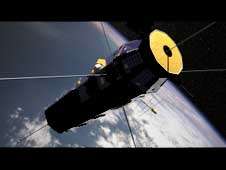
The C/NOFS mission gives scientists a new tool for forecasting space weather. The CINDI instrument aboard C/NOFS specifically studies the major elements that influence space weather near Earthıs equator. Credit: NASA

(PhysOrg.com) -- Observations made by NASA instruments onboard an Air Force satellite have shown that the boundary between the Earth's upper atmosphere and space has moved to extraordinarily low altitudes. These observations were made by the Coupled Ion Neutral Dynamics Investigation (CINDI) instrument suite, which was launched aboard the U.S. Air Force's Communication/Navigation Outage Forecast System (C/NOFS) satellite on April 16, 2008.

The CINDI suite, which was built under the direction Principal Investigator Rod Heelis of the University of Texas at Dallas, includes both ion and neutral sensors and makes measurements of the variations in neutral and ion densities and drifts.

CINDI and C/NOFS were designed to study disturbances in Earth's ionosphere that can result in a disruption of navigation and communication signals. The ionosphere is a gaseous envelope of electrically charged particles that surrounds our planet and it is important because Radar, radio waves, and global positioning system signals can be disrupted by ionospheric disturbances.

CINDI's first discovery was, however, that the ionosphere was not where it had been expected to be. During the first months of CINDI operations the transition between the ionosphere and space was found to be at about 260 miles (420 km) altitude during the nighttime, barely rising above 500 miles (800 km) during the day. These altitudes were extraordinarily low compared with the more typical values of 400 miles (640 km) during the nighttime and 600 miles (960 km) during the day.

The height of the ionosphere/space transition is controlled in part by the amount of extreme ultraviolet energy emitted by the Sun and a somewhat contracted ionosphere could have been expected because C/NOFS was launched during a minimum in the 11-year cycle of solar activity. However, the size of the actual contraction caught investigators by surprise. In fact, when they looked back over records of solar activity, they found that C/NOFS had been launched during the quietest solar minimum since the space age began.

This extraordinary circumstance is providing an unparalleled opportunity to study the connection between the interior dynamics of the Sun and the response of the Earth's space environment.

Animation: http://www.nasa.gov/mpg/296945main_CINDI_ionosphere_512x288.mpg

Source: NASA's Goddard Space Flight Center


print this article email this article download pdf blog this article bookmark this article     Stumble it Digg this share on Facebook retweet share on Reddit add to delicious
Rate this story - 4.2 /5 (9 votes)


December 15, 2008 all stories

Comments: 0

4.2 /5 (9 votes)
  • Stumble this up

  • Digg this

  • share this

  • hide
  • Related Stories

  • A lightning strike in Africa helps take the pulse of the sun
    created Nov 11, 2009 | popularity not rated yet | comments 0
  • NRL sensor provides critical space weather observations
    created Nov 03, 2009 | popularity not rated yet | comments 0
  • FASTSAT instruments shipped for tests and launch preparation
    created Oct 26, 2009 | popularity not rated yet | comments 0
  • New hyperspectral imager launched to International Space Station
    created Sep 10, 2009 | popularity not rated yet | comments 0
  • Scientists discover surprise in Earth's upper atmosphere
    created Sep 10, 2009 | popularity not rated yet | comments 0


  • hide
  • Relevant PhysicsForums posts

  • Climate Science Update
    created 7 hours ago
  • The IPCC and the term "most"
    created Nov 23, 2009
  • Is global warming a fact?
    created Nov 23, 2009
  • Random variability of wind patterns
    created Nov 23, 2009
  • More from Physics Forums - Earth

Other News

The Energy Sources of Ultraluminous Galaxies

The Energy Sources of Ultraluminous Galaxies

Space & Earth / Astronomy

created 4 hours ago | popularity 4 / 5 (5) | comments 0

(PhysOrg.com) -- Ultraluminous infrared galaxies ((ULIRGs) are galaxies whose luminosity exceeds that of a trillion suns; for comparison, the Milky Way galaxy has a typical (and much more modest) luminosity ...


Space shuttle Atlantis, 7 astronauts back on Earth (AP)

Space shuttle Atlantis, 7 astronauts back on Earth

Space & Earth / Space Exploration

created 5 hours ago | popularity not rated yet | comments 0

(AP) -- Space shuttle Atlantis and its seven astronauts returned to Earth with a smooth touchdown Friday to end an 11-day flight that resupplied the International Space Station.


Fermi Telescope Peers Deep into Microquasar

Fermi Telescope Peers Deep into Microquasar (w/ Video)

Space & Earth / Astronomy

created 3 hours ago | popularity 4.5 / 5 (2) | comments 0

(PhysOrg.com) -- NASA's Fermi Gamma-ray Space Telescope has made the first unambiguous detection of high-energy gamma-rays from an enigmatic binary system known as Cygnus X-3. The system pairs a hot, massive ...


China is set to launch its second moon orbiter next October, state media have reported

China to launch second lunar probe: state media

Space & Earth / Space Exploration

created 9 hours ago | popularity 5 / 5 (3) | comments 0

China will launch its second moon orbiter next October, state media reported Friday, as it powers ahead with a space programme that has sparked concerns abroad.


Herschel takes a peek at the ingredients of the galaxies

Herschel takes a peek at the ingredients of the galaxies

Space & Earth / Astronomy

created 2 hours ago | popularity not rated yet | comments 0

(PhysOrg.com) -- The European Space Agency has today released spectacular new observations from the Herschel Space Observatory, including the UK-led SPIRE instrument. Spectrometers on board all three Hershel ...