Tiny delivery system with a big impact on cancer cells
December 15th, 2008 Nanocomposite Particles

Enlarge

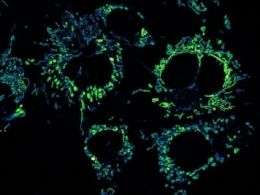
A new group of nanocomposite particles could lead to improved anti-cancer drugs, researchers report. Credit: Hari S. Muddana

Researchers in Pennsylvania are reporting for the first time that nanoparticles 1/5,000 the diameter of a human hair encapsulating an experimental anticancer agent, kill human melanoma and drug-resistant breast cancer cells growing in laboratory cultures. The discovery could lead to the development of a new generation of anti-cancer drugs that are safer and more effective than conventional chemotherapy agents, the scientists suggest. The research is scheduled for the Dec. 10 issue of ACS' Nano Letters.

In the new study, Mark Kester, James Adair and colleagues at Penn State's Hershey Medical Center and University Park campus point out that certain nanoparticles have shown promise as drug delivery vehicles. However, many of these particles will not dissolve in body fluids and are toxic to cells, making them unsuitable for drug delivery in humans. Although promising as an anti-cancer agent, ceramide also is insoluble in the blood stream making delivery to cancer cells difficult.

The scientists report a potential solution with development of calcium phosphate nanocomposite particles (CPNPs). The particles are soluble and with ceramide encapsulated with the calcium phosphate, effectively make ceramide soluble. With ceramide encapsulated inside, the CPNPs killed 95 percent of human melanoma cells and was "highly effective" against human breast cancer cells that are normally resistant to anticancer drugs, the researchers say.

Penn State Research Foundation has licensed the calcium phosphate nanocomposite particle technology known as "NanoJackets" to Keystone Nano, Inc. MK and JA are CMO and CSO, respectively.

Article: "Calcium Phosphate Nanocomposite Particles for In Vitro Imaging and Encapsulated Chemotherapeutic Drug Delivery to Cancer Cells", http://pubs.acs.org/stoken/presspac/presspac/full/10.1021/nl802098g

Provided by ACS


print this article email this article download pdf blog this article bookmark this article     Digg this Stumble it share on Facebook share on Reddit add to delicious save to Yahoo! bookmarks
4.7/5 after 18 votes

Rank Filter

Move the slider to adjust rank threshold, so that you can hide some of the comments.


Display comments: newest first

  • E_L_Earnhardt - Dec 16, 2008
    • Rank: 1 / 5 (1)
    o.k.! Whatever works that can be brought to market!

December 15th, 2008 all stories
Nanotechnology / Bio & Medicine

Comments: 1
Rank: 4.7/5 after 18 votes

  • Stumble this up

  • Digg this

  • Share it:
  • share on Facebook
  • share on MySpace
  • share on Slashdot
  • rss-newsfeed
  • share on Google
  • share on Reddit
  • add to delicious
  • save to Yahoo! bookmarks
  • share on Windows Live
  • Add to Mixx!
Rating: 4.7/5 after 18 votes

  • Related Stories

  • Microscopic 'beads' could help create 'designer' immune cells that ignore transplanted organs
    created 38 minutes ago | popularity not rated yet | comments 0
  • MicroRNAs hold promise for treating diseases in blood vessels
    created 21 hours ago | popularity not rated yet | comments 0
  • Nanoscale 'Fountain Pen' Draws Therapeutic Nanodiamonds
    created Jun 29, 2009 | popularity not rated yet | comments 0
  • Tiny capsules can deliver drugs to targeted cells
    created Jun 25, 2009 | popularity not rated yet | comments 0
  • A promising niche for nanotech
    created Jun 24, 2009 | popularity not rated yet | comments 0


  • Physicists Demonstrate Quantum Memory with Matter Qubits
    Physicists Demonstrate Quantum Memory with Matter Qubits
    Physics / General Physics
    created Jul 03, 2009 | popularity 4.4 / 5 (17) | comments 1
  • 'Holey' Nanosheets for Wastewater Dye Removal
    Nanotechnology / Nanomaterials
    created Jul 01, 2009 | popularity 5 / 5 (5) | comments 1
  • Jellyfish Robot Swims Like its Biological Counterpart
    Jellyfish Robot Swims Like its Biological Counterpart
    Electronics / Robotics
    created Jun 26, 2009 | popularity 4.4 / 5 (8) | comments 1
  • Could Maxwell's Demon Exist in Nanoscale Systems?
    Could Maxwell's Demon Exist in Nanoscale Systems?
    Physics / General Physics
    created Jun 24, 2009 | popularity 4.4 / 5 (18) | comments 29
  • Living Safely with Robots, Beyond Asimov's Laws
    Living Safely with Robots, Beyond Asimov's Laws
    Electronics / Robotics
    created Jun 22, 2009 | popularity 4.6 / 5 (53) | comments 40
  • Other News

    Nano Measurement in the 3rd Dimension

    Nano Measurement in the 3rd Dimension

    Nanotechnology / Nanophysics

    created 1hour ago | popularity 3 / 5 (1) | comments 0

    From the motion sensor to the computer chip - in many products of daily life components are used whose functioning is based on smallest structures of the size of thousandths - or even millionths - of millimetres. ...


    A 'quantum of sol' -- how nanotechnology could hold the key to a solar-powered future

    A 'quantum of sol' -- how nanotechnology could hold the key to a solar-powered future

    Nanotechnology / Nanomaterials

    created Jun 30, 2009 | popularity 3.9 / 5 (16) | comments 17

    (PhysOrg.com) -- A new generation of 'nano-structured' millimetre-sized solar cells that could convert the sun's energy to electricity more than twice as efficiently as current technology, is the subject of ...


    Australian researchers are set to begin human trials of a tiny nano-cell that acts as a "Trojan horse" against cancer

    Hi-tech 'Trojan horse' can kill cancer cells: researchers

    Nanotechnology / Bio & Medicine

    created Jun 29, 2009 | popularity 4.7 / 5 (12) | comments 7

    Australian researchers are set to begin human trials of a tiny nano-cell that acts as a "Trojan horse" against cancer cells, a breakthrough they say may curb the need for debilitating chemotherapy.


    'Holey' Nanosheets for Wastewater Dye Removal

    Nanotechnology / Nanomaterials

    created Jul 01, 2009 | popularity 5 / 5 (5) | comments 1

    (PhysOrg.com) -- Researchers have discovered that extremely thin sheets of nickel oxide with hexagonally shaped holes can absorb hazardous dyes from wastewater nearly as well as the best traditional methods, but are recyclable. ...


    Harnessing Nanoparticles To Track Cancer Cell Changes

    Nanotechnology / Bio & Medicine

    created Jul 03, 2009 | popularity not rated yet | comments 1

    The more dots there are, the more accurate a picture you get when you connect them. Cancer researchers adopting that philosophy have developed a new imaging technology that could give scientists the ability to simultaneously ...