Measuring conductance of carbon nanotubes, one by one
December 15th, 2008 By Anne Ju Measuring conductance of carbon nanotubes, one by one

Enlarge

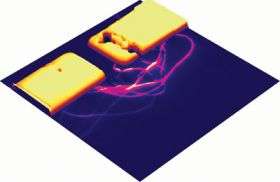
This 3D microscopic image of a simple nanotube device is taken with photothermal current microscopy performed in Jiwoong Park's lab. The two yellow blocks are electrodes, and strung between them are carbon nanotubes. The strength of each nanotube's electrical signal is visible according to its brightness. Image: Adam W. Tsen

(PhysOrg.com) -- A single batch of carbon nanotubes -- molecular carbon cylinders that may one day revolutionize electronics engineering -- often includes more than 100 types of tubes, each with different optical and electrical properties. Individual electrical measurements of the molecules typically require such slow and expensive methods as electron-beam lithography.

But now a team of Cornell researchers has invented an efficient, inexpensive method to electrically characterize individual carbon nanotubes, even when they are of slightly different shapes and sizes and are networked together.

Led by Jiwoong Park, Cornell assistant professor of chemistry and chemical biology, the group has demonstrated how to measure electrical conductance of both a single nanotube, and up to 150 of them arrayed together, using a single set of electrodes and the heat from a laser. The method is called photothermal current microscopy and could be a major step toward full manipulation of carbon nanotubes in electronic device engineering. It would be especially useful, Park said, for analyzing nanostructures when they are difficult to distinguish from one another.

"There is this tremendous excitement about nanostructures and nanoscale devices," Park said. "But there are a number of things we still need to figure out. One is, we have to be able to measure a large number of them simultaneously so we can have better control when we synthesize them. And that's easier said than done."

The results are reported in Nature Nanotechnology (already online and forthcoming in print Vol. DOI: 10.1038/NNano.2008.363). Collaborators include first author Adam W. Tsen, a graduate student of applied physics; Luke A.K. Donev, a graduate student of physics; Huseyin Kurt, a former postdoctoral associate at Harvard University; and Lihong H. Herman, a graduate student of applied physics.

For their technique, the researchers attached a pair of electrodes to the ends of an array of carbon nanotubes. They then used a laser to heat one nanotube at a time, which reduced the amount of electrical current flowing through it. The conductance change was proportional to the conductance of the nanotube being hit by the laser.

In essence, the nanotubes became temperature sensors, Park explained, and their conductance changes helped the researchers characterize which nanotubes were more or less conductive.

Provided by Cornell University


print this article email this article download pdf blog this article bookmark this article     Digg this Stumble it share on Facebook share on Reddit add to delicious save to Yahoo! bookmarks
4.5/5 after 11 votes

Rank Filter

Move the slider to adjust rank threshold, so that you can hide some of the comments.


Display comments: newest first

  • ny_cespedes - Dec 27, 2008
    • Rank: not rated yet
    Can't wait for the true {nano} Era to begin.

December 15th, 2008 all stories
Nanotechnology / Nanophysics

Comments: 1
Rank: 4.5/5 after 11 votes

  • Stumble this up

  • Digg this

  • Share it:
  • share on Facebook
  • share on MySpace
  • share on Slashdot
  • rss-newsfeed
  • share on Google
  • share on Reddit
  • add to delicious
  • save to Yahoo! bookmarks
  • share on Windows Live
  • Add to Mixx!
Rating: 4.5/5 after 11 votes

  • Related Stories

  • New radiation therapy promises relief for overheating laptops
    created Apr 13, 2009 | popularity not rated yet | comments 0
  • New hybrid nanostructures detect nanoscale magnetism
    created Dec 08, 2008 | popularity not rated yet | comments 0
  • Paperwork: Buckypapers Clarify Electrical, Optical Behavior of Nanotubes
    created Oct 15, 2008 | popularity not rated yet | comments 0
  • First STM spectroscopy of graphene flakes yields new surprises
    created Jul 21, 2008 | popularity not rated yet | comments 0
  • New Flexible, Transparent Transistors made of Nanotubes
    created Nov 27, 2007 | popularity not rated yet | comments 0


  • Physicists Demonstrate Quantum Memory with Matter Qubits
    Physicists Demonstrate Quantum Memory with Matter Qubits
    Physics / General Physics
    created Jul 03, 2009 | popularity 4.4 / 5 (17) | comments 1
  • 'Holey' Nanosheets for Wastewater Dye Removal
    Nanotechnology / Nanomaterials
    created Jul 01, 2009 | popularity 5 / 5 (5) | comments 1
  • Jellyfish Robot Swims Like its Biological Counterpart
    Jellyfish Robot Swims Like its Biological Counterpart
    Electronics / Robotics
    created Jun 26, 2009 | popularity 4.4 / 5 (8) | comments 1
  • Could Maxwell's Demon Exist in Nanoscale Systems?
    Could Maxwell's Demon Exist in Nanoscale Systems?
    Physics / General Physics
    created Jun 24, 2009 | popularity 4.4 / 5 (18) | comments 29
  • Living Safely with Robots, Beyond Asimov's Laws
    Living Safely with Robots, Beyond Asimov's Laws
    Electronics / Robotics
    created Jun 22, 2009 | popularity 4.6 / 5 (53) | comments 40
  • Other News

    Nano Measurement in the 3rd Dimension

    Nano Measurement in the 3rd Dimension

    Nanotechnology / Nanophysics

    created 1hour ago | popularity 3 / 5 (1) | comments 0

    From the motion sensor to the computer chip - in many products of daily life components are used whose functioning is based on smallest structures of the size of thousandths - or even millionths - of millimetres. ...


    A 'quantum of sol' -- how nanotechnology could hold the key to a solar-powered future

    A 'quantum of sol' -- how nanotechnology could hold the key to a solar-powered future

    Nanotechnology / Nanomaterials

    created Jun 30, 2009 | popularity 3.9 / 5 (16) | comments 17

    (PhysOrg.com) -- A new generation of 'nano-structured' millimetre-sized solar cells that could convert the sun's energy to electricity more than twice as efficiently as current technology, is the subject of ...


    Australian researchers are set to begin human trials of a tiny nano-cell that acts as a "Trojan horse" against cancer

    Hi-tech 'Trojan horse' can kill cancer cells: researchers

    Nanotechnology / Bio & Medicine

    created Jun 29, 2009 | popularity 4.7 / 5 (12) | comments 7

    Australian researchers are set to begin human trials of a tiny nano-cell that acts as a "Trojan horse" against cancer cells, a breakthrough they say may curb the need for debilitating chemotherapy.


    'Holey' Nanosheets for Wastewater Dye Removal

    Nanotechnology / Nanomaterials

    created Jul 01, 2009 | popularity 5 / 5 (5) | comments 1

    (PhysOrg.com) -- Researchers have discovered that extremely thin sheets of nickel oxide with hexagonally shaped holes can absorb hazardous dyes from wastewater nearly as well as the best traditional methods, but are recyclable. ...


    Harnessing Nanoparticles To Track Cancer Cell Changes

    Nanotechnology / Bio & Medicine

    created Jul 03, 2009 | popularity not rated yet | comments 1

    The more dots there are, the more accurate a picture you get when you connect them. Cancer researchers adopting that philosophy have developed a new imaging technology that could give scientists the ability to simultaneously ...