UC San Diego Adds Power Storage to Fuel Cell Project, Part of 'Smart Energy Grid'
(PhysOrg.com) -- The University of California, San Diego plans to store power produced at night from a planned 2.8 megawatt "green" fuel cell and use the energy during peak-demand hours the following day when electricity rates are highest. Implementation of the advanced energy storage system at UC San Diego, one of the greenest universities in the nation, was made possible by the Nov. 21 approval by the California Public Utility Commission (CPUC) of a measure designed to lower peak demands on the state’s electrical power grid.
“The pairing of advanced energy-storage systems with distributed renewable generating technologies is a hugely important step in facilitating the effective integration of renewables into the California system,” said Michael R. Peevey, President of the California Public Utilities Commission. “Increasingly the state will be relying on renewable resources, like wind, fuel cells, and other technologies that do not necessarily produce energy when it is most valuable. Storage solves that problem, transforming what would otherwise be low-value energy into high-value energy that can be used onsite to reduce peak energy demand. UCSD should be commended for taking this important step.”
Under the CPUC order, UC San Diego’s power-storage system would be eligible for $3.4 million in financial incentives. A formula of incentives encourages non-utility operators of fuel cells and small wind turbines of 5 megawatts or less to couple those systems to energy storage technologies.
“Energy storage to reduce peak-load demands on utilities is emerging as an important way to address the intermittency of renewable energy resources,” said President Peevey. “Wind energy produced in the middle of the night may be wasted unless it can be stored, and conversely, solar energy production could be used after the sun goes down if we had an efficient way to store it. UC San Diego and other adopters of energy storage technology will be forming the foundation of what we call a ‘smart energy grid.’”
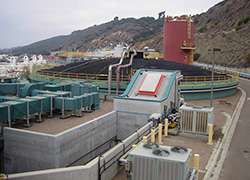
UC San Diego’s fuel cell system from FuelCell Energy of Danbury, CT, will be installed on campus by late 2009. It will use an electrochemical process to convert methane gas directly into electricity. The renewable methane will be collected at the city of San Diego’s Point Loma Wastewater Treatment Plant and purified by the Linde Group, whose U.S. headquarters are in Murray Hill, NJ. The wastewater treatment plant’s methane is currently flared off as waste.
Once in operation, the electrical output of the fuel cell will be used 20 hours a day to power the campus’s grid, and be used four hours a day to charge batteries, compress air, or employ another energy-storage technology. This stored power will be discharged the following afternoon during periods of highest electricity demand. The entire fuel cell project is expected to cost as much as $16 million. In addition, the university will capture the waste heat generated by the fuel cell as a continuous power source for 320 tons of chilling capacity to cool campus buildings.
“California continues to lead the nation in promoting innovative new green technologies, and it is appropriate that one of the nation’s greenest universities is leading an effort that could be a model for other universities in California and other states,” said State Sen. Christine Kehoe (D-San Diego), who will chair the Senate Appropriations Committee during the 2009-2010 legislative session. “The UCSD project will reduce demand on the regional electrical grid during peak-demand hours, benefiting all San Diegans and saving the state and the university money.”
Few universities can afford to purchase such expensive alternative energy solutions at a time when they are controlling costs in every phase of their operations. UC San Diego is assembling the fuel cell project as part of an 8-megawatt alternative energy portfoliothout spending its own money by collaborating with private investors. The private ventures will finance and build the improvements, taking advantage of investment incentives and tax breaks to lower their net costs. The return on their investment is predictable because UC San Diego agrees to purchase all the power generated at pre-determined rates.
“The credit crunch hurting the lending industry and reductions in state funding of capital projects have required the university to rely on innovative private-public partnerships to ensure that our sustainability goals remain on schedule,” said Steve Relyea, UC San Diego vice chancellor of business affairs. “This is actually a very workable model for any entrepreneurial university that wants to be greener.”
UC San Diego also embraces low-tech alternative energy solutions, and even combines low- and high-tech. For example, in 2001 the university built a state-of-the-art 30-megawatt natural-gas-fired cogeneration plant. That plant meets about 75 percent of the campus’s peak electrical demand while producing low emissions of nitrous oxide and other pollutants. Waste exhaust heat from the plant’s twin gas turbine generators is harnessed to power a system that sends chilled water into a 3.2-million-gallon holding tank. That water is tapped to cool buildings during daytime peak-demand periods, saving about $500,000 per year in energy costs.
The chilled water system allows the university to reduce its peak energy requirements by about 14 percent. The planned electrical energy storage technology linked to the fuel cell will reduce peak energy demand by another 6 percent, for a total reduction in UC San Diego’s peak energy demand of approximately 20 percent.
The university’s fuel cell is part of an 8-megawatt alternative energy system that involves usage of electricity produced by solar photovoltaic panels and wind power generated off campus. The 8-megawatt system will produce enough electricity to power more than 4,000 homes a year, equivalent to removing more than 10,000 tons of carbon dioxide from the atmosphere annually.
Students are involved in a variety of ways in many of the university’s alternative energy projects, essentially turning UC San Diego into a living laboratory of green energy ideas and solutions.
“Efficient energy storage and the concept of a smart energy grid are challenging technical issues not just in California, but also nationally and worldwide,” said Art Ellis, vice chancellor for research at UC San Diego. “We are committed to going green not only because it makes economic and environmental sense, but also because it represents research and educational opportunities for our faculty, staff and students.”
UC San Diego will soon be using the electricity produced by a 1-megawatt solar photovoltaic (PV) system. The university is planning to install another megawatt of PV panels.
“At the same time that California’s energy leaders are creating a smart energy grid, UC San Diego is creating a cutting-edge version of it on campus,” said Byron Washom, director of strategic energy initiatives. “UC San Diego’s experience in combining fuel cell and energy-storage technologies as part of its growing smart energy grid will enable it to collaborate on a variety of related future projects with the U.S. Department of Energy, the California Energy Commission, Sandia National Laboratories, the Electric Power Research Institute and other governmental and electric utility entities.”
Provided by UCSD


