Diverse landscapes are better: Policymakers urged to think broadly about biofuel crops
December 15, 2008
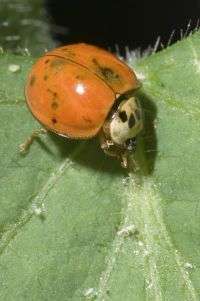
Ladybird Beetle

Enlarge

A ladybird beetle, or ladybug. Credit: Kurt Stepnitz, Michigan State University

Diversity is valuable socially, economically and now environmentally. Research by Michigan State University scientists has found that growing more corn to produce ethanol – creating less diverse landscapes – reduces the ability of beneficial insects to control pests, a loss valued at about $58 million per year in the four states studied (Michigan, Iowa, Minnesota and Wisconsin).

"Corn is a less favorable habitat for many ladybird beetles (ladybugs) and other beneficial insects that feed on pests such as the soybean aphid," said Doug Landis, MSU professor of entomology. "As we plant more corn, we reduce the ability of that landscape to supply beneficial predators to control pests in soybeans and other crops. This results in increased pesticide use and yield losses. This research estimates the value of this biological pest control service in soybeans (in the four states) to be about $240 million each year."

The research was published in the current issue of the Proceedings of the National Academy of Sciences.

From 2006 to 2007, corn acreage increased by 19 percent in the United States, reducing landscape diversity in many areas, according to the scientists.

"Over-reliance on any one crop is likely to reduce the value of natural control of pest insects by beneficial insects," said Scott Swinton, MSU professor of agricultural, food and resource economics and paper co-author. "If we look at farmers who grow only corn and soybeans, increasing corn acreage and reducing soybean acreage will probably mean higher costs for soybean pest control. Beneficial insects help control pests so growers have lower pest control costs."

Both Landis and Swinton are members of the Great Lakes Bioenergy Research Center, a partnership between Michigan State and the University of Wisconsin-Madison funded by the U.S. Department of Energy to conduct basic research aimed at solving complex problems in converting natural materials to energy.

The researchers say achieving the biofuel production levels mandated by Congress will take millions of acres to provide the necessary raw materials and will change agricultural landscapes. Understanding how these landscape changes affect the sustainability of biofuel production is the overall goal of the research.

"Ultimately, we hope this helps policymakers think about which and how much of any biofuel crop, as well as the location of the crop, makes sense for a particular landscape," Landis said. "We could choose to create monocultures of a single biofuel crop or have diverse mixtures of many biomass sources including perennial trees and grasses as well as corn. Diverse landscapes often support higher levels of vital ecosystems services such as pest suppression and pollination. Our goal is to provide information so people can make more informed decisions."

Source: Michigan State University


Rank not rated yet
Relevant PhysicsForums posts

More news stories

A mitosis mystery solved: How chromosomes align perfectly in a dividing cell

Although the process of mitotic cell division has been studied intensely for more than 50 years, Whitehead Institute researchers have only now solved the mystery of how cells correctly align their chromosomes during symmetric ...

Biology / Cell & Microbiology

created 10 hours ago | popularity 4.3 / 5 (16) | comments 0 | with audio podcast

Researchers find extensive RNA editing in human transcriptome

In a new study published online in Nature Biotechnology, researchers from BGI, the world's largest genomics organization, reported the evidence of extensive RNA editing in a human cell line by analysis of RNA-seq data, demons ...

Biology / Biotechnology

created 9 hours ago | popularity 5 / 5 (4) | comments 0 | with audio podcast

The proteins ensuring genome protection

Researchers from the University of Geneva (UNIGE), Switzerland, have discovered the crucial role of two proteins in developing a cell 'anti-enzyme shield'. This protection system, which operates at the level of molecular ...

Biology / Cell & Microbiology

created 10 hours ago | popularity 5 / 5 (3) | comments 0 | with audio podcast

Entire genome of extinct human decoded from fossil

(PhysOrg.com) -- In 2010, Svante Pääbo and his colleagues presented a draft version of the genome from a small fragment of a human finger bone discovered in Denisova Cave in southern Siberia. The ...

Biology / Biotechnology

created Feb 07, 2012 | popularity 4.7 / 5 (60) | comments 51 | with audio podcast

Why are there so few fish in the Earth's oceans?

(PhysOrg.com) -- A Stony Brook University researcher has found that, contrary to popular belief, there are not plenty of fish in the sea.

Biology / Plants & Animals

created Feb 08, 2012 | popularity 4.2 / 5 (18) | comments 27 | with audio podcast


Scientists discover molecular secrets of 2,000-year-old Chinese herbal remedy

For roughly two thousand years, Chinese herbalists have treated Malaria using a root extract, commonly known as Chang Shan, from a type of hydrangea that grows in Tibet and Nepal. More recent studies suggest that halofuginone, ...

New method to examine batteries -- MRI from the inside

There is an ever-increasing need for advanced batteries for portable electronics, such as phones, cameras, and music players, but also to power electric vehicles and to facilitate the distribution and storage of energy derived ...

Google might launch Drive for cloud storage soon

(PhysOrg.com) -- Google's next big move, according to the Wall Street Journal, is a cloud storage service called Drive. Hardly first to the plate, Google is simply catching up to introducing its cloud reposi ...

Lab study raises questions over nano-particle impact

Tests involving chickens have raised questions about the impact on health from engineered nano-particles, the ultra-fine grains commonly used in drugs and processed foods, scientists said on Sunday.

Starve a virus, feed a cure? Findings show how some cells protect themselves against HIV

A protein that protects some of our immune cells from the most common and virulent form of HIV works by starving the virus of the molecular building blocks that it needs to replicate, according to research published online ...

Overeating may double risk of memory loss

New research suggests that consuming between 2,100 and 6,000 calories per day may double the risk of memory loss, or mild cognitive impairment (MCI), among people age 70 and older. The study was released today and will be ...