Researchers revisit male bisexuality
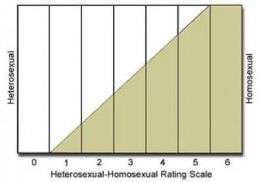
The landmark "Sexual Behavior in the Human Male" report revealed major insights into bisexual behavior and orientation -- without even using the word "bisexual" -- when it was published 60 years ago by pioneering sex researcher Alfred Kinsey and his research team at Indiana University.
The iconic "Kinsey Report" unveiled the seven-point Heterosexual-Homosexual Rating Scale, commonly known as the Kinsey Scale, as a tool to gauge a person's sexual orientation or experiences with both sexes.
While the Kinsey Scale has become a fixture in sexuality textbooks and even popular culture, the rating system and Kinsey's findings regarding male bisexuality, and cultural influences on male sexuality in general, have largely been overlooked by today's sex researchers, according to an article in the December issue of the "Journal of Bisexuality."
For this article, which is part of a special issue recognizing the 60th anniversary of the first "Kinsey Report," sex researchers from the Center for Sexual Health Promotion at IU collaborated with Paul H. Gebhard, an original member of Kinsey's research team and later a long-time director of The Kinsey Institute at IU, to reflect on research involving male bisexuality since the "Kinsey Report" and potential directions for future research.
"Overall, Kinsey would be disappointed," Gebhard told the researchers, Michael Reece and Brian Dodge, director and associate director of the Center for Sexual Health Promotion in the School of Health, Physical Education and Recreation.
Kinsey believed that culture plays a key role in a person's sexual behavior. Gebhard said Kinsey and his research team avoided looking for causes for sexual orientation out of concern that the findings could be used against people. Through sexual history interviews, they instead sought to capture snapshots of human sexual experience, which proved to be fluid, according to their research, with individual sexual preferences or orientation often moving along the heterosexual-homosexual scale during one's lifetime.
Since Kinsey's day, Gebhard noted that many researchers have moved to a medical model of sex research -- looking for genetic causes of homosexuality, often conducting research solely in the context of sexually transmitted disease transmissions or in an attempt to define what is "normal," usually using heterosexuality as the reference point. The place for bisexual individuals in sexuality research is vague, with research generally categorizing people either "homosexual" or "heterosexual," giving scant recognition to the continuum described by the sexual orientation scale.
"It's not necessarily a bad thing that research is evolving," Dodge said. "Biology and genetics, of course, are part of the picture. But we seem to be swinging in the direction where some scientists are using these as universal explanatory constructs and trying to minimize, or even negate, the role of an individual's culture and environment, aspects that Kinsey thought were most important."
Gebhard, 92, is the last living member of the original Kinsey research team. He is professor-emeritus in the Department of Anthropology at IU and served as director of the Kinsey Institute from 1956-1982, when it was called the Institute for Sex Research. He lives in southern Indiana.
He and his co-authors offered the following suggestions for future research focusing on male bisexuality:
*Move away from a disease-focused lens. Dodge said the medical model of sexuality research has established heterosexuality as the norm even though Kinsey's findings indicated it was natural for people to move across the Kinsey Scale throughout their lives.
*Improve sampling methods for bisexuality research. Dodge acknowledged that finding "bisexual" participants for studies is often challenging but important, requiring innovative techniques. All too often, however, researchers recruit participants from predominantly "gay-identified" venues, like bars, which are considered convenient yet lack the bisexual individuals that researchers seek.
Source: Indiana University


