Cookie cutter in the sky: Seeing the shape of material around black holes for first time
December 16, 2008
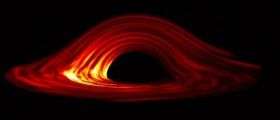
This is a visualization of material swirling around a black hole. Credit: Chris Reynolds
Black holes can now be thought of as donut holes. The shape of material around black holes has been seen for the first time: an analysis of over 200 active galactic nuclei—cores of galaxies powered by disks of hot material feeding a super-massive black hole—shows that all have a consistent, ordered physical structure that seems to be independent of the black hole's size.
"This should be a very messy and complicated environment, but the stuff flowing onto different black holes looks the same, no matter how massive the black hole is," says Barry McKernan, a Research Associate in Astrophysics at the American Museum of Natural History and a professor at the Borough of Manhattan Community College, City University of New York. "This observed shape should constrain all our ideas as to how the glow around black holes is produced, and if we can handle the stuff around black holes, we can begin to study black holes themselves."
Although black holes cannot be seen directly, the hot material swirling around super-massive black holes can be observed. In this paper, McKernan and colleagues tested a hypothesis about the relationship between two extremes of radiation coming from around super-massive black holes: X-rays should come from very hot material close to the black hole, and infrared light should come from warm material much further from the hole. This pattern allowed them to tell if matter around the black hole was being observed face-on (looking directly down onto the black hole ringed by X-rays and infrared light) or edge-on (seeing only the side of the donut of material). Some of the infrared light should also come from part of the donut that has been fried by X-ray bombardment. By comparing the proportion of X-rays to infrared light coming from around a black hole, it is possible to indirectly figure out how material may be distributed around the black hole.
McKernan and colleagues looked at a large sample size of 245 active galactic nuclei containing black holes between 1 million and 100 million times heavier than the sun. All of these active galactic nuclei have been described, and data is available through the NASA/IPAC Extragalactic Database. After partitioning the systems into those observed edge-on and those observed face-on, the team found that 90% of the active galactic nuclei observable face-on had basically the same proportion of X-rays to infrared light.
"Because the data points in the infrared range are from the old Infrared Astronomical Satellite, we can say this is not a infrared-biased sample because the satellite looked at all of the sky," says coauthor K.E. Saavik Ford, also a Research Associate in Astrophysics at AMNH and a professor at BMCC, CUNY. "It is interesting to learn something about black holes as a class."
McKernan agrees. "Now we know they all look like donuts, and the same kind of donut too. The lack of variety would disappoint Homer Simpson."
The research is published in Monthly Notices of the Royal Astronomical Society.
Source: American Museum of Natural History


(I hope what I mean is clear)
http://www.presto...ndex.htm
The flatness of the rings of saturn, the solar system and a black hole's donut is not caused by anti-gravity matter because there isn't any nearby. I expect it's due to collisions between particles sapping energy out of the system and generating heat.
All the theory give with your site is very interesting but I want to see some proof. Give me calculations, stick to the scientific method!
oh, btw, in case of the rings of saturn and the solar system, it isnt heat that is creating that. I don't know what it is, but heat generates disorder (higher entropy thus higher disorder). Concerning the rings of Saturn, they are composed of debris and ice...
*waits for the 1 rating* Bring it on you unintelligent geeks! Keep thinking in that box of yours you call your 'life'.
But then again, the best scientist is one who doubts. But if you say that they don't exist, show it to me. Give me the theory (or should I say truth because when it is theory, people will shout that it isn't so) or the calculations that show that the theory is false, inaccurate or incomplete.
Or come up with a better theory that explains the anomolies that we encounter together with a sound mathematical solution.
No, the 1-rating (by my account I will be honest) is because of your second comment... It is kind of sad in my opinion.
Thecis: agree with you completely.
On the subject of donut shapes and rings and such, the explanation is quite simple. No matter how complex a motion you start with, you are going to end up with a net rotation in one direction only, assuming the individual particles can affect each other. For instance, start in your mind with a spherical ball of dust, with particles shooting around in all directions. There is a *net* vector in there somewhere in one direction. Eventually, due to collisions and such, most of the random motions will cancel out, and you'll be left with a net rotation in one specific direction.
Gravity can help, too. Imagine two objects passing each other in orbits that are at some arbitrary angle. the effect of gravitational interaction as they pass closely is to reduce that angle. Eventually, given enough passes, They will end up in the same orbital plane.
I am not a trained professional in this area as I lack the proper mathematical and Physics education and I can not offer any mathematical proof to support or argue such a claim.
However, It does seems apparent to me that we are indeed still missing something crucial to our understanding of the objects as it is my understanding that even current theories and models themselves do not have the mathematical proof needed to describe them.
I can not shake the very intense feeling that we are missing something that will change our understanding of these objects and lead us to a new understanding of our Universe and its creation.
Setting aside black holes for the moment Saturn's rings are, as far as I can see, circular. Our Moon has a very circular orbit.
Most planets' orbits are effectively circles.
Is gravity and friction between the aggregating particles sufficient to explain these three examples?
A way of detecting it:- there's probably no anti-gravity matter near the earth, so the best way to detect it is through observing its effects on visible objects in space as described here:-
http://www.presto...ndex.htm
Give me another.
I'll try ;-)
I have seen the site and also the section of the maths. Here there are given some formulas about the distribution of the AGM. But these formulas are general and also apply to normal matter; it is just a distribution.
Futhermore I encountered the following sentence: "The author regrets that he is unable to integrate that term properly but has calculated it to be equal to 2/3 to six significant figures".
How can this be? The author cannot integrate the term but has found the answer. That seems disturbing to me and makes me doubt the whole calculation.
What I wondered. Anti-matter has been proven. These particles were made in particle accelerators and proven that they exist. How about AGM?
The last bit. Even quantummechanics predict a lot and even though it is more a matter of probability (i.e. the position of electron in orbitals around atoms)it still holds up. Also, wave functions can be determined exactly for 1-dimension calculations. Show me how that work with AGM?
Is this enough calculation for you? ;-)
Yet you also have comets and asteroids with very elliptical orbits. My guess, without doing any math, would be that the more that interaction is possible between particles orbiting a common centre, the more opportunity there is for them to influence each other and "average out" the orbits. Of course, sometimes an interaction will result in a slingshot effect that sends one or both masses into the great beyond, but then you're left with the ones that didn't slingshot. So it's a combination of sampling bias and orbital interactions.
What part of "there's probably no anti-gravity matter near the earth" didn't you understand?!
Probably, as in "who knows, I can't make predictions about the particles in my theory." Like, how to detect or manufacturer them, nor at what point during the formation of the universe they came into the existence, and where among the current family of particles they lie or diverged from.
What I do know though, is that I've seen pictures of galaxies and computer simulations of their movement and formation and without a doubt in my mind I can tell you that this is practical and irrefutable evidence that absolutely, positively, anti-gravitational matter (particles) do exist.
Give me another!!
I also have seen pictures of galaxies and simulations of their movements. Do you know what conclusions I came to? That dark matter and dark energy makes sense. What evidence do you have that AGM is any better than Dark matter? The only difference seems to be that there have been no expiriments to try and dectect AGM while the effects of dark matter and energy have been observed near bodies of matter, where AGM supposedly shouldn't be because AGM is
That would mean basically nowhere in any galaxy.
I certainly know the meaning of the term "probablity". It is the same the AGM. It will probably exist. But the people here show that everything has to do with AGM. Everything can be explained with it. I said fine, show it to me. And TimmESimmons replied that he was willing to make some calculations for me.
After that I gave him some things to think about. And you replied in a sense that I am stupid?? Which part I wouldn't understand??
I must admit that a theory is very nice. Take for example the theory of relativity. It had assumptions but the assumption were CALCULATED aftwerwards and proven.
So to be honest, I find your post not at all interesting. It is shouting like a child who thinks something is injust... It's just disappointing.
However, I am a scientist and I will certainly keep an open mind but I do recognise the scientific method. You are a "follower" of the AGM theory. It is your job to convince me. I asked some questions because I doubt the theory. I have never attacked one personally, only the explanation.
Futhermore, if there is no AGM within a few lightyears, is that so big a problem? Does that mean it can't be created in (for example) high velocity experiments? Anti-matter isn't here within a million lightyears but it could be created. That was all I ment, nothing else.
Oh, 2 more things.
I have seen people float and fly, ghosts on photo's and simulations that showed bayond a doubt that people can use telepathy and telekinesis. Still, people are doubting this? How odd... You see my parallel??
Secondly, when ending your post with "Give me another!!" you suggest you have given a satisfactory answer.
Well, I can assure you that that you absolutely, positively haven't!
So maybe you can focus more on the scientific part in stead of the rebellion part.
I do not support nor believe in "AGM" but I do support TimESimmons himself in the investigation of "different avenues" of Universal truths.
He has simply failed to convince me to date of the existence of AGM. About once a month there is an article posted that could be assumed as evidence for AGM, but is inconclusive. There is no hard data for the theory, only third party observations and conjecture. Understandably so, considering the resources required. I too have "theories," but don't assume they are the "cure all" to the mysteries of the Universe and I remain open about many other interpretations... Including AGM.
TimESimmons however seems unwaveringly convinced he is absolutely right an does not wish consider other options. For his sake, I hope he is.
http://www.presto...ndex.htm
What that means is that the function can be plotted as a curve on a graph, the integral of that function is the area under the graph. I can't evaluate the integral but I have plotted it on my laptop and measured the area under the curve. The answer I get is 2/3 to 6 sig figs. Not a proof but I'm convinced.
Then we share the same thinking. Also my apologies!
I absolutely agree with your post.
Haha, quite a good one actually! You fooled me with my eyes open!
I hadn't thought about that option. Calculating the area under the curve is a possibility. Im not sure if it is the correct way in this matter but it is certainly a possibility.
Yea, I went back and did the integral, and it is definently not 2/3. Using radians, you get 0. Using degrees, you get .0015. I tried both just because the answer was so far off from yours. Also, I graphed it out, and it looks like my answer waS correct. If I were you, I would never trust that laptop again.
http://www.presto...tion.xls
p(.oo9*pi*(r^3))mG/(r^3)
Pretend p is actualy ro, because I have no idea how to format that correctly.
I beg to differ. If those had been indefinite integrals, it wouldn't really matter. But as they are definite integrals, they have a finite answer that can only be determined by calculating the sin of pi. That answer differs greatly depending whether you use degrees or radians.
Also the first integral comes to zero because the function is symmetrical about the x-axis as shown here. This is independent of whether you calculate in degrees or radians.
http://www.presto...ion2.xls
I hope for your sake that that's supposed to be sarcastic. They're teaching that in high school now. All you do is substitute a term in the integrand for an arbitrary variable with the hopes that, when the integral is put into the terms of the variable, any other terms with a differnet variable will be canceled out. You then integrate in terms of the new variuable and substitute the original term into the answer wherever you see the new variable. Then, since this was a definite integral, plug in the limiting values and solve for a finite answer.
And you're right, I reexamined the first integral and I did make an error. But the first integral, I checked repeatedly, and even by yourr own graph the answer is not 2/3. I don't use speadsheet very frequently, so tell me the calculation in F and maybe I'll see what's going on. And by the way, yes, units matter. Judging by your calculations for the sin values, you are using radians.
Now a sanity check. Look at the graph. We want the area under the graph. Guess at the average of our function as shown on the graph (Melt the peaks so they fill the troughs). I'd say the average is about 0.2. So the area we're after is something like a rectangle 0.2 high and 3.1415 wide. The answer is going to be about 0.6 and a bit.
Back to the numbers. As you go down the rows of the spreadsheet you go from left to right across the graph. Each row represents a narrow rectangle under the curve on the graph. Each little rectangle has a height of the function and a width of pi/1000 (because there are 1000 rows).
So column F is the area of the little rectangles calculated from E x pi /1000. And column G is the areas of the rectagles being added up as you go down. Element G1007 (bottom right) is the sum of all the areas = 0.666665022
http://www.presto...ion3.xls