A sparkling spray of stars
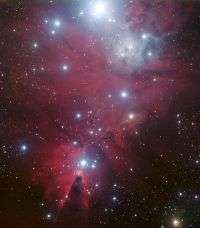
December 16, 2008 NGC 2264 and the Christmas Tree Cluster

Enlarge

This color image of the region known as NGC 2264 -- an area of sky that includes the sparkling blue baubles of the Christmas Tree star cluster -- was created from data taken through four different filters (B, V, R and H-alpha) with the Wide Field Imager at ESO's La Silla Observatory, 2400 m high in the Atacama Desert of Chile in the foothills of the Andes. The image shows a region of space about 30 lightyears across. Credit: ESO

NGC 2264 lies about 2600 light-years from Earth in the obscure constellation of Monoceros, the Unicorn, not far from the more familiar figure of Orion, the Hunter. The image shows a region of space about 30 light-years across.

William Herschel discovered this fascinating object during his great sky surveys in the late 18th century. He first noticed the bright cluster in January 1784 and the brightest part of the visually more elusive smudge of the glowing gas clouds at Christmas nearly two years later. The cluster is very bright and can easily be seen with binoculars. With a small telescope (whose lenses will turn the view upside down) the stars resemble the glittering lights on a Christmas tree. The dazzling star at the top is even bright enough to be seen with the unaided eye. It is a massive multiple star system that only emerged from the dust and gas a few million years ago.

As well as the cluster there are many interesting and curious structures in the gas and dust. At the bottom of the frame, the dark triangular feature is the evocative Cone Nebula, a region of molecular gas flooded by the harsh light of the brightest cluster members. The region to the right of the brightest star has a curious, fur-like texture that has led to the name Fox Fur Nebula.

Much of the image appears red because the huge gas clouds are glowing under the intense ultra-violet light coming from the energetic hot young stars. The stars themselves appear blue as they are hotter, younger and more massive than our own Sun. Some of this blue light is scattered by dust, as can be seen occurring in the upper part of the image.

This intriguing region is an ideal laboratory for studying how stars form. The entire area shown here is just a small part of a vast cloud of molecular gas that is in the process of forming the next generation of stars. Besides the feast of objects in this picture there are many interesting objects hidden behind the murk of the nebulosity. In the region between the tip of the Cone Nebula and the brightest star at the top of the picture there are several stellar birthing grounds where young stars are forming. There is even evidence of the intense stellar winds from these youthful embryos blasting out from the hidden stars in the making.

This picture of NGC 2264, including the Christmas Tree Cluster, was created from images taken with the Wide Field Imager (WFI), a specialised astronomical camera attached to the 2.2-metre Max-Planck Society/ESO telescope at the La Silla observatory in Chile. Located nearly 2400 m above sea level, in the mountains of the Atacama Desert, ESO's La Silla enjoys some of the clearest and darkest skies on the whole planet, making the site ideally suited for studying the farthest depths of the Universe. To make this image, the WFI stared at the cluster for more than ten hours through a series of specialist filters to build up a full colour image of the billowing clouds of fluorescing hydrogen gas.

Source: ESO


print this article email this article download pdf blog this article bookmark this article     Stumble it Digg this share on Facebook retweet share on Reddit add to delicious
Rate this story - 4 /5 (4 votes)


December 16, 2008 all stories

Comments: 0

4 /5 (4 votes)
  • Stumble this up

  • Digg this

  • share this

  • hide
  • Related Stories

  • Close-up movie shows hidden details in the birth of super-suns (w/ Video)
    created Nov 16, 2009 | popularity not rated yet | comments 0
  • Opening up a colorful cosmic jewel box
    created Oct 29, 2009 | popularity not rated yet | comments 0
  • The Explosive Disintegration of a Young Stellar System in Orion
    created Oct 23, 2009 | popularity not rated yet | comments 0
  • Galaxy cluster smashes distance record
    created Oct 22, 2009 | popularity not rated yet | comments 0
  • Young Star Clusters
    created Oct 12, 2009 | popularity not rated yet | comments 0


  • hide
  • Relevant PhysicsForums posts

  • Some help with a X-Ray astronomy question please!
    created 2 hours ago
  • Help with Images and Optical Instrument Question..
    created 13 hours ago
  • Redshift as a distance indicator
    created 20 hours ago
  • Question about 2-body gravity
    created Nov 24, 2009
  • More from Physics Forums - General Astronomy

Other News

Space shuttle Atlantis aims for morning landing

Space & Earth / Space Exploration

created 33 minutes ago | popularity not rated yet | comments 0

(AP) -- Space shuttle Atlantis looks to be headed for an on-time landing.


New climate targets may not change daily life much (AP)

New climate targets may not change daily life much

Space & Earth / Environment

created 22 minutes ago | popularity not rated yet | comments 0

(AP) -- Americans' day-to-day lives won't change noticeably if President Barack Obama achieves his newly announced goal of slashing carbon dioxide pollution by one-sixth in the next decade, experts say.


Marine ecosystems get a climate form guide

Marine ecosystems get a climate form guide

Space & Earth / Environment

created 24 minutes ago | popularity not rated yet | comments 0

(PhysOrg.com) -- The first-ever Australian benchmark of climate change impacts on marine ecosystems and options for adaptation is being released in Brisbane today.


China is set to launch its second moon orbiter next October, state media have reported

China to launch second lunar probe: state media

Space & Earth / Space Exploration

created 1hour ago | popularity 5 / 5 (2) | comments 0

China will launch its second moon orbiter next October, state media reported Friday, as it powers ahead with a space programme that has sparked concerns abroad.


Past regional cold and warm periods linked to natural climate drivers

Space & Earth / Earth Sciences

created 18 hours ago | popularity 3.6 / 5 (12) | comments 21

Intervals of regional warmth and cold in the past are linked to the El Niņo phenomenon and the so-called "North Atlantic Oscillation" in the Northern hemisphere's jet stream, according to a team of climate scientists. These ...