Researchers interpret asymmetry in early universe
December 16th, 2008 The Cosmic Microwave Background

Enlarge

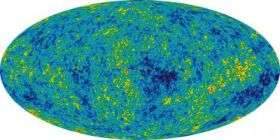
The cosmic microwave background as seen by the WMAP satellite. This radiation was emitted when the Universe was 380,000 years old and has an average temperature of 2.7 Kelvin. The red and blue spots are temperature fluctuations that differ from the average temperature by only 0.0002 degrees. The region of maximal variation is in the lower right quadrant. Credit: NASA/WMAP Science Team

(PhysOrg.com) -- The Big Bang is widely considered to have obliterated any trace of what came before. Now, astrophysicists at the California Institute of Technology (Caltech) think that their new theoretical interpretation of an imprint from the earliest stages of the universe may also shed light on what came before.

"It's no longer completely crazy to ask what happened before the Big Bang," comments Marc Kamionkowski, Caltech's Robinson Professor of Theoretical Physics and Astrophysics. Kamionkowski joined graduate student Adrienne Erickcek and senior research associate in physics Sean Carroll to propose a mathematical model explaining an anomaly in what is supposed to be a universe of uniformly distributed radiation and matter.

Their investigations turn on a phenomenon called inflation, first proposed in 1980, which posits that space expanded exponentially in the instant following the Big Bang. "Inflation starts the universe with a blank slate," Erickcek describes. The hiccup in inflation, however, is that the universe is not as uniform as the simplest form of the theory predicts it to be. Some parts of it are more intensely varied than others.

Until recently, measurements of the Cosmic Microwave Background (CMB) radiation, a form of electromagnetic radiation that permeated the universe 400,000 years after the Big Bang, were consistent with inflation--miniscule fluctuations in the CMB seemed to be the same everywhere. But a few years ago, some researchers, including a group led by Krzysztof Gorski of NASA's Jet Propulsion Laboratory, which is managed by Caltech, scrutinized data from NASA's Wilkinson Microwave Anisotropy Probe (WMAP). They discovered that the amplitude of fluctuations in the CMB is not the same in all directions.

"If your eyes measured radio frequency, you'd see the entire sky glowing. This is what WMAP sees," Kamionkowksi describes. WMAP depicts the CMB as an afterglow of light from shortly after the Big Bang that has decayed to microwave radiation as the universe expanded over the past 13.7 billion years. The probe also reveals more pronounced mottling--deviations from the average value--in the CMB in one half of the sky than the other.

"It's a certified anomaly," Kamionkowski remarks. "But since inflation seems to do so well with everything else, it seems premature to discard the theory." Instead, the team worked with the theory in their math addressing the asymmetry.

They started by testing whether the value of a single energy field thought to have driven inflation, called the inflaton, was different on one side of the universe than the other. It didn't work--they found that if they changed the mean value of the inflaton, then the mean temperature and amplitude of energy variations in space also changed. So they explored a second energy field, called the curvaton, which had been previously proposed to give rise to the fluctuations observed in the CMB. They introduced a perturbation to the curvaton field that turns out to affect only how temperature varies from point to point through space, while preserving its average value.

The new model predicts more cold than hot spots in the CMB, Kamionkowski says. Erickcek adds that this prediction will be tested by the Planck satellite, an international mission led by the European Space Agency with significant contributions from NASA, scheduled to launch in April 2009.

For Erickcek, the team's findings hold the key to understanding more about inflation. "Inflation is a description of how the universe expanded," she adds. "Its predictions have been verified, but what drove it and how long did it last? This is a way to look at what happened during inflation, which has a lot of blanks waiting to be filled in."

But the perturbation that the researchers introduced may also offer the first glimpse at what came before the Big Bang, because it could be an imprint inherited from the time before inflation. "All of that stuff is hidden by a veil, observationally," Kamionkowski says. "If our model holds up, we may have a chance to see beyond this veil."

The study appears December 16 in the journal Physical Review D.

Provided by California Institute of Technology


print this article email this article download pdf blog this article bookmark this article     Digg this Stumble it share on Facebook share on Reddit add to delicious save to Yahoo! bookmarks
4.3/5 after 35 votes

Rank Filter

Move the slider to adjust rank threshold, so that you can hide some of the comments.


Display comments: newest first

  • kwilco - Dec 16, 2008
    • Rank: 3 / 5 (1)
    The universe is getting more and more exciting! I thirst for this kind of news from physorg. Bring it on!
  • brant - Dec 16, 2008
    • Rank: 2 / 5 (2)
    I interpret asymmetry as a faliure of the big bang.

    And dont forget about the Jetson Zipatron field...
  • mysticshakra - Dec 17, 2008
    • Rank: 5 / 5 (2)
    "It's no longer completely crazy to ask what happened before the Big Bang,"

    No, just highly arrogant, presumptive and downright stupid. Hmm, faith also comes to mind.

    First you have to prove THERE WAS a big bang before you can make assumptions based on on it. Since the big bang is entirely based on the disproven premise that red shift equals doppler shift and therefore distance, it has no supporting evidence, only faith.
  • rab96 - Dec 17, 2008
    • Rank: 5 / 5 (2)
    "It's no longer completely crazy to ask what happened before the Big Bang,"

    To describe the early universe or the Big Bang, first the General Theory of Relativity and the Quantum Theory have to be unified. To this day, as far as I know, no-one has succeeded in doing this.
  • Damon_Hastings - Dec 17, 2008
    • Rank: 3 / 5 (1)
    These guys aren't claiming to know what happened before the big bang -- they're simply saying that their data *suggests* that there *may* have been an asymmetry before the big bang which carried through to our present universe. It's a twist in the mystery, not an answer to it.

    First you have to prove THERE WAS a big bang before you can make assumptions based on on it.


    Actually, that's not true at all. A common way to disprove a theory is to temporarily assume it is correct, and then find an inconsistency which results from that assumption. Moreover, nothing (even your own existence) can ever be proven 100%. But the big bang is the best model we have of the early universe -- so if we wish to explore the universe's origins (which we do), then this is naturally the model we will continue to use, until a better one comes along. If the big bang is ever disproven, then there will be a lot of other theories to tear down or rework, and that may set us back a few decades. But it's a much smaller risk at this point than the risk of halting scientific progress because we refuse to build on any theory which is not at least 99.999% certain.
  • mysticshakra - Dec 17, 2008
    • Rank: not rated yet
    It has been disproven. See Arp's work.

    But there is no interest in fact, only upholding broken theory.

    "Science progresses one death at a time."

December 16th, 2008 all stories
Physics / General Physics

Comments: 6
Rank: 4.3/5 after 35 votes

  • Stumble this up

  • Digg this

  • Share it:
  • share on Facebook
  • share on MySpace
  • share on Slashdot
  • rss-newsfeed
  • share on Google
  • share on Reddit
  • add to delicious
  • save to Yahoo! bookmarks
  • share on Windows Live
  • Add to Mixx!
Rating: 4.3/5 after 35 votes

  • Related Stories

  • QUIET team to deploy new gravity-wave probe in June
    created May 15, 2009 | popularity not rated yet | comments 0
  • Super-Sensors to Measure 'Signature' of Inflationary Universe (w/Video)
    created May 03, 2009 | popularity not rated yet | comments 0
  • Cosmologists aim to observe first moments of universe
    created Feb 16, 2009 | popularity not rated yet | comments 0
  • ESA's Planck satellite builds on Nobel-prize-winning science
    created Oct 04, 2006 | popularity not rated yet | comments 0
  • New Satellite Data On Universe's First Trillionth Second
    created Mar 16, 2006 | popularity not rated yet | comments 0


  • Physicists Demonstrate Quantum Memory with Matter Qubits
    Physicists Demonstrate Quantum Memory with Matter Qubits
    Physics / General Physics
    created Jul 03, 2009 | popularity 4.4 / 5 (17) | comments 1
  • 'Holey' Nanosheets for Wastewater Dye Removal
    Nanotechnology / Nanomaterials
    created Jul 01, 2009 | popularity 5 / 5 (5) | comments 1
  • Jellyfish Robot Swims Like its Biological Counterpart
    Jellyfish Robot Swims Like its Biological Counterpart
    Electronics / Robotics
    created Jun 26, 2009 | popularity 4.4 / 5 (8) | comments 1
  • Could Maxwell's Demon Exist in Nanoscale Systems?
    Could Maxwell's Demon Exist in Nanoscale Systems?
    Physics / General Physics
    created Jun 24, 2009 | popularity 4.4 / 5 (18) | comments 29
  • Living Safely with Robots, Beyond Asimov's Laws
    Living Safely with Robots, Beyond Asimov's Laws
    Electronics / Robotics
    created Jun 22, 2009 | popularity 4.6 / 5 (53) | comments 40
  • Other News

    UQ researchers break the law -- of physics

    Physics / General Physics

    created 5 hours ago | popularity 4.7 / 5 (9) | comments 0

    (PhysOrg.com) -- Two UQ Science researchers have proved two famous physical laws that have been widely used for the past 25 years do not always work.


    Scientists create first electronic quantum processor

    Scientists create first electronic quantum processor

    Physics / General Physics

    created Jun 28, 2009 | popularity 4.8 / 5 (54) | comments 42

    A team led by Yale University researchers has created the first rudimentary solid-state quantum processor, taking another step toward the ultimate dream of building a quantum computer.


    Science journals

    How to Spot an Influential Paper Based on its Citations

    Physics / General Physics

    created Jul 04, 2009 | popularity 3.9 / 5 (10) | comments 6

    (PhysOrg.com) -- At first it may seem that the number of citations received by a published scientific paper is directly related to that paper's quality of content. The higher the quality, the more people read ...


    Fermilab's CDF observes Omega-sub-b baryon

    Fermilab's CDF observes Omega-sub-b baryon

    Physics / General Physics

    created Jun 29, 2009 | popularity 4.7 / 5 (18) | comments 7

    (PhysOrg.com) -- At a recent physics seminar at the Department of Energy’s Fermi National Accelerator Laboratory, Fermilab physicist Pat Lukens of the CDF experiment announced the observation of a new particle, ...


    New insights, and a new angle, on high-temperature superconductivity

    New insights, and a new angle, on high-temperature superconductivity

    Physics / Superconductivity

    created Jun 29, 2009 | popularity 4.9 / 5 (14) | comments 7

    (PhysOrg.com) -- A Princeton-led research team has revealed surprising information about how electron behavior influences the conduction of electricity in a class of high-temperature superconductors. An increased ...