Dark Energy Found Stifling Growth in Universe
December 16th, 2008 Dark energy found stifling growth in universe

Enlarge

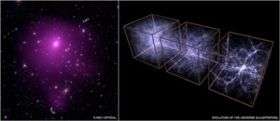
On the left is a composite image of Abell 85 made from X-rays from NASA's Chandra X-ray Observatory and optical light from the Sloan Digital Sky Survey. This galaxy cluster is one of 86 observed with Chandra to trace how dark energy has stifled the growth of these massive structures over the last 7 billion years. Galaxy clusters are the largest collapsed objects in the Universe and are ideal for studying the properties of dark energy across the Universe. The illustration on the right shows snapshots from a simulation representing the growth of cosmic structures when the Universe was 0.9 billion, 3.2 billion, and 13.7 billion years old. Credit: X-ray (NASA/CXC/SAO/A.Vikhlinin et al.); Optical (SDSS); Illustration (MPE/V.Springel)

(PhysOrg.com) -- For the first time, astronomers have clearly seen the effects of "dark energy" on the most massive collapsed objects in the universe using NASA's Chandra X-ray Observatory. By tracking how dark energy has stifled the growth of galaxy clusters and combining this with previous studies, scientists have obtained the best clues yet about what dark energy is and what the destiny of the universe could be.

This work, which took years to complete, is separate from other methods of dark energy research such as supernovas. These new X-ray results provide a crucial independent test of dark energy, long sought by scientists, which depends on how gravity competes with accelerated expansion in the growth of cosmic structures. Techniques based on distance measurements, such as supernova work, do not have this special sensitivity.
Comparing of Expansion of Universe and Growth of Structures
Enlarge

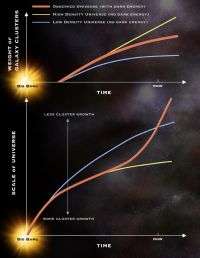
This pair of illustrations shows the change in scale of the Universe over cosmic time, followed by the change in the weight of a typical galaxy cluster over the same time frame. The orange line shows the evolution of the observed Universe, with dark energy and cosmic acceleration, and the yellow and blue lines show high and low density models that do not contain dark energy. The observed change in weight of galaxy clusters over the last 7 billion years agrees very well with predictions for a Universe dominated by dark energy. (Illustration: NASA/CXC/M.Weiss)

Scientists think dark energy is a form of repulsive gravity that now dominates the universe, although they have no clear picture of what it actually is. Understanding the nature of dark energy is one of the biggest problems in science. Possibilities include the cosmological constant, which is equivalent to the energy of empty space. Other possibilities include a modification in general relativity on the largest scales, or a more general physical field.

To help decide between these options, a new way of looking at dark energy is required. It is accomplished by observing how cosmic acceleration affects the growth of galaxy clusters over time.

"This result could be described as 'arrested development of the universe'," said Alexey Vikhlinin of the Smithsonian Astrophysical Observatory in Cambridge, Mass., who led the research. "Whatever is forcing the expansion of the universe to speed up is also forcing its development to slow down."

Vikhlinin and his colleagues used Chandra to observe the hot gas in dozens of galaxy clusters, which are the largest collapsed objects in the universe. Some of these clusters are relatively close and others are more than halfway across the universe.

The results show the increase in mass of the galaxy clusters over time aligns with a universe dominated by dark energy. It is more difficult for objects like galaxy clusters to grow when space is stretched, as caused by dark energy. Vikhlinin and his team see this effect clearly in their data. The results are remarkably consistent with those from the distance measurements, revealing general relativity applies, as expected, on large scales.

"For years, scientists have wanted to start testing how gravity works on large scales and now, we finally have," said William Forman, a co-author of the study from the Smithsonian Astrophysical Observatory. "This is a test that general relativity could have failed."

When combined with other clues -- supernovas, the study of the cosmic microwave background, and the distribution of galaxies -- this new X-ray result gives scientists the best insight to date on the properties of dark energy.

The study strengthens the evidence that dark energy is the cosmological constant. Although it is the leading candidate to explain dark energy, theoretical work suggests it should be about 10 raised to the power of 120 times larger than observed. Therefore, alternatives to general relativity, such as theories involving hidden dimensions, are being explored.

"Putting all of this data together gives us the strongest evidence yet that dark energy is the cosmological constant, or in other words, that 'nothing weighs something'," said Vikhlinin. "A lot more testing is needed, but so far Einstein's theory is looking as good as ever."

These results have consequences for predicting the ultimate fate of the universe. If dark energy is explained by the cosmological constant, the expansion of the universe will continue to accelerate, and the Milky Way and its neighbor galaxy, Andromeda, never will merge with the Virgo cluster. In that case, about a hundred billion years from now, all other galaxies ultimately would disappear from the Milky Way's view and, eventually, the local superclusters of galaxies also would disintegrate.

The work by Vikhlinin and his colleagues will be published in two separate papers in the Feb. 10 issue of The Astrophysical Journal.

Provided by Chandra X-ray Center


print this article email this article download pdf blog this article bookmark this article     Digg this Stumble it share on Facebook share on Reddit add to delicious save to Yahoo! bookmarks
4.3/5 after 40 votes

Rank Filter

Move the slider to adjust rank threshold, so that you can hide some of the comments.


Display comments: newest first

  • ShadowRam - Dec 16, 2008
    • Rank: 1.3 / 5 (3)
    What is the mass of the Sun, as a percentage of the mass of our entire solar system?
  • jonnyboy - Dec 16, 2008
    • Rank: 1.3 / 5 (3)
    99%
  • theophys - Dec 16, 2008
    • Rank: 1 / 5 (2)
    I wish the article went a little more in depth. I'm curious and want to know more about the data, but I'm lazy and don't want to go hunting down the information on the internets.
  • MRD - Dec 16, 2008
    • Rank: 1 / 5 (2)
    1.99 /10^23
  • Soylent - Dec 16, 2008
    • Rank: 2.6 / 5 (5)
    99%


    No, 99.86% would be correctly rounded to 100%.
  • Quantum_Conundrum - Dec 16, 2008
    • Rank: 1 / 5 (2)
    1.99 /10^23


    No, if that is supposed to be the mass of the sun, try this:

    1.9891 ×10^30 kg

    which is 332,946 Earths
  • Atomsview - Dec 16, 2008
    • Rank: 1.8 / 5 (9)
    Dark energy is the repulsion between matter and antimatter. Gravity is caused by the eclipses of nuclei by the orbiting particles in atoms. The physics relates to the quantum effects, Gauss's law and Coulomb's law. Gravity is electrical, and therefore it is attractive or repulsive under specific conditions. CERN and LOS Alamos Lab have the manuscript. The experiment by ALPHA - CERN and DAPNIA (see Google)will verify that antihydrogen will be repulsive by earth's gravity.
  • TimESimmons - Dec 17, 2008
    • Rank: 1 / 5 (5)
    No Atomsview Dark Energy is the repulsion between matter and anti-gravity matter, and between anti-gravity matter and itself. Anti-gravity matter also causes all the effects currently attributed to Dark Matter. Don't think anti-gravity matter is antimatter because we'd see the annihilation radiation all around and also because there's probably far more anti-gravity matter than normal matter so you've got the same baryon asymmetry problem the other way round.

    http://www.presto...ndex.htm
  • seanpu - Dec 17, 2008
    • Rank: 2.7 / 5 (3)
    "For the first time, astronomers have clearly seen the effects of "dark energy" on the most massive collapsed objects in the universe"

    hmm dark energy is turning out just like gravity, its there, we see it, we can sense it, we have some form of calculations for it, BUT WTF IS IT????? We have no idea but we'll brush over that.

    we still have no clear idea what gravity is, but we have some idea what its effects are. How in the universe then can they even begin to think they can glean any understanding of this dark energy?

  • Szkeptik - Dec 17, 2008
    • Rank: 1 / 5 (1)
    "This is a test that general relativity could have failed."

    WOW. Just WOW. This is exactly the kind of statement that can end a career. I wouldn't be throwing around stuff like this so early and easily if I was him.
  • Atomsview - Dec 17, 2008
    • Rank: 2.5 / 5 (2)
    DAPNIA mentions a theory of repulsion between matter and antimatter ( see Google; Antihydrogen gravity DAPNIA ALPHA ). The theory also shows attraction between atoms of antimatter, and atraction between atoms of matter. There is no annihilation between galaxies of matter and antimatter because of mutual repulsion. Many of the mysteries of physics are explained by this theory.
  • theophys - Dec 17, 2008
    • Rank: 5 / 5 (3)
    DAPNIA mentions a theory of repulsion between matter and antimatter ( see Google; Antihydrogen gravity DAPNIA ALPHA ). The theory also shows attraction between atoms of antimatter, and atraction between atoms of matter. There is no annihilation between galaxies of matter and antimatter because of mutual repulsion. Many of the mysteries of physics are explained by this theory.

    I have a difficult time beleiving that antimatter and matter repulse eacother, seeing as they are basically the same thing with opposite charges. Wouldn't that mean they attract eachother?
  • Atomsview - Dec 17, 2008
    • Rank: 3 / 5 (2)
    Hi theophys, look at the net charges of atoms and antiatoms. Orbiting particles (electrons or positrons) cause eclipses between atoms and net charges results between the atoms. The net charges produce a very weak force per Coulomb's law, this is gravity. The time of the eclipses are very short and are calculated using quantum physics.
  • Alizee - Dec 17, 2008
    • Rank: 1 / 5 (2)
    that general relativity could have failed
    The existence of dark matter doesn't violate the GR in fact - in certain sense it could serve as a best confirmation of it. It just demonstrates, the derivation of Einstein field equation was approaximate, because of ignorance of mass-energy equivalence principle.

    In brief, if the curvature of space has some energy by GR, we shouldn't neglect the mass corresponding this energy in more general reference frame. This mass density should exhibit and additional gravitational field, which balances the action of the gravity and mass, which has caused it, originally.

    In AWT this effect corresponds a "surface tension" of gravity field gradient (a blob of dense vacuum around massive objecys, responsible the gravity field and gravity lensing effects).

    The same result can be derived from light spreading from massive object under omnidirectional Universe expansion: light freezes in the expanding space gradually, which can be interpreted as a cloud of more dense vacuum (dark matter), surrounding such object.
  • Alizee - Dec 18, 2008
    • Rank: 1 / 5 (2)
    This is exactly the kind of statement that can end a career
    Maybe yes, maybe not - but such result would become dishonor of science, not the person, who presented such idea...;-)

    Blind adherence to mainstream opinion was exactly, which ended the carrier of Galileo - we can see, the fear of violation the intersubjectivelly accepted truth can have a quite opposite effect in its remote/large scale consequences.

    By AWT such result exactly corresponds the supersymmetric action of gravity at short/long distance and/or low/high energy scales. This is because the information spreading acellerates energy spreading in civilisation, so it undegoes the same laws, like energy spreading in Universe. By AWT every phenomena or law "violates itself" in more general scale, so if you understand repulsive stance toward remote ideas in science (pathological skepticism), you can understand the nature of repulsive action for gravity at larger distances - and vice-versa.
  • theophys - Dec 18, 2008
    • Rank: not rated yet
    net charges produce a very weak force per Coulomb's law, this is gravity

    This is not gravity. Conceptualy, the equation is very similar to Newton's equation for gravity and the forces act in much the same way. But mathamaticaly, the numbers are different for Coulombs electric force and for gravity. Also, the dielectric constant in Coulomb's equation changes changes the force depending on the medium between the two charges, whereas the gravitational force between two particles will be the same no matter what the medium is(so long as the radius does not change and you are only looking at the force between the two particles independent of the gravitational forces of the rest of the universe).
    And I still don't understand why matter and antimatter would repel eachother.
  • Atomsview - Dec 18, 2008
    • Rank: not rated yet
    Hi Theophys, In matter the orbiting electrons cause an eclipse between nuclei. The eclipses block repulsive forces of the nuclei and the over all net force is net attraction. If matter and antimatter is considered, the eclipses block protons and antiprotons, this is an attractive force, the overall net force is repulsion. All particles in the atoms or antiatoms are considered to determine the net force. You are correct in your comparison between coulomb's and Newtons laws. If you calculate the force between atoms using thess two laws, you will find that they are equal. For charge use current multiplied by time of the eclipses. Time of eclipses are calculated using quantum physics.
  • theophys - Dec 22, 2008
    • Rank: not rated yet
    Ok, taking this one step at a time. First off, what force comes into play that makes the net force between matter and antimatter repulsive? As far as magnetism goes, I could see the positrons slowing a proton nucleus down a little, but the electrons should have a stronger atraction to the positrons than the nucleus-positron repulsion. Eventualy the electrons and positrons would anihalate eachother and the two nuclei would continue on their course to anihalation.
  • Atomsview - Dec 23, 2008
    • Rank: not rated yet
    The easiest way to think of the net forces are as follows: Atoms are neutral for both matter and antimatter. However the individual particles have charges. When considering matter, the orbiting electrons cause eclipses between nuclei. The eclipses block all repulsive forces between the nuclei, and the remaining net foces between the atoms are attractive.

    When considering matter and antimatter atoms, the nucleus of the matter atom is blocked from the nucleus of the antiatom by orbiting particles, this is the blocking of an attractive force. The remaining net forces between the atom and antiatom are repulsive.
  • theophys - Dec 23, 2008
    • Rank: not rated yet
    That makes it sound like they are attracted to eachother until they come close enough to bond, at which point they would probably just anihalate eachother anyway.
  • Atomsview - Dec 23, 2008
    • Rank: not rated yet
    Hi theophys, the eclipses are easier to understand if you sketch an atom and an antiatom. The most basic is hydrogen and antihydrogen. The electron blocks the proton and antiproton. The positron also blocks the proton and antiproton. These eclipses block the attractive force between the atom and antiatom. The balance of the other forces between the atom and antiatom are repulsive, the net force is therefore repulsive. The eclipses are similar to a lunar eclipse except that the electrical fields are blocked as per Gauss's law. The atom eclipses are for very short periods of time.

    Hi theophys, the eclipses are easier to understand if you sketch an atom and an antiatom. The most basic is hydrogen and antihydrogen. The electron blocks the proton and antiproton. The positron also blocks the proton and antiproton. These eclipses block the attractive force between the atom and antiatom. The balance of the other force between the atom and antiatom are repulsive, the net force is therefore repulsive. The eclipses are similar to a lunar eclipse except that the electrical fields are blocked as per Gauss's law. The atom eclipses are for very short periods of time.
  • theophys - Dec 24, 2008
    • Rank: not rated yet
    So the atoms are only repulsive for a very short period of time and only when the elctrons and positrons are in just the right spot.
    As for gravity
    If you calculate the force between atoms using thess two laws, you will find that they are equal. For charge use current multiplied by time of the eclipses. Time of eclipses are calculated using quantum physics.

    I don't have the two being the same. I come up with gravity being much weaker at this scale.
  • Atomsview - Dec 24, 2008
    • Rank: not rated yet
    Hi theophys, The manuscript, "The Electromagnetic Theory of Gravity" clearly shows the electrical nature of gravity. The electrical net forces are equal to the forces of gravity under Newton's law of gravity. The manuscript should become available after the antihydrogen experiments.
  • Dileep_Sathe - Dec 26, 2008
    • Rank: not rated yet
    Dark Energy: The fact that scientists are considering the repulsive gravity, in connection with the Dark Energy, reminds me of my own conceptual contribution in the "Silver Jubilee Volume" of Indian Journal of Theoretical Physics. It is a quarterly of the Institute of Theoretical Physics, Kolkata. Interested persons can contact me on Home phone: 020-65100495 or by email: dvsathe@gmail.com
  • theophys - Dec 28, 2008
    • Rank: not rated yet
    Hi theophys, The manuscript, "The Electromagnetic Theory of Gravity" clearly shows the electrical nature of gravity. The electrical net forces are equal to the forces of gravity under Newton's law of gravity. The manuscript should become available after the antihydrogen experiments.

    I look forward to reading that, but for now I'm just bafled. My summed forces are different.
  • protostar - Feb 01, 2009
    • Rank: not rated yet
    Repulsive gravity? Is that gravity that "makes no sense"? Gravity that comes from the "side" instead
    of "from the bottom"? A spiral system that moves through objects and then "re-groups" on the other side of said object, dark energy moves slowly like
    a spiral galaxy. It's function is to "move or pull atoms apart"

December 16th, 2008 all stories
Physics / General Physics

Comments: 26
Rank: 4.3/5 after 40 votes

  • Stumble this up

  • Digg this

  • Share it:
  • share on Facebook
  • share on MySpace
  • share on Slashdot
  • rss-newsfeed
  • share on Google
  • share on Reddit
  • add to delicious
  • save to Yahoo! bookmarks
  • share on Windows Live
  • Add to Mixx!
Rating: 4.3/5 after 40 votes

  • Related Stories

  • Queen's astronomers propose new supernova interpretation
    created Jun 09, 2009 | popularity not rated yet | comments 0
  • Radio telescopes extend astronomy's best 'yardstick'
    created Jun 08, 2009 | popularity not rated yet | comments 0
  • Keck Study Sheds New Light on "Dark" Gamma-ray Bursts
    created Jun 08, 2009 | popularity not rated yet | comments 0
  • Celebrating gravity’s light-bending landmark
    created May 29, 2009 | popularity not rated yet | comments 0
  • Better Supernovae Measurements Aim To Improve Understanding of Dark Energy
    created May 22, 2009 | popularity not rated yet | comments 0


  • Physicists Demonstrate Quantum Memory with Matter Qubits
    Physicists Demonstrate Quantum Memory with Matter Qubits
    Physics / General Physics
    created Jul 03, 2009 | popularity 4.4 / 5 (17) | comments 1
  • 'Holey' Nanosheets for Wastewater Dye Removal
    Nanotechnology / Nanomaterials
    created Jul 01, 2009 | popularity 5 / 5 (5) | comments 1
  • Jellyfish Robot Swims Like its Biological Counterpart
    Jellyfish Robot Swims Like its Biological Counterpart
    Electronics / Robotics
    created Jun 26, 2009 | popularity 4.4 / 5 (8) | comments 1
  • Could Maxwell's Demon Exist in Nanoscale Systems?
    Could Maxwell's Demon Exist in Nanoscale Systems?
    Physics / General Physics
    created Jun 24, 2009 | popularity 4.4 / 5 (18) | comments 29
  • Living Safely with Robots, Beyond Asimov's Laws
    Living Safely with Robots, Beyond Asimov's Laws
    Electronics / Robotics
    created Jun 22, 2009 | popularity 4.6 / 5 (53) | comments 40
  • Other News

    UQ researchers break the law -- of physics

    Physics / General Physics

    created 5 hours ago | popularity 4.7 / 5 (9) | comments 0

    (PhysOrg.com) -- Two UQ Science researchers have proved two famous physical laws that have been widely used for the past 25 years do not always work.


    Scientists create first electronic quantum processor

    Scientists create first electronic quantum processor

    Physics / General Physics

    created Jun 28, 2009 | popularity 4.8 / 5 (54) | comments 42

    A team led by Yale University researchers has created the first rudimentary solid-state quantum processor, taking another step toward the ultimate dream of building a quantum computer.


    Science journals

    How to Spot an Influential Paper Based on its Citations

    Physics / General Physics

    created Jul 04, 2009 | popularity 3.9 / 5 (10) | comments 6

    (PhysOrg.com) -- At first it may seem that the number of citations received by a published scientific paper is directly related to that paper's quality of content. The higher the quality, the more people read ...


    Fermilab's CDF observes Omega-sub-b baryon

    Fermilab's CDF observes Omega-sub-b baryon

    Physics / General Physics

    created Jun 29, 2009 | popularity 4.7 / 5 (18) | comments 7

    (PhysOrg.com) -- At a recent physics seminar at the Department of Energy’s Fermi National Accelerator Laboratory, Fermilab physicist Pat Lukens of the CDF experiment announced the observation of a new particle, ...


    New insights, and a new angle, on high-temperature superconductivity

    New insights, and a new angle, on high-temperature superconductivity

    Physics / Superconductivity

    created Jun 29, 2009 | popularity 4.9 / 5 (14) | comments 7

    (PhysOrg.com) -- A Princeton-led research team has revealed surprising information about how electron behavior influences the conduction of electricity in a class of high-temperature superconductors. An increased ...