Close encounters with 3-D cell growth
December 16, 2008
Close encounters with 3-D cell growth

Enlarge

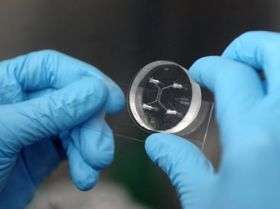
MIT engineers built a device that gives them an unprecedented view of 3-d cell growth and migration Photo / Donna Coveney

(PhysOrg.com) -- MIT engineers have built a device that gives them an unprecedented view of three-dimensional cell growth and migration, including the formation of blood vessels and the spread of tumor cells.

The microfluidic device, imprinted on a square inch of plastic, could be used to evaluate the potential side effects of drugs in development, or to test the effectiveness of cancer drugs in individual patients.

Roger Kamm, MIT professor of biological and mechanical engineering, and his colleagues reported their observations of angiogenesis -- the process by which blood vessels are formed -- in the Oct. 31 online issue of the journal Lab on a Chip.

Microfluidic devices have been widely used in recent years to study cells, but most only allow for the study of cells growing on a flat (two-dimensional) surface, or else lack the ability to observe and control cell behavior. With the new device, researchers can observe cells in real time as they grow in a three-dimensional collagen scaffold under precisely controlled chemical or physical conditions.

Observing angiogenesis and other types of cell growth in three dimensions is critical because that is how such growth normally occurs, said Kamm.

Working with researchers around MIT, Kamm has studied growth patterns of many types of cells, including liver cells, stem cells and neurons. He has also used the device to investigate the pressure buildup that causes glaucoma.

The device allows researchers to gain new insight into cell growth patterns. For example, the researchers observed that one type of breast cancer cell tends to migrate in a uniform mass and induces new capillaries to sprout aggressively toward the original tumor, while a type of brain cancer cell breaks from the primary tumor and migrates individually but does not promote capillary formation.

The system is configured so that researchers can manipulate and study mechanical and biochemical factors that influence cell growth and migration, including stiffness of the gel scaffold, concentration of growth factors and other chemicals, and pressure gradients.

Two or three channels imprinted onto the plastic square contain either a normal cell growth medium or a chemical under study, such as growth factor. Cells growing in the scaffold between the channels are bathed in chemicals from the channels, and the effect of the chemicals can be evaluated based on various measures of cell function.

Kamm and his colleagues first described their microfluidic device in a January 2007 paper in Lab on a Chip. Vernella Vickerman, a graduate student in chemical engineering, and Seok Chung, a postdoctoral fellow in biological engineering, played critical roles in developing the device, Kamm said.

Provided by MIT


Rank 5 /5 (1 vote)
Relevant PhysicsForums posts

More news stories

Fool's gold may prove an unlikely alternative to overexploited catalytic materials

Catalytic materials, which lower the energy barriers for chemical reactions, are used in everything from the commercial production of chemicals to catalytic converters in car engines. However, with current catalytic materials ...

Chemistry / Materials Science

created 14 hours ago | popularity 4.4 / 5 (8) | comments 5 | with audio podcast

Unpicking HIV’s invisibility cloak

Drug researchers hunting for alternative ways to treat human immunodeficiency virus (HIV) infections may soon have a novel target—its camouflage coat. HIV hides inside a cloak unusually rich in a sugar ...

Chemistry / Biochemistry

created 14 hours ago | popularity 5 / 5 (5) | comments 0

No entry without protein recycling: Researchers discover new coherence in enzyme transport

The group of Prof. Dr. Ralf Erdmann at the Ruhr-Universität Bochum, Germany, discovered a connection of peroxisomal protein import and receptor export. In the Journal of Biological Chemistry, they disclo ...

Chemistry / Biochemistry

created 14 hours ago | popularity not rated yet | comments 0

Hydrogen from acidic water: Researchers develop potential low cost alternative to platinum for splitting water

A technique for creating a new molecule that structurally and chemically replicates the active part of the widely used industrial catalyst molybdenite has been developed by researchers with the Lawrence Berkeley ...

Chemistry / Materials Science

created Feb 09, 2012 | popularity 4.8 / 5 (14) | comments 14 | with audio podcast

Under the microscope #7

In this video Dr Ingrid Graz shows us a thin layer of gold on top of rubber. Cracks in the gold allow it to stretch and we can use this for stretchable electronics.

Chemistry / Other

created 16 hours ago | popularity not rated yet | comments 0


Google users warned of threat to smartphone wallets

Users of Google smartphone wallets were being warned on Friday that there is a way to crack pass codes intended to thwart thieves from going on illicit shopping sprees.

Anonymous knocks CIA website offline (Update)

The website of the Central Intelligence Agency was inaccessible on Friday after the hacker group Anonymous claimed to have knocked it offline.

New error-correcting codes guarantee the fastest possible rate of data transmission

Error-correcting codes are one of the triumphs of the digital age. They’re a way of encoding information so that it can be transmitted across a communication channel — such as an optical fiber o ...

Humans may have helped the decline of African rainforests 3000 years ago

(PhysOrg.com) -- Large areas of rainforests in Central Africa mysteriously disappeared over three thousand years ago, to be replaced by savannas. The prevailing theory has been that the cause was a change ...

Complex wiring of the nervous system may rely on a just a handful of genes and proteins

Researchers at the Salk Institute have discovered a startling feature of early brain development that helps to explain how complex neuron wiring patterns are programmed using just a handful of critical genes. ...

New power source discovered

(PhysOrg.com) -- Researchers at the Massachusetts Institute of Technology (MIT) and RMIT University have made a breakthrough in energy storage and power generation.