New research shows how horses recognise their neighbours
December 16, 2008
New research shows how horses recognise their neighbours

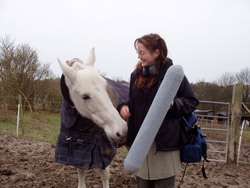
Straight from the horse's mouth: Leanne Proops and subject.

(PhysOrg.com) -- A new study into how horses recognise members of the same herd suggests that it's not just humans who use complex memory processes to identify each other.

University of Sussex mammal communication researchers studied the reaction of horses to the sight of one member of the same herd while they heard the call of either the same horse, or a different herd member.

They found that the horses showed a stronger reaction to the 'incongruent' calls that didn't match the herd member they had just seen compared with the congruent calls.

The results, published in Proceedings of the National Academy of Sciences of the United States of America on December 15, 2008, suggest that horses, like humans, use a 'cross modal' system for recognising each other - one that involves a combination of sensory cues such as auditory and visual/olfactory information.

Lead author, doctoral student Leanne Proops, whose thesis is on social cognition in horses, says: "Individual recognition within species is a complex process and is very poorly understood. We know that in humans it is cross-modal. For example, we recognise someone by how they look and how they sound. It now appears that horses, and perhaps other animals, also possess a cross-modal representation of known individuals."

The study, by Leanne Proops, her DPhil supervisor Dr Karen McComb and mammal communication researcher Dr David Reby, focussed on 24 horses at Woodingdean livery yard in Sussex and Sussex Horse Rescue Trust. Subjects watched a herd member being led past them before the individual went out of view and a call from that or a different associate was played from a loudspeaker positioned close to the point of disappearance. The researchers measured how long the test horse looked in the direction of the loudspeaker. They found that horses responded more quickly and looked for longer in the direction of the incongruent calls (which didn't match the horse they had seen) compared to the congruent calls, indicating that the mismatched combination violated their expectations.

Leanne Proops says: "Given that the stimulus horse was out of sight when the vocal cue was heard, it is likely that the test horse was accessing or activating some form of multimodal memory of that individual's characteristics."

Dr McComb, from the University's Centre for Mammal Vocal Communication Research in the Department of Psychology, says: "Our experimental design could provide a powerful way to study the cognitive abilities underlying individual recognition in a wide range of species."

More info: 'Cross modal individual recognition in domestic horses (Equus caballus)' by Leanne Proops, Karen McComb and David Reby, is published by Proceedings of the National Academy of Sciences of the United States of America, on 15 December, 2008

Provided by University of Sussex

4.4 /5 (5 votes)  

Filter


Move the slider to adjust rank threshold, so that you can hide some of the comments.


Display comments: newest first

COCO
Dec 17, 2008

Rank: 1 / 5 (1)
wow - what useful research - horses maybe the stupidest livestock in existence - if we could only ride pigs!
Velanarris
Dec 17, 2008

Rank: not rated yet
wow - what useful research - horses maybe the stupidest livestock in existence - if we could only ride pigs!
I'm starting to think that you're the dumbest livestock on the planet.

Rank 4.4 /5 (5 votes)
Relevant PhysicsForums posts

More news stories

A mitosis mystery solved: How chromosomes align perfectly in a dividing cell

Although the process of mitotic cell division has been studied intensely for more than 50 years, Whitehead Institute researchers have only now solved the mystery of how cells correctly align their chromosomes during symmetric ...

Biology / Cell & Microbiology

created 13 hours ago | popularity 4.4 / 5 (21) | comments 0 | with audio podcast

Researchers find extensive RNA editing in human transcriptome

In a new study published online in Nature Biotechnology, researchers from BGI, the world's largest genomics organization, reported the evidence of extensive RNA editing in a human cell line by analysis of RNA-seq data, demons ...

Biology / Biotechnology

created 13 hours ago | popularity 5 / 5 (4) | comments 0 | with audio podcast

The proteins ensuring genome protection

Researchers from the University of Geneva (UNIGE), Switzerland, have discovered the crucial role of two proteins in developing a cell 'anti-enzyme shield'. This protection system, which operates at the level of molecular ...

Biology / Cell & Microbiology

created 13 hours ago | popularity 5 / 5 (3) | comments 0 | with audio podcast

Entire genome of extinct human decoded from fossil

(PhysOrg.com) -- In 2010, Svante Pääbo and his colleagues presented a draft version of the genome from a small fragment of a human finger bone discovered in Denisova Cave in southern Siberia. The ...

Biology / Biotechnology

created Feb 07, 2012 | popularity 4.7 / 5 (60) | comments 51 | with audio podcast

Why are there so few fish in the Earth's oceans?

(PhysOrg.com) -- A Stony Brook University researcher has found that, contrary to popular belief, there are not plenty of fish in the sea.

Biology / Plants & Animals

created Feb 08, 2012 | popularity 4.3 / 5 (19) | comments 27 | with audio podcast


Scientists discover molecular secrets of 2,000-year-old Chinese herbal remedy

For roughly two thousand years, Chinese herbalists have treated Malaria using a root extract, commonly known as Chang Shan, from a type of hydrangea that grows in Tibet and Nepal. More recent studies suggest that halofuginone, ...

New method to examine batteries -- MRI from the inside

There is an ever-increasing need for advanced batteries for portable electronics, such as phones, cameras, and music players, but also to power electric vehicles and to facilitate the distribution and storage of energy derived ...

Google might launch Drive for cloud storage soon

(PhysOrg.com) -- Google's next big move, according to the Wall Street Journal, is a cloud storage service called Drive. Hardly first to the plate, Google is simply catching up to introducing its cloud reposi ...

Lab study raises questions over nano-particle impact

Tests involving chickens have raised questions about the impact on health from engineered nano-particles, the ultra-fine grains commonly used in drugs and processed foods, scientists said on Sunday.

Starve a virus, feed a cure? Findings show how some cells protect themselves against HIV

A protein that protects some of our immune cells from the most common and virulent form of HIV works by starving the virus of the molecular building blocks that it needs to replicate, according to research published online ...

Iran blocks email, restricts net access: reports

Iran has further restricted access to the Internet and blocked popular email services for the past few days, in a move a top lawmaker said could "cost the regime dearly," media reports said on Sunday.