Sun Often 'Tears Out A Wall' In Earth's Solar Storm Shield
December 16, 2008
Sun Often 'Tears Out A Wall' In Earth's Solar Storm Shield

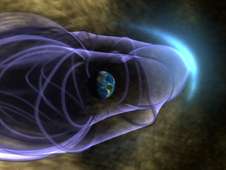
NASA's THEMIS mission has overturned a longstanding belief about the interaction between solar particles and Earth's magnetic field. Credit: NASA

(PhysOrg.com) -- Earth's magnetic field, which shields our planet from particles streaming outward from the Sun, often develops two holes that allow the largest leaks, according to researchers sponsored by NASA and the National Science Foundation.

"The discovery overturns a long-standing belief about how and when most of the solar particles penetrate Earth's magnetic field, and could be used to predict when solar storms will be severe. Based on these results, we expect more severe storms during the upcoming solar cycle," said Vassilis Angelopoulos of the University of California, Los Angeles, Principal Investigator for NASA's THEMIS mission (Time History of Events and Macroscale Interactions during Substorms). THEMIS was used to discover the size of the leak.

Earth's magnetic field acts as a shield against the bombardment of particles continuously streaming from the sun. Because the solar particles (ions and electrons) are electrically charged, they feel magnetic forces and most are deflected by our planet's magnetic field. However, our magnetic field is a leaky shield and the number of particles breaching this shield depends on the orientation of the sun's magnetic field. It had been thought that when the sun's magnetic field is aligned with that of the Earth, the door is shut and that few if any solar particles enter Earth's magnetic shield. The door was thought to open up when the solar magnetic field direction points opposite to Earth's field, leading to more solar particles inside the shield.

Surprisingly, recent observations by the THEMIS spacecraft fleet demonstrate that the opposite is true. "Twenty times more solar particles cross the Earth's leaky magnetic shield when the sun's magnetic field is aligned with that of the Earth compared to when the two magnetic fields are oppositely directed," said Marit Oieroset of the University of California, Berkeley, lead author of one of two papers on this research, published May 2008 in Geophysical Research Letters.

Researchers have long suspected that this "closed door" entry mechanism might exist, but didn't know how important it was. "It's as if people knew there was a crack in a levy, but they did not know how much flooding it caused," said Oieroset.

Previous spacecraft could only sample a small part of this enormous layer of solar particles inside the Earth's magnetic shield, but the five spacecraft in the THEMIS fleet spanned the entire rapidly-growing layer to give definitive measurements.

While the THEMIS researchers discovered the size of the leak, they didn't know its location(s). This was discovered by Wenhui Li of the University of New Hampshire, Durham, N.H., and his team. They used a computer simulation to discover where two holes frequently develop in Earth's magnetic field, one at high latitude over the Northern hemisphere, and one at high latitude over the Southern hemisphere. The holes form over the daylit side of Earth, on the side of the magnetic shield facing the sun.

The simulation also showed how the leaks develop. As solar particles flow out from the sun, they carry solar magnetic fields past our planet. Li's team realized that the solar magnetic field drapes against Earth's field as it passes by. Even though the two fields point in the same direction at equatorial latitudes, they point in opposite directions at high latitudes, When compression forces the opposite fields together, they link up with each other in a process called magnetic reconnection. This process tears the two holes in Earth's magnetic field and appends the section of the solar field between the two holes to Earth's field, carrying the solar particles on this section into the magnetosphere, according to Li's team. "We've found if the door is closed, the sun tears down a wall. The crack is huge – about four times wider than Earth and more then seven Earth diameters long," said Li, whose paper will be published in an upcoming article of the Journal of Geophysical Research.

Solar particles by themselves don't cause severe space weather, but they get energized when the solar magnetic field becomes oppositely-directed to Earth's and reconnects in a different way. The energized particles then cause magnetic storms that can overload power lines with excess current, causing widespread blackouts. The particles also can cause radiation storms that present hazards to spacecraft in high orbits and astronauts passing through the storms on the way to the moon or other destinations in the solar system.

"The more particles, the more severe the storm," said Joachim "Jimmy" Raeder of the University of New Hampshire, a co-author of Li's paper. "If the solar field has been aligned with the Earth's for a while, we now know Earth's field is heavily loaded with solar particles and primed for a strong storm. This discovery gives us a basic predictive capability for the severity of solar storms, similar to a hurricane forecaster's realization that warmer oceans set the stage for more intense hurricanes. In fact, we expect stronger storms in the upcoming solar cycle. The sun's magnetic field changes direction every cycle, and due to its new orientation in the upcoming cycle, we expect the clouds of particles ejected from the sun will have a field which is at first aligned with Earth, then becomes opposite as the cloud passes by."

Provided by NASA's Goddard Space Flight Center

4.5 /5 (21 votes)  

Filter


Move the slider to adjust rank threshold, so that you can hide some of the comments.


Display comments: newest first

Bob_B
Dec 16, 2008

Rank: 4 / 5 (3)
Nice image, it brings up a question I have.

Is it possible for the magnetic lines being pushed away by the solar storms to tear, or to break so that the loop is incomplete? If so is that a common thing for magnetic loops?
Arikin
Dec 16, 2008

Rank: 3 / 5 (2)
Does this explain the ozone layer holes at the poles? Yes the ozone layer is being depleted but this article shows that we are getting higher radiation readings at the poles for a reason.

Also, can these holes be prevented if we controlled the field? Recently, an article presented that an artificial shield could be used to shield space craft on long trips (like to Mars).
am_Unition
Dec 16, 2008

Rank: 4.3 / 5 (3)
Physorg - thank you for covering this article.

I first stumbled upon the Associated Press's version of this phenomenon, written by an author that had NO idea what they were talking about.
axemaster
Dec 17, 2008

Rank: 4.3 / 5 (3)
"Nice image, it brings up a question I have.

Is it possible for the magnetic lines being pushed away by the solar storms to tear, or to break so that the loop is incomplete? If so is that a common thing for magnetic loops?"

No, that's something that cannot happen. The loops are actually vector fields, not loops like string. They are closed and connected by definition.
earls
Dec 17, 2008

Rank: 5 / 5 (2)
"Covering" as in copy and pasting. While I appreciate the existence of physorg as a hub of scientific articles, they rarely compose their own.

Check out the link to the original press release that has some cool animations:

http://www.nasa.g...eld.html
TRoc
Jan 05, 2009

Rank: 5 / 5 (1)
Bob_B, axemaster:

"Is it possible for the magnetic lines being pushed away by the solar storms to tear, or to break so that the loop is incomplete? If so is that a common thing for magnetic loops?"

"No, that's something that cannot happen. The loops are actually vector fields, not loops like string. They are closed and connected by definition."

The question & answer should be worded to include the particles that are FOLLOWING the magnetic field lines. They can and do "break", and then "RE-connect" (by definition). That usually happens on the tail side, but can happen anywhere.

:)

Rank 4.5 /5 (21 votes)
Relevant PhysicsForums posts
  • Do some geologists actually act a lot like Randy Marsh?
    createdFeb 11, 2012
  • Discrepancy between oxygen and carbon-dioxide levels
    createdFeb 09, 2012
  • where gems are found in the world
    createdFeb 09, 2012
  • Wind Waves in Reservoir ~ Wind run-up and Wind set-up
    createdFeb 08, 2012
  • Balance of oxygen in the atmosphere
    createdFeb 01, 2012
  • The case for a methanol-based economy
    createdJan 30, 2012
  • More from Physics Forums - Earth

More news stories

Salvage workers begin pumping fuel from Italian shipwreck

Salvage workers Sunday began pumping fuel from the shipwrecked Italian cruise liner Costa Concordia, a day ahead of schedule, officials said.

Space & Earth / Environment

created 2 hours ago | popularity not rated yet | comments 0

Latin America mining boom clashes with conservation

Latin America is experiencing a mining boom as prices rise fuelled by a hike in global demand, but the region is also being hit by a wave of violent protests, strikes and rallies by environmentalists.

Space & Earth / Environment

created 10 hours ago | popularity 5 / 5 (1) | comments 1

Political leaders play key role in how worried Americans are by climate change: study

More than extreme weather events and the work of scientists, it is national political leaders who influence how much Americans worry about the threat of climate change, new research finds.

Space & Earth / Environment

created Feb 06, 2012 | popularity 5 / 5 (6) | comments 73

NASA budget will axe Mars deal with Europe: scientists

US President Barack Obama's budget proposal to be submitted next week for 2013 will cut NASA's budget by 20 percent and eliminate a major partnership with Europe on Mars exploration, scientists said Thursday.

Space & Earth / Space Exploration

created Feb 10, 2012 | popularity 5 / 5 (3) | comments 58

Humans may have helped the decline of African rainforests 3000 years ago

(PhysOrg.com) -- Large areas of rainforests in Central Africa mysteriously disappeared over three thousand years ago, to be replaced by savannas. The prevailing theory has been that the cause was a change ...

Space & Earth / Environment

created Feb 10, 2012 | popularity 4.1 / 5 (14) | comments 20 | with audio podcast report


Scientists discover molecular secrets of 2,000-year-old Chinese herbal remedy

For roughly two thousand years, Chinese herbalists have treated Malaria using a root extract, commonly known as Chang Shan, from a type of hydrangea that grows in Tibet and Nepal. More recent studies suggest that halofuginone, ...

New method to examine batteries -- MRI from the inside

There is an ever-increasing need for advanced batteries for portable electronics, such as phones, cameras, and music players, but also to power electric vehicles and to facilitate the distribution and storage of energy derived ...

Google might launch Drive for cloud storage soon

(PhysOrg.com) -- Google's next big move, according to the Wall Street Journal, is a cloud storage service called Drive. Hardly first to the plate, Google is simply catching up to introducing its cloud reposi ...

Lab study raises questions over nano-particle impact

Tests involving chickens have raised questions about the impact on health from engineered nano-particles, the ultra-fine grains commonly used in drugs and processed foods, scientists said on Sunday.

A mitosis mystery solved: How chromosomes align perfectly in a dividing cell

Although the process of mitotic cell division has been studied intensely for more than 50 years, Whitehead Institute researchers have only now solved the mystery of how cells correctly align their chromosomes during symmetric ...

Starve a virus, feed a cure? Findings show how some cells protect themselves against HIV

A protein that protects some of our immune cells from the most common and virulent form of HIV works by starving the virus of the molecular building blocks that it needs to replicate, according to research published online ...