Why did the London Millennium Bridge 'wobble'?
December 17, 2008 Why did the London Millennium Bridge 'wobble'?

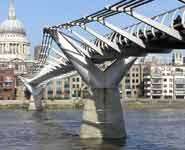
The London Millenium Bridge seen from the south bank of the Thames. Photo by Adrian Pingstone

(PhysOrg.com) -- On its opening day, the London Millennium Bridge experienced unexpected swaying due to the large number of people crossing it. A new study finally explains the Millennium Bridge 'wobble' by looking at how humans stay balanced while walking.

The same pedestrian-structure interaction has also been identified on several other bridges, including Bristol's famous Clifton Suspension Bridge. The phenomenon is not related to the structural form of the bridge, but rather the behaviour of the pedestrians. The paper by civil engineers at the University of Bristol, published in the Royal Society journal Proceedings of the Royal Society A, examines the basic way humans maintain balance.

Balance is achieved by changing the position of foot placement for each step, based only on the final displacement and speed of the centre of mass from the previous step.

The same balance strategy as for normal walking on a stationary surface was applied to walking on a laterally swaying bridge.

Without altering their pacing frequency, averaged over a large number of cycles, the pedestrian can effectively act as a negative damper to the bridge motion, which may be at different frequency. Hence the pedestrian can inadvertently feed energy into bridge oscillations.

Dr John Macdonald, Senior Lecturer in Civil Engineering, said: "It is clear that the motion of the bridge affects the force from the pedestrian, rather than the pedestrian simply applying an external force."

It has generally been thought the Millennium Bridge 'wobble' was due to pedestrians synchronizing their footsteps with the bridge motion. However, this is not supported by measurements of the phenomenon on other bridges.

The researchers found, to their surprise, that pedestrians walking randomly, keeping balance as normal can cause large bridge sway. This finally seems to explain the initiation of the Millennium Bridge 'wobble' and gives new insight for designing bridges to avoid vibration problems.

The paper: Lateral excitation of bridges by balancing pedestrians; John H. G. Macdonald, Proceedings of the Royal Society A, 17 December 2008. http://publishing.royalsociety.org/index.cfm?page=1568

Provided by University of Bristol


print this article email this article download pdf blog this article bookmark this article     Stumble it Digg this share on Facebook retweet share on Reddit add to delicious
Rate this story - 4.1 /5 (21 votes)


December 17, 2008 all stories

Comments: 0

4.1 /5 (21 votes)
  • Stumble this up

  • Digg this

  • share this

  • hide
  • Related Stories

  • Orangutans unique in movement through tree tops
    created Jul 27, 2009 | popularity not rated yet | comments 0
  • Unearthing clues of catastrophic earthquakes
    created Apr 16, 2008 | popularity not rated yet | comments 0
  • Truck-safe bamboo bridge opens in China
    created Dec 12, 2007 | popularity not rated yet | comments 0
  • Rapid Sea Level Rise in the Arctic Ocean May Alter Views of Human Migration
    created Oct 11, 2006 | popularity not rated yet | comments 0
  • Computer Visualization Puts Cars Back on Buffalo's Main Street
    created Aug 09, 2006 | popularity not rated yet | comments 0


  • hide
  • Relevant PhysicsForums posts

  • Pushing the piston.
    created 6 hours ago
  • Do Camcorders/ Video camera have Sensors in them?
    created 10 hours ago
  • Aspiring Engineering major looking for general answers
    created Nov 19, 2009
  • Calculating max load of square tube (steel)
    created Nov 19, 2009
  • More from Physics Forums - General Engineering

Other News

Newspaper circulation may be worse than it looks (AP)

Newspaper circulation may be worse than it looks

Technology / Internet

created 6 hours ago | popularity not rated yet | comments 0

(AP) -- While U.S. newspapers are losing subscribers at a staggering rate, a few dailies stand out because their circulation is rising. But they aren't necessarily selling more copies.


Canadian woman loses benefits over Facebook photo

Technology / Internet

created 7 hours ago | popularity 5 / 5 (1) | comments 0

(AP) -- A Canadian woman on long-term sick leave for depression says she lost her benefits because her insurance agent found photos of her on Facebook in which she appeared to be having fun.


China is the world's largest emitter of the greenhouse gases blamed for global warming

China harnesses mountain wind power

Technology / Energy

created 16 hours ago | popularity 4.1 / 5 (7) | comments 0

In the mountains above the southwestern Chinese town of Dali, dozens of new wind turbines dot the landscape -- a symbol of the country's sky-high ambitions for clean, green energy.


Analysts say AmEx is most interested in the so-called peer-to-peer services of Revolution

American Express takes aim at PayPal with Revolution

Technology / Internet

created 13 hours ago | popularity 4.5 / 5 (2) | comments 0

With its deal to buy Revolution Money, American Express is taking aim at the growing market for online and alternative payments, in a challenge to recognized leader PayPal, analysts say.


Hackers leak e-mails, stoke climate debate

Technology / Internet

created Nov 21, 2009 | popularity 4.4 / 5 (31) | comments 26

(AP) -- Computer hackers have broken into a server at a well-respected climate change research center in Britain and posted hundreds of private e-mails and documents online - stoking debate over whether some scientists have ...