Tiny magnetic crystals in bacteria are a compass, say researchers
December 17, 2008
Tiny magnetic crystals in bacteria are a compass, say researchers

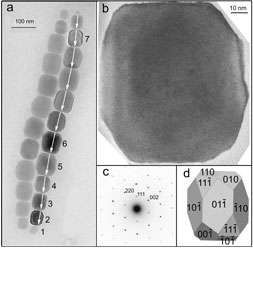
These tiny magnetic crystals (figures a, b,c and d) help the bacteria to navigate.

Scientists have shown that tiny crystals found inside bacteria provide a magnetic compass to help them navigate through sediment to find the best food, in research out today.

Researchers say their study, published in the Journal of the Royal Society Interface, could provide fresh clues to explain biomagnetism – a phenomenon in which some birds, insects and marine life navigate using the magnetic field that encompasses the Earth.

The study focuses on magnetotactic bacteria, which contain chains of magnetic crystals, called magnetosomes. They exist all over the globe, living in lake and pond sediments and in ocean coastal regions.

Since the discovery of magnetotactic bacteria in the 1970s, it has not been clear exactly what magnetosomes were for. Previous research suggested that some magnetosome chains would not be useful for navigation because their crystal sizes did not possess the right magnetic qualities.

However, researchers at Imperial College London and the University of Edinburgh have now shown that previous modelling methods were inaccurate. New calculations prove that all known magnetosomes do posses the right magnetic qualities needed to facilitate navigation. Study leader, Dr Adrian Muxworthy, from Imperial's Department of Earth Science and Engineering, explains:

"Magnetosomes align with one another to form a chain inside the bacteria and work like a magnetic compass. We are still not sure how, but this compass interacts with the Earth's magnetic field, helping the bacteria to navigate through sediment to the best feeding grounds."

Dr Muxworthy says the study is a nice example of evolution which demonstrates how a relatively simple organism can develop a highly optimised navigational capability. He says it may provide fresh insights into the evolutionary processes that have helped other animals and aquatic species to become skilled navigators.

Paper: Adrian R. Muxworthy, Wyn Williams, "Critical superparamagnetic/single-domain grain sizes in interacting magnetite particles: implications for magnetosome crystals", Royal Society Interface.

Source: Imperial College London

4.9 /5 (12 votes)  

Filter


Move the slider to adjust rank threshold, so that you can hide some of the comments.


Display comments: newest first

seanpu
Dec 17, 2008

Rank: 5 / 5 (3)
there's no reason that the bacteria can't use the same mechanism to sense the immediate environment for magnetic properties as well.
gwargh
Dec 17, 2008

Rank: not rated yet
there's no reason that the bacteria can't use the same mechanism to sense the immediate environment for magnetic properties as well.

Exactly what I was thinking. But navigation only seems like too small of a role. Some bacteria have 1000's of magnetosomes, i.e. way more than needed for just navigation.
Velanarris
Dec 17, 2008

Rank: 4 / 5 (1)
there's no reason that the bacteria can't use the same mechanism to sense the immediate environment for magnetic properties as well.

Exactly what I was thinking. But navigation only seems like too small of a role. Some bacteria have 1000's of magnetosomes, i.e. way more than needed for just navigation.
If having one is a benefit, and having more than one provides no additional benefit or hinderance, then through mutation you'd end up with some varieties having several thousand by virtue of a lack of natural selection bias.
tkjtkj
Dec 17, 2008

Rank: 5 / 5 (1)
Its a pity that this article didnt
show just how they 'proved' that the
organisms use this structure for
"navigation" .. Lacking that essential
feature, the article is worthless
'vapor-science'.
M_N
Dec 17, 2008

Rank: not rated yet
One idea I heard was that these bacteria mainly use the magnetic crystals to sense up and down (rather than north-south orientation). For much of the Earth's surface, the magnetic field has a significant vertical component. At the scale of these bacteria, magnetic effects are quite significant compared to gravity.
zevkirsh
Dec 18, 2008

Rank: not rated yet
maybe they use them for refrigeration.
gwargh
Dec 19, 2008

Rank: not rated yet
there's no reason that the bacteria can't use the same mechanism to sense the immediate environment for magnetic properties as well.

Exactly what I was thinking. But navigation only seems like too small of a role. Some bacteria have 1000's of magnetosomes, i.e. way more than needed for just navigation.
If having one is a benefit, and having more than one provides no additional benefit or hinderance, then through mutation you'd end up with some varieties having several thousand by virtue of a lack of natural selection bias.

Kind of, except that from what I've read some of these structures don't even seem useful for navigation (i.e they are all bunched against one end of the cell, or the chain is so twisted it doesn't really show direction anymore). What I'm wondering is having magnetic crystals could help in metabolism in any way.
Rank 4.9 /5 (12 votes)
Relevant PhysicsForums posts

More news stories

Big Society could threaten biodiversity conservation

A study of the Moray Firth Seal Management Plan (MFSMP), in north-east Scotland, identified four key conditions for long-term success, three of which pointed to the importance of direct government involvement.

Biology / Ecology

created 1 hour ago | popularity not rated yet | comments 0

New molecule has potential to help treat genetic diseases and HIV

(PhysOrg.com) -- Chemists at The University of Texas at Austin have created a molecule that's so good at tangling itself inside the double helix of a DNA sequence that it can stay there for up to 16 days before ...

Biology / Plants & Animals

created 3 hours ago | popularity 5 / 5 (2) | comments 0 | with audio podcast

Biobased approaches examined in fight against zebra chip

Thanks to investigations by scientists-turned-detectives with the U.S. Department of Agriculture (USDA) and other agencies, potato growers in the western United States and abroad now know the identities of ...

Biology / Ecology

created 1 hour ago | popularity not rated yet | comments 0

Integrated pest management recommendations for the southern pine beetle

The southern pine beetle, Dendroctonus frontalis Zimmermann, is a chronic insect pest within pine forests in the southeastern United States. Under favorable environmental and host conditions, it is an agg ...

Biology / Ecology

created 6 hours ago | popularity not rated yet | comments 0

A mitosis mystery solved: How chromosomes align perfectly in a dividing cell

Although the process of mitotic cell division has been studied intensely for more than 50 years, Whitehead Institute researchers have only now solved the mystery of how cells correctly align their chromosomes during symmetric ...

Biology / Cell & Microbiology

created 21 hours ago | popularity 4.5 / 5 (24) | comments 0 | with audio podcast


Fast photon control brings quantum photonic technologies closer

(PhysOrg.com) -- Using photons instead of electrons to transmit information could lead to faster and more secure ways to communicate, among other advantages. Now a team of physicists has taken another step toward realizing ...

Planck mission steps closer to the cosmic blueprint

(PhysOrg.com) -- ESA's Planck mission has revealed that our Galaxy contains previously undiscovered islands of cold gas and a mysterious haze of microwaves. These results give scientists new treasure to mine ...

New ability to regrow blood vessels holds promise for treatment of heart disease

(Medical Xpress) -- University of Texas at Austin researchers have demonstrated a new and more effective method for regrowing blood vessels in the heart and limbs — a research advancement that could have ...

Slowing ocean current caused Earth to spin faster

(PhysOrg.com) -- Most people probably didn’t notice it, but back in 2009, the Earth spun around on its axis a tiny bit faster than usual, making for some slightly shorter days. It only happened for a ...

Myths and shame keep many from seeking bankruptcy protection

(PhysOrg.com) -- Two interesting facts that may counter modern ideas about bankruptcy: The overwhelming majority of U.S. filings belong to individuals rather than corporations or entities, and most of these ...

Motivation to exercise affects behavior

(Medical Xpress) -- For many people, the motivation to exercise fluctuates from week to week, and these fluctuations predict whether they will be physically active, according to researchers at Penn State. In an effort to ...