Researchers find nature's shut-off switch for cellulose production
December 17, 2008
Nick Carpita, Purdue University

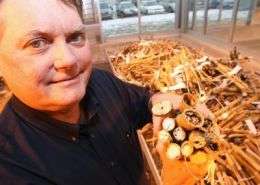
Purdue researcher Nick Carpita said plants may be able to produce more biofuel mass if the means of shutting down cellulose production is disrupted. His research team learned that small RNAs are key in determining the duration of cellulose production. Purdue Agricultural Communication photo/Tom Campbell

Purdue University researchers found a mechanism that naturally shuts down cellulose production in plants, and learning how to keep that switch turned on may be key to enhancing biomass production for plant-based biofuels.

Nicholas Carpita, a professor of botany and plant pathology, said that small-interfering RNAs (siRNAs) play a normal role in plant development by shutting off genes involved in primary cell wall growth in order to begin development of thicker, secondary cell walls.

"These small RNAs were known to play a role in fending off disease-causing pathogens, but we are only now beginning to understand their involvement in normal plant development," he said.

Carpita's research team reported its findings in Monday's (Dec. 15) early online issue of the Proceedings of the National Academy of Sciences.

"If we can learn to interfere with the down-regulation of cellulose synthesis, then plants may be able to produce more cellulose, which is key to biofuels production," Carpita said.

Mick Held, a postdoctoral researcher in Carpita's lab, virologist Steve Scofield, a U.S. Department of Agriculture research scientist and adjunct assistant professor of agronomy at Purdue, and Carpita made the discovery in barley after introducing a virus as a way to "silence" specific genes and study their functions. The researchers noticed that the virus had more effect then anticipated.

"The virus hijacked a whole suite of genes, and when we compared the targeted plant to our control plants we found that the small RNAs were responsible and already in the controls even without adding the virus," Held said.

Carpita said this let researchers see that the siRNAs - among other things - regulate and shut down primary cell wall development to begin secondary wall growth.

"These secondary stages result in characteristics such as tough rinds of corn stalks, vascular elements to conduct water and fibers for strength," he said.

The researchers said that delaying or preventing the shutdown of both primary and secondary cellulose production might enhance total plant biomass.

"Most biofuel researchers believe that cellulose utilization offers the best path to sustainable ethanol production," Scofield said. "Our work uncovered a previously unknown mechanism that suggests a way to increase the amount of cellulose produced in plants."

The research paper is available at http://www.pnas.or … s.0809408105 .

Provided by Purdue University

4.5 /5 (4 votes)  

Rank 4.5 /5 (4 votes)
Related Stories
Relevant PhysicsForums posts

More news stories

Entire genome of extinct human decoded from fossil

(PhysOrg.com) -- In 2010, Svante Pääbo and his colleagues presented a draft version of the genome from a small fragment of a human finger bone discovered in Denisova Cave in southern Siberia. The ...

Biology / Biotechnology

created Feb 07, 2012 | popularity 4.7 / 5 (58) | comments 45 | with audio podcast

Why are there so few fish in the Earth's oceans?

(PhysOrg.com) -- A Stony Brook University researcher has found that, contrary to popular belief, there are not plenty of fish in the sea.

Biology / Plants & Animals

created Feb 08, 2012 | popularity 4.3 / 5 (17) | comments 26 | with audio podcast

Miami battling invasion of giant African snails

No one knows how they got there. But an invasion of African giant snails has southern Florida in a panic over potential crop damage, disease and general yuckiness surrounding the slimy gastropods.

Biology / Ecology

created Feb 10, 2012 | popularity 4.5 / 5 (2) | comments 5

Deciding to go left or right: Researchers use device to determine that lower animals can navigate too

For decades, scientists have associated binary decision making — opting to go left or right — with higher-ranking animals, including humans. A team of Harvard researchers, however, is rewriting that ...

Biology / Plants & Animals

created Feb 09, 2012 | popularity 4 / 5 (1) | comments 4 | with audio podcast

Study shows chimps able to understand needs of others

(PhysOrg.com) -- By setting up a unique experiment, a small team of researchers has found that chimpanzees are able to understand need in other chimps, despite their general disinclination to offer aid when ...

Biology / Plants & Animals

created Feb 07, 2012 | popularity 5 / 5 (2) | comments 4 | with audio podcast report


Google might launch Drive for cloud storage soon

(PhysOrg.com) -- Google's next big move, according to the Wall Street Journal, is a cloud storage service called Drive. Hardly first to the plate, Google is simply catching up to introducing its cloud reposi ...

Latin America mining boom clashes with conservation

Latin America is experiencing a mining boom as prices rise fuelled by a hike in global demand, but the region is also being hit by a wave of violent protests, strikes and rallies by environmentalists.

Love a click away in Indonesia's Twitter Republic

He was a geeky kid from Yogyakarta, she a glamorous city girl in Jakarta. In a country with one of the world's most vibrant social networking scenes they fell in love on Twitter.

Walney offshore wind farm is world's biggest (for now)

(PhysOrg.com) -- The Walney wind farm on the Irish Sea--characterized by high tides, waves and windy weather--officially opened this week. The farm is treated in the press as a very big deal as the Walney ...

GPS court ruling leaves US phone tracking unclear

A US Supreme Court decision requiring a warrant to place a GPS device on the car of a criminal suspect leaves unresolved the bigger issue of police tracking using mobile phones, legal experts say.

Europeans protest controversial Internet pact

Tens of thousands of people marched in protests in more than a dozen European cities Saturday against a controversial anti-online piracy pact that critics say could curtail Internet freedom.