Technique provides snapshot of all genes in human genome
December 17, 2008 By Krishna Ramanujan Technique provides snapshot of all genes in human genome

Enlarge

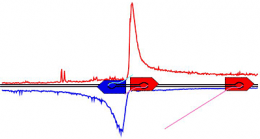
This graphic shows polymerases on one strand of DNA (red) pausing during the transcription process, but some polymerases start moving again, travel through and transcribe the gene. Polymerases on the opposite strand (blue) travel in the opposite direction and also pause but do not travel significantly farther. Image: Lis Lab

(PhysOrg.com) -- Like Silly Putty lifting an imprint of the Sunday comics off a newspaper, complex enzymes called RNA polymerases lift information off DNA strands. The polymerases then transcribe those genetic instructions onto RNA for making proteins that cells use for basic functions.

In the Dec. 19 issue of Science, Cornell researchers report on a new technique that takes a snapshot of all the locations on the human genome where RNA polymerases actively transcribe genes. The method provides a new and highly sensitive way to pinpoint all the active and silent genes in the human genome.

The researchers also report on a new mechanism: Scientists always thought that RNA polymerases read DNA in one direction, by starting at a bit of DNA at the front of a gene -- the so-called promoter -- and moving to the end of the gene. But the new polymerase maps reveal that polymerases also appear on the other side of the promoter and run in the opposite direction.

"We always thought that polymerases followed one direction, but now we have polymerases going both ways," said John Lis, the paper's senior author and the Barbara McClintock Professor of Molecular Biology and Genetics at Cornell.

The polymerases going forward follow through to the end of the gene and transcribe the information for making proteins, but for reasons yet unknown, polymerases going in the opposite direction travel only a short distance and then stop. Researchers hypothesize that these opposite-facing polymerases could be holding open a segment of DNA for transcription.

The researchers also observed that the transcription process pauses because polymerases accumulate near the promoter before moving to the end of the gene. The pause may have a structural function, the researchers suggest, to hold open the site for other polymerases to enter. The pause seems to occur at genes that respond to signals (called regulated genes) and could allow time to prepare the gene for a rapid and coordinated response to a signal. Or, a pause may be necessary to make sure that all the necessary components are in place for proper transcription.

"A pause can likely be serving a different role at different genes," said Josh Waterfall, a postdoctoral researcher in Lis' lab and a co-author of the paper. "It's only in the last few years that experiments suggest these pauses are a common pattern on a lot of genes." The new study confirms that the high frequency of locations where polymerases build up, as seen in other studies, are sites where transcription pauses.

Leighton Core, a graduate student in Lis' lab and the paper's lead author, developed the new mapping technique by modifying an older technique. "The assay is actually around 30 years old, but it traditionally only measured the polymerases locations at small discrete units," he said. "But we were able to adapt the assay to measure actively engaged polymerases across the human genome."

This paper is one of four simultaneous papers appearing in Science that discuss these divergent polymerases for the first time. The papers have been online at Science Express since Dec. 4.

Provided by Cornell University


print this article email this article download pdf blog this article bookmark this article     Stumble it Digg this share on Facebook retweet share on Reddit add to delicious
Rate this story - 4.8 /5 (6 votes)


December 17, 2008 all stories

Comments: 0

4.8 /5 (6 votes)
  • Stumble this up

  • Digg this

  • share this

  • hide
  • Related Stories

  • Reversing the conventional DNA wisdom
    created Dec 04, 2008 | popularity not rated yet | comments 0
  • Study Shows How Antibiotic Sets Up Road Block To Kill Bacteria
    created Oct 23, 2008 | popularity not rated yet | comments 0
  • Study shows how antibiotic sets up road block to kill bacteria
    created Oct 22, 2008 | popularity not rated yet | comments 0
  • Small helpers in the genome coordinate defence strategies in plants
    created Mar 20, 2008 | popularity not rated yet | comments 0
  • Hepatitis C helicase unwinds DNA in a spring-loaded, 3-step process
    created Jul 26, 2007 | popularity not rated yet | comments 0


Other News

Golden Oldie: Key Role for Ancient Protein in Algae Photosynthesis

Golden Oldie: Key Role for Ancient Protein in Algae Photosynthesis

Biology / Biotechnology

created 4 hours ago | popularity not rated yet | comments 1

The discovery that an ancient light harvesting protein plays a pivotal role in the photosynthesis of green algae should help the effort to develop algae as a biofuels feedstock. Researchers with the Lawrence ...


Hammerhead shark

Wide heads give hammerheads exceptional stereo view

Biology / Plants & Animals

created 12 hours ago | popularity 4.4 / 5 (5) | comments 4

Hammerhead sharks are some of the Ocean's most distinctive residents. 'Everyone wants to understand why they have this strange head shape,' says Michelle McComb from Florida Atlantic University. One possible ...


Indonesia rejects Bali plan for turtle sacrifices (AP)

Indonesia rejects Bali plan for turtle sacrifices

Biology / Ecology

created 10 hours ago | popularity not rated yet | comments 0

(AP) -- Indonesia has rejected a push by the resort island of Bali for rare turtles to be legally slain in Hindu ceremonies, siding with conservationists of the protected reptiles against religious advocates, ...


Tough yet stiff deer antler is materials scientist's dream

Biology / Plants & Animals

created 12 hours ago | popularity not rated yet | comments 2

Prized for their impressive antlers, red deer have been caught in the hunters' sights for generations. But a deer's antlers are much more than decorative. They are lethal weapons that stags crash together when duelling. John ...


Ecologists sound out new solution for monitoring cryptic species

Biology / Ecology

created 12 hours ago | popularity not rated yet | comments 0

Ecologists have at last worked out a way of using recordings of birdsong to accurately measure the size of bird populations. This is the first time sound recordings from a microphone array have been translated into accurate ...