Research links osteoporosis and 'bloodless' icefish
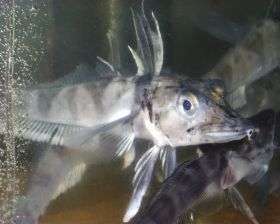
December 17th, 2008 Photo of the icefish Chionodraco hamatus by H. William Detrich.

Enlarge

Photo of the icefish Chionodraco hamatus by H. William Detrich.

(PhysOrg.com) -- Biologists face the major challenge of understanding genetic and environmental risk factors underlying human diseases. Surprisingly, animal species in the wild have sometimes acquired the characteristics of a human disease through evolution.

Yet, the 'disease' trait is precisely what allows them to flourish in their natural environment. Trends in Genetics features a new study co-authored by Dr. William Detrich, professor of biochemistry and marine biology in the Department of Biology at Northeastern University, which argues that these “evolutionary mutant models” are likely to hold important clues for understanding, and eventually treating, human diseases.

Detrich and Trends in Genetics co-authors R. Craig Albertson of Syracuse University, John Postlethwait of the University of Oregon, and Pam Yelick of Tufts University have just received a joint $2.48 million, five-year award from the National Institutes of Health (NIH) to study mineralization of the icefish skeleton as a model for osteopenia (low bone density) and osteoporosis (the disease that results from osteopenia). Theirs is a fresh approach to learning how the regulation of bone calcification can lead to osteoporosis in the elderly.

“There is a growing recognition among biologists that organisms that live in novel environments have evolved certain characteristics that work well for them but would cause disease in humans,” said Detrich. “There is a lot that evolution and adaptation can tell us about the human condition. Oddball creatures, such as cavefish that lack eyes, giraffes with high blood pressure, and Antarctic fishes, provide powerful research systems that complement the more traditional models of human disease, like the mouse.”

Through the replacement of bone by connective tissue and decreased mineralization of the skeleton as a whole, many Antarctic fish species have evolved reduced bone density. This adaptation increases their buoyancy in water, a characteristic that enables them to move easily in the water column for feeding. This adaptive trait clearly mimics the detrimental human condition osteopenia, a reduction in bone mineral density that affects 34 million American women and 12 million American men.

Osteopenia can lead to osteoporosis, a disease characterized by low bone mass, bone deterioration and fragility, and increased susceptibility to and slow healing of fractured bones. The authors propose that the type and mode of action of adaptive mutations favored by natural selection in wild populations—such as low bone density for increased buoyancy in Antarctic fishes—are similar to those that contribute to human diseases like osteoporosis. Studies in evolutionary mutant models have the potential to identify presently unknown genes and gene/environment interactions that affect human health and underlie human disease.

A subset of Antarctic fishes, the icefishes, too, have acquired the characteristics of human disease. Icefishes do not make hemoglobin, the oxygen-transporting protein of all other vertebrates, or produce red blood cells: they are profoundly anemic. Nevertheless, icefishes survive and thrive in oxygen-rich cold waters surrounding Antarctica. In humans, anemia (reduced numbers of circulating red blood cells) is deleterious because it greatly reduces delivery of oxygen to the body tissues. Patients undergoing kidney dialysis or chemotherapy often suffer from anemia.

Work from Detrich’s laboratory on the icefishes has already revealed novel genes involved in red cell formation that might be developed as new targets for anemia treatments, providing further support for the potential large role that studies of evolutionary mutant models can play in improving human health.

Provided by Northeastern University


print this article email this article download pdf blog this article bookmark this article     Digg this Stumble it share on Facebook share on Reddit add to delicious save to Yahoo! bookmarks
2/5 after 2 votes


December 17th, 2008 all stories
Biology /

Comments: 0
Rank: 2/5 after 2 votes

  • Stumble this up

  • Digg this

  • Share it:
  • share on Facebook
  • share on MySpace
  • share on Slashdot
  • rss-newsfeed
  • share on Google
  • share on Reddit
  • add to delicious
  • save to Yahoo! bookmarks
  • share on Windows Live
  • Add to Mixx!
Rating: 2/5 after 2 votes

  • Related Stories

  • Blood stem cell growth factor reverses memory decline in mice
    created Jul 01, 2009 | popularity not rated yet | comments 0
  • Human cardiac master stem cells identified
    created Jul 01, 2009 | popularity not rated yet | comments 0
  • New trigger for chronic inflammation in rheumatoid arthritis discovered
    created Jun 28, 2009 | popularity not rated yet | comments 0
  • Scientists discover new source for harvesting stem cells
    created Jun 23, 2009 | popularity not rated yet | comments 0
  • Key found to how tumor cells invade the brain in childhood cancer
    created Jun 17, 2009 | popularity not rated yet | comments 0

Tags

human, bone

  • Physicists Demonstrate Quantum Memory with Matter Qubits
    Physicists Demonstrate Quantum Memory with Matter Qubits
    Physics / General Physics
    created Jul 03, 2009 | popularity 4.4 / 5 (17) | comments 1
  • 'Holey' Nanosheets for Wastewater Dye Removal
    Nanotechnology / Nanomaterials
    created Jul 01, 2009 | popularity 5 / 5 (5) | comments 1
  • Jellyfish Robot Swims Like its Biological Counterpart
    Jellyfish Robot Swims Like its Biological Counterpart
    Electronics / Robotics
    created Jun 26, 2009 | popularity 4.4 / 5 (8) | comments 1
  • Could Maxwell's Demon Exist in Nanoscale Systems?
    Could Maxwell's Demon Exist in Nanoscale Systems?
    Physics / General Physics
    created Jun 24, 2009 | popularity 4.4 / 5 (18) | comments 29
  • Living Safely with Robots, Beyond Asimov's Laws
    Living Safely with Robots, Beyond Asimov's Laws
    Electronics / Robotics
    created Jun 22, 2009 | popularity 4.6 / 5 (52) | comments 40
  • Other News

    California water plan aims to save Puget Sound orcas

    Biology / Ecology

    created 1hour ago | popularity not rated yet | comments 0

    A plan to restore salmon runs on California's Sacramento River also could help revive killer whale populations 700 miles to the north in Puget Sound, as federal scientists struggle to protect endangered species in a complex ...


    Scientists 'rebuild' giant moa using ancient DNA

    Biology / Plants & Animals

    created Jul 01, 2009 | popularity 5 / 5 (10) | comments 12

    (PhysOrg.com) -- Scientists have performed the first DNA-based reconstruction of the giant extinct moa bird, using prehistoric feathers recovered from caves and rock shelters in New Zealand.


    Pacific Giant Salamander (Dicamptodon tenebrosus)

    Salamanders, regenerative wonders, heal like mammals, people

    Biology / Microbiology

    created Jul 01, 2009 | popularity 4.9 / 5 (19) | comments 10

    The salamander is a superhero of regeneration, able to replace lost limbs, damaged lungs, sliced spinal cord -- even bits of lopped-off brain. But it turns out that remarkable ability isn't so mysterious after ...


    Genetically modified trees

    Anti-biotech groups obstruct forest biotechnology

    Biology / Biotechnology

    created Jun 30, 2009 | popularity 3.7 / 5 (7) | comments 5

    The potential of forest biotechnology to help address significant social and environmental issues is being "strangled at birth" by the rigid opposition of some groups and regulations that effectively preclude ...


    Super-sleepers could help super-sizers!

    Super-sleepers could help super-sizers!

    Biology / Plants & Animals

    created Jun 29, 2009 | popularity 5 / 5 (2) | comments 4

    Burrowing frogs can survive buried for several years without food or water. Scientists have discovered that the metabolism of their cells changes radically during the dormancy period allowing the frogs to ...