Most Distant Water in the Universe Found
December 17, 2008 Most Distant Water in the Universe Found

Enlarge

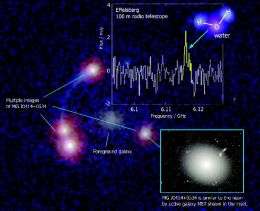
The spectrum -- a radio "fingerprint" that revealed radio emission from water masers in the distant quasar MG J0414+0534. The background image is an infrared image of the quasar, made with the Hubble Space Telescope. The quasar appears broken up into four components by a foreground galaxy (diffuse object in the center), acting as a gravitational lens and strengthening the signal by a factor of 35. The inset with the galaxy M87 shows how the quasar might be seen from nearby. Image: Milde Science Communication, STScI, CFHT, J.-C. Cuillandre, Coelum.

(PhysOrg.com) -- Astronomers have found the most distant water yet seen in the Universe, in a galaxy more than 11 billion light-years from Earth. Previously, the most distant water had been seen in a galaxy less than 7 billion light-years from Earth.

Using the giant, 100-meter-diameter radio telescope in Effelsberg, Germany, and the National Science Foundation's Very Large Array (VLA) in New Mexico, the scientists detected a telltale radio "fingerprint" of water molecules in the distant galaxy.

The soggy galaxy, dubbed MG J0414+0534, harbors a quasar -- a supermassive black hole powering bright emission -- at its core. In the region near the core, the water molecules are acting as masers, the radio equivalent of lasers, to amplify radio waves at a specific frequency.

The astronomers say their discovery indicates that such giant water masers were more common in the early Universe than they are today. MG J0414+0534 is seen as it was when the Universe was roughly one-sixth of its current age.

At the galaxy's great distance, even the strengthening of the radio waves done by the masers would not by itself have made them strong enough to detect with the radio telescopes. However, the scientists got help from nature in the form of another galaxy, nearly 8 billion light-years away, located directly in the line of sight from MG J0414+0534 to Earth. That foreground galaxy's gravity served as a lens to further brighten the more-distant galaxy and make the emission from the water molecules visible to the radio telescopes.

"We were only able to discover this distant water with the help of the gravitational lens," said Violette Impellizzeri, an astronomer with the Max-Planck Institute for Radioastronomy (MPIfR) in Bonn, Germany. "This cosmic telescope reduced the amount of time needed to detect the water by a factor of about 1,000," she added.

The astronomers first detected the water signal with the Effelsberg telescope. They then turned to the VLA's sharper imaging capability to confirm that it was indeed coming from the distant galaxy. The gravitational lens produces not one, but four images of MG J0414+0534 as seen from Earth. Using the VLA, the scientists found the specific frequency attributable to the water masers in the two brightest of the four lensed images. The other two lensed images, they said, are too faint for detecting the water signal.

The radio frequency emitted by the water molecules was Doppler shifted by the expansion of the Universe from 22.2 GHz to 6.1 GHz.

Water masers have been found in numerous galaxies at closer distances. Typically, they are thought to arise in disks of molecules closely orbiting a supermassive black hole at the galaxy's core. The amplified radio emission is more often observed when the orbiting disk is seen nearly edge-on. However, the astronomers said MG J0414+0534 is oriented with the disk almost face-on as seen from Earth.

"This may mean that the water molecules in the masers we're seeing are not in the disk, but in the superfast jets of material being ejected by the gravitational power of the black hole," explained John McKean, also of MPIfR.

Impellizzeri and McKean worked with Alan Roy, Christian Henkel, and Andreas Brunthaler, also of the Max-Planck Institute; Paola Castangia of the Max-Planck Institute and the INAF Astronomical Observatory of Cagliari in Italy; and Olaf Wucknitz of the Argelander Institute for Astronomy in Bonn, Germany. The scientists reported their results in the December 18 issue of the scientific journal Nature.

Provided by National Radio Astronomy Observatory


print this article email this article download pdf blog this article bookmark this article     Stumble it Digg this share on Facebook retweet share on Reddit add to delicious
Rate this story - 4.8 /5 (25 votes)

Rank Filter

Move the slider to adjust rank threshold, so that you can hide some of the comments.


Display comments: newest first

  • brant - Dec 17, 2008
    • Rank: 3.5 / 5 (2)
    OH is not water....
  • Thecis - Dec 18, 2008
    • Rank: 5 / 5 (1)
    I agree that it could be something else. Although water consists of two OH-bonds and it is the general way to identify water (even here on earth) the possibility exists that it could be something else. That would show also in the spectrum recorded though, but still the possibility exist.

    What worries me more is the height of the peak in the spectrum. If I approach it the statistical way, the height needs to be approx. 4 times the noise in order to be significant. So, can this signal be trusted?
  • jeffsaunders - Jun 08, 2009
    • Rank: not rated yet
    The astronomers say their discovery indicates that such giant water masers were more common in the early Universe than they are today. MG J0414 0534 is seen as it was when the Universe was roughly one-sixth of its current age.
    Not a bad guess since this is the furthest galaxy that they have found with water molecules. I love the way we can infer such things from a sample of one. It makes all crackpot theories about everything much more likely.

December 17, 2008 all stories

Comments: 3

4.8 /5 (25 votes)
  • Stumble this up

  • Digg this

  • share this

  • hide
  • Related Stories

  • ET: Check your voicemail
    created 20 hours ago | popularity not rated yet | comments 0
  • Radio telescopes extend astronomy's best 'yardstick'
    created Jun 08, 2009 | popularity not rated yet | comments 0
  • Scientists document fate of huge oil slicks from seeps at coal oil point
    created May 13, 2009 | popularity not rated yet | comments 0
  • Most distant detection of water in the Universe
    created Apr 22, 2009 | popularity not rated yet | comments 0
  • Researcher discover two highly complex organic molecules detected in space
    created Apr 21, 2009 | popularity not rated yet | comments 0


  • hide
  • Relevant PhysicsForums posts

  • Question about 2-body gravity
    created Nov 24, 2009
  • life on Mars
    created Nov 24, 2009
  • Semi-major axis from cartesian co-ordinates
    created Nov 23, 2009
  • Primary Mirror grinding
    created Nov 23, 2009
  • More from Physics Forums - General Astronomy

Other News

Cosmic 'dig' reveals vestiges of the Milky Way's building blocks

Cosmic 'Dig' Reveals Vestiges of the Milky Way's Building Blocks

Space & Earth / Astronomy

created 31 minutes ago | popularity 5 / 5 (1) | comments 0

(PhysOrg.com) -- Peering through the thick dust clouds of our galaxy's "bulge" (the myriads of stars surrounding its center), a team of astronomers has unveiled an unusual mix of stars in the stellar grouping ...


Cutting greenhouse pollutants could directly save millions of lives worldwide

Space & Earth / Environment

created 2 hours ago | popularity 1 / 5 (2) | comments 1

Tackling climate change by reducing carbon dioxide and other greenhouse emissions will have major direct health benefits in addition to reducing the risk of climate change, especially in low-income countries, according to ...


Small faults in Southeast Spain reduce earthquake risk of larger ones

Small faults in Southeast Spain reduce earthquake risk of larger ones

Space & Earth / Earth Sciences

created 3 hours ago | popularity not rated yet | comments 0

A team of Spanish scientists, studying recent, active deformations in the Baetic mountain range, have shown that the activity of smaller tectonic structures close to larger faults in the south east of the ...


Mars Reconnaissance Orbite

Mars Reconnaissance Orbite Team Plans Uplink of Protective Files

Space & Earth / Space Exploration

created 5 hours ago | popularity 5 / 5 (1) | comments 0

(PhysOrg.com) -- The team operating NASA's Mars Reconnaissance Orbiter plans to uplink protective files to the spacecraft next week as one step toward resuming the orbiter's research and relay activities.


It's not just dirt!

Space & Earth / Environment

created 2 hours ago | popularity 5 / 5 (1) | comments 0

Soil is the linchpin of the environment, where atmosphere, biosphere, and hydrosphere meet. Despite that, many students see soil as "just dirt" - a place to grow plants, but nothing more. Soil science educators are challenged ...