Cognitive computing: Building a machine that can learn from experience
December 17, 2008 Cognitive computing: Building a machine that can learn from experience

Enlarge

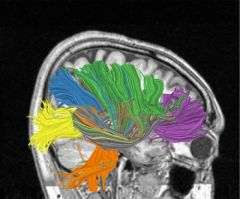
Scientists are studying complex wiring of the brain to build the computer of the future, one that combines the brain’s abilities for sensation, perception, action, interaction and cognition and its low power consumption and compact size. Understanding the process behind these seemingly effortless feats of the human brain and creating a computational theory based on it remains one of the biggest challenges for computer scientists. Illustration by: D. Modha, IBM

(PhysOrg.com) -- Suppose you want to build a computer that operates like the brain of a mammal. How hard could it be? After all, there are supercomputers that can decode the human genome, play chess and calculate prime numbers out to 13 million digits.

But University of Wisconsin-Madison research psychiatrist Giulio Tononi, who was recently selected to take part in the creation of a "cognitive computer," says the goal of building a computer as quick and flexible as a small mammalian brain is more daunting than it sounds.

Tononi, professor of psychiatry at the UW-Madison School of Medicine and Public Health and an internationally known expert on consciousness, is part of a team of collaborators from top institutions who have been awarded a $4.9 million grant from the Defense Advanced Research Projects Agency (DARPA) for the first phase of DARPA's Systems of Neuromorphic Adaptive Plastic Scalable Electronics (SyNAPSE) project.

Tononi and scientists from Columbia University and IBM will work on the "software" for the thinking computer, while nanotechnology and supercomputing experts from Cornell, Stanford and the University of California-Merced will create the "hardware." Dharmendra Modha of IBM is the principal investigator.

The idea is to create a computer capable of sorting through multiple streams of changing data, to look for patterns and make logical decisions.

There's another requirement: The finished cognitive computer should be as small as a the brain of a small mammal and use as little power as a 100-watt light bulb. It's a major challenge. But it's what our brains do every day.

"Our brains can do it, so we have proof that it is possible," says Tononi. "What our brains are good at is being flexible, learning from experience and adapting to different situations."

While the project will take its inspiration from the brain's architecture and function, Tononi says it isn't possible or even desirable to recreate the entire structure of the brain down to the level of the individual synapse.

"A lot of the work will be to determine what kinds of neurons are crucial and which ones we can do without," he says.

It all comes down to an understanding of what is necessary for teaching an artificial brain to reason and learn from experience.

"Value systems or reward systems are important aspects," he said. "Learning is crucial because it needs to learn from experience just like we do."

So a system modeled after the neurons that release neuromodulators could be important. For example, neurons in the brain stem flood the brain with a neurotransmitter during times of sudden stress, signaling the "fight-or flight" response.

"Every neuron in the brain knows that something has changed," Tononi explains. "It tells the brain, 'I got burned, and if you want to change, this is the time to do it.'"

Thus, a cat landing on a hot stovetop not only jumps off immediately, it learns not to do that again.

Tononi says the ideal artificial brain will need to be plastic, meaning it is capable of changing as it learns from experience. The design will likely convey information using electrical impulses modeled on the spiking neurons found in mammal brains. And advances in nanotechnology should allow a small artificial brain to contain as many artificial neurons as a small mammal brain.

It won't be an easy task, says Tononi, a veteran of earlier efforts to create cognitive computers. Even the brains of the smallest mammals are quite impressive when you consider what tasks they perform with a relatively small volume and energy input.

"I would be happy to create a mouse brain," Tononi says. "A mouse brain is quite remarkable. And from there, it shouldn't be too hard to scale up to a rat brain, and then a cat or monkey brain."

Provided by University of Wisconsin-Madison


print this article email this article download pdf blog this article bookmark this article     Stumble it Digg this share on Facebook retweet share on Reddit add to delicious
Rate this story - 4 /5 (7 votes)

Rank Filter

Move the slider to adjust rank threshold, so that you can hide some of the comments.


Display comments: newest first

  • Quantum_Conundrum - Dec 17, 2008
    • Rank: 1 / 5 (2)
    I gave it a 5.

    However, I add a somewhat sarcastic "Good luck" with this response.

    I have deeply considered the "minimum" requirements of a true learning computer, and I submit it is far, far beyond the capability of any one human being to comprehend or plan its development.

    Also, the brain doesn't really have "software" at all, at least as far as we know.

    It has only "firmware" and pure "data".
  • DGBEACH - Dec 17, 2008
    • Rank: not rated yet
    And machines that digest cellulose and meat to make fuel for fuel cells might start eating people!!! Dont say I didnt warn you.

    Neil, you usually bore me and leave me feeling "hungry" even though I've eaten...but that was funny :)
  • magpies - Dec 18, 2008
    • Rank: not rated yet
    Dude the last thing we want is something that can think like us and actualy out think us... Why don't we just build something like a super bomb and place it everywhere and put a button on it that says free burger and ask people to stay away from it. Like really are we such a retarded race as to actualy build AI that has our abilitys? If I was going to build AI I would make it so stupid it could never get smart and stay slave like in nature forever. But thats just me. I mean I don't like the thought of terminators actualy running around or worse yet staying in one place and just thinking us to death. For real if it hasn't already been done in terms of building advanced AI we probably shouldn't do it or give people easy tools to do it. ALtho if we keep advancing technology in any way it will eventualy happen. At that point imo anyone who is not AI like to an extream will probably be removed just by the fact that they wont be able to keep up with the changes.
  • nonoice - Dec 18, 2008
    • Rank: not rated yet
    "I have deeply considered the "minimum" requirements of a true learning computer, and I submit it is far, far beyond the capability of any one human being to comprehend or plan its development."

    Check out liquid state machines Maass et al.
    We are starting to get close to the basic units for cognition: Using basic connection data from bio brains actualy improve the functionality of those network.
  • truth1000 - Dec 19, 2008
    • Rank: not rated yet
    technolgies like fire are neither good nor evil but can be used for both...and very powerful technologies like advanced AI can not be ignored but should be embraced since even if good people abstain then bad ones wont so the answer to the terminator paradox is not to do nothing but to advance and control it while augmenting our physical selfs with up grades to keep up with AI advancments so we have the tools to control it!

December 17, 2008 all stories

Comments: 5

4 /5 (7 votes)
  • Stumble this up

  • Digg this

  • share this

  • hide
  • Related Stories

  • IBM Seeks to Build the Computer of the Future Based on Insights from the Brain
    created Nov 20, 2008 | popularity not rated yet | comments 0
  • Deep sleep short-circuits brain’s grid of connectivity
    created Sep 29, 2005 | popularity not rated yet | comments 0
  • The court will now call its expert witness: the brain
    created Nov 20, 2009 | popularity not rated yet | comments 0
  • Military experiment seeks to predict PTSD
    created Nov 20, 2009 | popularity not rated yet | comments 0
  • Waking up memories while you sleep
    created Nov 19, 2009 | popularity not rated yet | comments 0


  • hide
  • Relevant PhysicsForums posts

  • Aspiring Engineering major looking for general answers
    created Nov 19, 2009
  • Calculating max load of square tube (steel)
    created Nov 19, 2009
  • Passive Chemical Heating
    created Nov 19, 2009
  • Shortening Boat Trailer
    created Nov 18, 2009
  • More from Physics Forums - General Engineering

Other News

Hackers leak e-mails, stoke climate debate

Technology / Internet

created 10 hours ago | popularity 4.3 / 5 (16) | comments 8

(AP) -- Computer hackers have broken into a server at a well-respected climate change research center in Britain and posted hundreds of private e-mails and documents online - stoking debate over whether some scientists have ...


plug-in hybrid electric vehicle

Pulling the plug on hybrid myths

Technology / Energy

created Nov 19, 2009 | popularity 3.8 / 5 (12) | comments 17

(PhysOrg.com) -- Whether you call them myths, urban legends, fables or old wives' tales, there's a lot of misinformation out there about plug-in electric hybrid vehicles. These vehicles, abbreviated PHEVs, ...


UK police make 2 Trojan computer virus arrests

Technology / Internet

created Nov 18, 2009 | popularity 5 / 5 (1) | comments 10

(AP) -- A couple suspected of helping spread some of the Internet's most aggressive computer viruses has been arrested in the English city of Manchester, police said Wednesday.


A sign marks the entrance to IBM Corporate Headquarters

IBM makes Big Blue cloud

Technology / Software

created Nov 16, 2009 | popularity 2.9 / 5 (8) | comments 8

IBM on Monday announced it has created the world's largest business computing "cloud" capable of holding an amount of digital data on a par with 250 billion iTunes songs.


Google SPDY

Google's SPDY will speed up downloads

Technology / Internet

created Nov 16, 2009 | popularity 4.4 / 5 (16) | comments 7

(PhysOrg.com) -- As part of its effort to speed up the Web, Google is experimenting with SPDY, a new application layer protocol, that it hopes will speed up the conversation between browsers and Web servers ...