Ancient soil replenishment technique helps in battle against global warming
December 17, 2008 UGA Biorefinery and Carbon Cycling Program

Enlarge

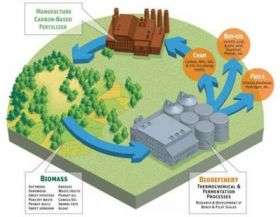
UGA's Biorefinery and Carbon Cycling Program, in partnership with EPRIDA, a private firm in Athens, Ga., host a pilot thermochemical biorefinery on the UGA campus. The pilot-scale refinery system converts peanut hulls to hydrogen (or other fuels) to biochar. This byproduct holds tremendous potential for carbon sequestration and production of soil amendments, bio-based products and fuels. Credit: University of Georgia

Former inhabitants of the Amazon Basin enriched their fields with charred organic materials-biochar-and transformed one of the earth's most infertile soils into one of the most productive. These early conservationists disappeared 500 years ago, but centuries later, their soil is still rich in organic matter and nutrients. Now, scientists, environmental groups and policymakers forging the next world climate agreement see biochar not only as an important tool for replenishing soils, but as a powerful tool for combating global warming.

Christoph Steiner, a University of Georgia research scientist in the Faculty of Engineering, was a major contributor to the biochar proposal that was submitted by the United Nations Convention to Combat Desertification last week at the United Nations Climate Change Conference meeting in Poland. The new climate change agreement will replace the Kyoto Protocol, which expires in 2012.

"The potential of biochar lies in its ability to sequester-capture and store-huge amounts of carbon while also displacing fossil fuel energy, effectively doubling its carbon impact," said Steiner, a soil scientist whose research in the Amazon Basin originally focused on the use of biochar as a soil amendment. At UGA's Biorefinery and Carbon Cycling Program, he now investigates the global potential of biochar to sequester carbon. He also serves as a consultant to the UNCCD, a sister program to the climate change convention.

Steiner explained that almost any kind of organic material-peanut shells, pine chips and even poultry litter-can be burned in air-tight conditions, a process called pyrolysis. The byproducts are biochar, a highly porous charcoal that helps soil retain nutrients and water, and gases and heat that can be used as energy.

But because the carbon in biochar so effectively resists degradation, it also can sequester carbon in soils for hundreds to thousands of years, effectively making it a permanent "sink" - a natural system that soaks up carbon dioxide from the atmosphere. Soils containing biochar made by ancient Amazon people still contain up to 70 times more carbon than surrounding soils and have a higher nutrient content. Steiner said scientists estimate biochar from agriculture and forestry residues can potentially sequester billions of tons of carbon in the world's soils.

Biochar also avoids the disadvantages of other bioenergy technologies that deplete soil organic matter, said Steiner.

"Removing crop residues for bioenergy production reduces the organic matter accumulating on agricultural fields and thus the soil organic carbon pool, which depends on constant input of decomposing plant material. In contrast, pyrolysis with biochar carbon sequestration produces renewable energy, sequesters CO2 and cycles nutrients back into agricultural fields."

"This unique system ideally utilizes waste biomass, and thus does not compete with food production," said Steiner. Currently most waste biomass decomposes or is burned in the field. Both processes release carbon dioxide stored in the plant biomass-for no other use than getting rid of it. Biochar can capture up to 50 percent of the carbon stored in biomass and establishes a significant carbon sink, as long as renewable resources are used and biochar is used as a soil amendment.

To address our world's climate change dilemma, said Steiner, "We need a carbon sink in addition to greater energy efficiency and renewable energy. Acceptance of the UNCCD proposal in Poland is a first step to make carbon trading based on biochar a reality.

This has not only consequences for mitigating climate change, but also for agricultural sustainability, and could provide a strong incentive to reduce deforestation, especially in the tropics."

Source: University of Georgia


print this article email this article download pdf blog this article bookmark this article     Stumble it Digg this share on Facebook retweet share on Reddit add to delicious
Rate this story - 3 /5 (2 votes)

Rank Filter

Move the slider to adjust rank threshold, so that you can hide some of the comments.


Display comments: newest first

  • MikeB - Dec 17, 2008
    • Rank: 5 / 5 (1)
    It seems like there may be a quick or easy technological fix for climate change. I wonder if the researchers in this previous article:

    http://www.physor...558.html

    considered biochar?

  • CER - Dec 17, 2008
    • Rank: 2.7 / 5 (7)
    Assuming at some point that people start listening to real science that Global Warming caused by man is Fraud and it is byproduct of Sun long term patterns & we are actually in global cooling cycle for 10-20 years now.

    And lets hope that reasonable environmentalist see that Kyoto Protocol set global environment back decades thru none 18 signing countries achomplishing none of their goals & by pushing all undeveloped countries into major polluters = China #1 now (vs #7 previously) and Russia #4 (vs #9 previously) - with others inbetween...most have only paper monitoring.

    So whats say the new climate agreement undo the huge screwup the Kyoto caused & the Emissions traders find another way to screw Western industry & workers out of money??
    Regards CER
  • CER - Dec 20, 2008
    • Rank: 2.6 / 5 (5)
    Looking past the Global Warming nonsense & at carbon fertilizer aspects - another feature of the biochar would be that carbon also acts as filter for water purification (many plants using coal/petcoke as fuel can use some raw material to filter plant water outfall).
    Also if this was combined with Phyotoremediation in mining type area the improved soil would make it possible for plants recover heavy metals ect (SAfrica using it recover Gold soils)which could be burnt & ash used as ore. Which would make it also solution for other chared carbon sources use.

    CO2 is breath of Earth not a emission - since there are only few acres useable land (75% surface is water/mountains-lakes-deserts remove half remaing 25%)for agriculture it is fixed number meanwhile people grow geometric rates - increased CO2 is only way to grow more with less land (all best land eventually consumed by towns/cities growth).
    Using CO2 emissions from plants into greenhouses with biochar fertilizer to grow trees for planting is another combined use.
  • jay66 - Dec 25, 2008
    • Rank: 1 / 5 (1)
    "These early conservationists disappeared 500 years ago"

    Stop romanticizing, these people were nothing more than terra formers and opportunists who also drove many species of mega-fauna into extinction.
  • Velanarris - Dec 29, 2008
    • Rank: not rated yet
    "These early conservationists disappeared 500 years ago"

    Stop romanticizing, these people were nothing more than terra formers and opportunists who also drove many species of mega-fauna into extinction.

    Aside from the fact that you're off base by about 10k years, no, nevermind, you're just way off base.
  • dachpyarvile - Jan 03, 2009
    • Rank: not rated yet
    I wonder aloud, "How many kilometers of rain forest had these ancient "conservationists" burned to manufacture their biochar?" :-)

December 17, 2008 all stories

Comments: 6

3 /5 (2 votes)
  • Stumble this up

  • Digg this

  • share this

  • hide
  • Related Stories

  • Fertilizer industry finds its alternative energy: corncobs
    created Jun 18, 2009 | popularity not rated yet | comments 0
  • Biochar: turning waste into wealth
    created Jun 10, 2009 | popularity not rated yet | comments 0
  • A 'black magic' CO2 fix
    created Dec 09, 2008 | popularity not rated yet | comments 0
  • Limitations of charcoal as an effective carbon sink
    created May 02, 2008 | popularity not rated yet | comments 0
  • Using soil to lock up carbon could help offset global warming
    created May 14, 2007 | popularity not rated yet | comments 0


  • hide
  • Relevant PhysicsForums posts

  • cycles
    created 13 hours ago
  • The Origin of the term 'fossil' fuels
    created Nov 05, 2009
  • co2
    created Nov 03, 2009
  • Early Earths Sulfidic Ocean Conditions
    created Oct 30, 2009
  • More from Physics Forums - Earth

Other News

Deep creep means milder, more frequent earthquakes along Southern California's San Jacinto fault

Deep creep means milder, more frequent earthquakes along Southern California's San Jacinto fault

Space & Earth / Earth Sciences

created 12 hours ago | popularity 4.7 / 5 (3) | comments 0

With an average of four mini-earthquakes per day, Southern California's San Jacinto fault constantly adjusts to make it a less likely candidate for a major earthquake than its quiet neighbor to the east, the ...


Success in 'space elevator' competition (AP)

Success in 'space elevator' competition (Update 3)

Space & Earth / Space Exploration

created Nov 05, 2009 | popularity 4.3 / 5 (33) | comments 50

(AP) -- A robot powered by a ground-based laser beam climbed a long cable dangling from a helicopter on Wednesday to qualify for prize money in a $2 million competition to test the potential reality of the ...


In a Galaxy Far, Far Away...

In a Galaxy Far, Far Away...

Space & Earth / Astronomy

created Nov 06, 2009 | popularity 4.8 / 5 (5) | comments 16

(PhysOrg.com) -- Astronomers have published the discovery of the farthest known object in the cosmos: a star that exploded when the universe was only 630 million years old -- only 4.6% of its current age. ...


'Dropouts' pinpoint earliest galaxies

'Dropouts' pinpoint earliest galaxies

Space & Earth / Astronomy

created Nov 06, 2009 | popularity 4.2 / 5 (10) | comments 13

Astronomers, conducting the broadest survey to date of galaxies from about 800 million years after the Big Bang, have found 22 early galaxies and confirmed the age of one by its characteristic hydrogen signature ...


Space hotel taking bookings for 2012 opening

Space hotel taking bookings for 2012 opening

Space & Earth / Space Exploration

created Nov 05, 2009 | popularity 4.4 / 5 (21) | comments 11

(PhysOrg.com) -- The first orbiting space hotel is on track to open for its first customers in 2012, but hurry, as bookings are filling fast.