Moon's polar craters could be the place to find lunar ice, scientists report
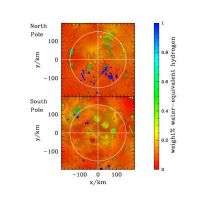
December 18, 2008 Map Showing Hydrogen Concentrations on the Moon

Enlarge

A map showing the north and south polar regions of the moon. The dark blue shaded areas represent the highest concentrations of hydrogen. Credit: Dr. Vincent Eke, Durham University/NASA

Scientists have discovered where they believe would be the best place to find ice on the moon.

Astrophysicists, led by an expert at Durham University, say if frozen water exists then it is most likely to be found near to the moon's poles in craters that are permanently shaded from the sun.

Their findings are based on a new computer analysis of data from the Lunar Prospector, a space probe sent to the moon in 1998 by NASA. The researchers showed that hydrogen on the moon is concentrated into polar craters where temperatures are colder than minus 170 degrees Celsius.

Hydrogen, together with the oxygen that is abundant within moon rock, is a key element in making water.

If ice is present in the craters then the researchers say it could potentially provide a water source for the eventual establishment of a manned base on the moon. A moon base could be used as a platform for exploration into the further reaches of our solar system.

The findings are published in the International Journal of Solar System Studies, Icarus.

They show that if the hydrogen is present as water ice, then the average concentration in some craters corresponds to ten grams of ice in each kilogram of moon rock.

However the researchers say that instead of being water ice, hydrogen may be present in the form of protons fired from the sun into the dusty lunar surface.

Dr Vincent Eke, in the Institute for Computational Cosmology, at Durham University, said: "This research applies a newly developed technique to data from the Lunar Prospector mission to show that hydrogen is actually concentrated into the permanently shaded polar craters.

"Water ice should be stable for billions of years on the moon provided that it receives no sunlight.

"If the hydrogen is present as water ice then our results imply that the top metre of the moon holds about enough water to fill up Kielder Water."

Kielder Water, in Northumberland, UK, holds 200,000 million litres of water, making it the largest UK manmade reservoir in Northern Europe.

The research may be of immediate use in lunar exploration. Dr Richard Elphic, in the Planetary Systems Branch, NASA Ames Research Center, said: "These results will help NASA's soon-to-be launched Lunar Crater Observation and Sensing Satellite (LCROSS) and Lunar Reconnaissance Orbiter (LRO) missions.

"For example, LCROSS aims to liberate water by impacting into permanently shadowed polar terrain where ice may exist, and our improved maps of hydrogen abundance can help LCROSS select a promising impact site.

"These maps will also help focus LRO's search for possible polar ice by identifying hydrogen-rich locales".

Source: Durham University


print this article email this article download pdf blog this article bookmark this article     Stumble it Digg this share on Facebook retweet share on Reddit add to delicious
Rate this story - 5 /5 (2 votes)


December 18, 2008 all stories

Comments: 0

5 /5 (2 votes)
  • Stumble this up

  • Digg this

  • share this

  • hide
  • Related Stories

  • NASA 'Drops' Next Generation Robotic Lander During Autonomous Tests
    created Nov 16, 2009 | popularity not rated yet | comments 0
  • LCROSS Impact Finds Water on the Moon
    created Nov 13, 2009 | popularity not rated yet | comments 0
  • Distal Rampart of Crater in Chryse Planitia
    created Nov 13, 2009 | popularity not rated yet | comments 0
  • Fantastic Voyage
    created Nov 02, 2009 | popularity not rated yet | comments 0
  • Icebreaker: Scientist brings out big gun to explore behavior of ice in planetary collisions
    created Oct 29, 2009 | popularity not rated yet | comments 0


  • hide
  • Relevant PhysicsForums posts

  • Some help with a X-Ray astronomy question please!
    created 13 hours ago
  • Help with Images and Optical Instrument Question..
    created Nov 26, 2009
  • Redshift as a distance indicator
    created Nov 26, 2009
  • Question about 2-body gravity
    created Nov 24, 2009
  • More from Physics Forums - General Astronomy

Other News

Fermi Telescope Peers Deep into Microquasar

Fermi Telescope Peers Deep into Microquasar (w/ Video)

Space & Earth / Astronomy

created 7 hours ago | popularity 4.3 / 5 (3) | comments 0

(PhysOrg.com) -- NASA's Fermi Gamma-ray Space Telescope has made the first unambiguous detection of high-energy gamma-rays from an enigmatic binary system known as Cygnus X-3. The system pairs a hot, massive ...


The Energy Sources of Ultraluminous Galaxies

The Energy Sources of Ultraluminous Galaxies

Space & Earth / Astronomy

created 7 hours ago | popularity 4.3 / 5 (7) | comments 0

(PhysOrg.com) -- Ultraluminous infrared galaxies ((ULIRGs) are galaxies whose luminosity exceeds that of a trillion suns; for comparison, the Milky Way galaxy has a typical (and much more modest) luminosity ...


Space shuttle Atlantis, 7 astronauts back on Earth (AP)

Space shuttle Atlantis, 7 astronauts back on Earth

Space & Earth / Space Exploration

created 8 hours ago | popularity not rated yet | comments 0

(AP) -- Space shuttle Atlantis and its seven astronauts returned to Earth with a smooth touchdown Friday to end an 11-day flight that resupplied the International Space Station.


Herschel takes a peek at the ingredients of the galaxies

Herschel takes a peek at the ingredients of the galaxies

Space & Earth / Astronomy

created 5 hours ago | popularity 5 / 5 (1) | comments 0

(PhysOrg.com) -- The European Space Agency has today released spectacular new observations from the Herschel Space Observatory, including the UK-led SPIRE instrument. Spectrometers on board all three Hershel ...


China is set to launch its second moon orbiter next October, state media have reported

China to launch second lunar probe: state media

Space & Earth / Space Exploration

created 12 hours ago | popularity 5 / 5 (3) | comments 0

China will launch its second moon orbiter next October, state media reported Friday, as it powers ahead with a space programme that has sparked concerns abroad.