Where did Venus's water go?
December 18, 2008
Where did Venus's water go?

Enlarge

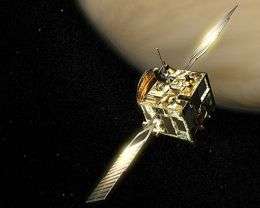
Venus Express is studying largely unknown phenomena in the Venusian atmosphere like never before. Its suite of instruments is also digging into the interaction between the solar wind and the planetary environment. In addition, the mission is gathering glimpses of the planet's surface, which is strictly coupled with its dense atmosphere. Credits: ESA (Image by AOES Medialab)

(PhysOrg.com) -- Venus Express has made the first detection of an atmospheric loss process on Venus's day-side. Last year, the spacecraft revealed that most of the lost atmosphere escapes from the night-side. Together, these discoveries bring planetary scientists closer to understanding what happened to the water on Venus, which is suspected to have once been as abundant as on Earth.

The spacecraft's magnetometer instrument (MAG) detected the unmistakable signature of hydrogen gas being stripped from the day-side. "This is a process that was believed to be happening at Venus but this is the first time we measured it," says Magda Delva, Austrian Academy of Sciences, Graz, who leads the investigation.

Thanks to its carefully chosen orbit, Venus Express is strategically positioned to investigate this process; the spacecraft travels in a highly elliptical path sweeping over the poles of the planet.

Water is a key molecule on Earth because it makes life possible. With Earth and Venus approximately the same size, and having formed at the same time, astronomers believe that both planets likely began with similar amounts of the precious liquid. Today, however, the proportions on each planet are extremely different. Earth's atmosphere and oceans contain 100 000 times the total amount of water on Venus. In spite of the low concentration of water on Venus Delva and colleagues found that some 2x1024 hydrogen nuclei, a constituent atom of the water molecule, were being lost every second from Venus's day-side.

Last year, the Analyser of Space Plasma and Energetic Atoms (ASPERA) on board Venus Express showed that there was a great loss of hydrogen and oxygen on the night-side. Roughly twice as many hydrogen atoms as oxygen atoms were escaping. Because water is made of two hydrogen atoms and one oxygen atom, the observed escape indicates that water is being broken up in the atmosphere of Venus.

The Sun not only emits light and heat into space, it constantly spews out solar wind, a stream of charged particles. This solar wind carries electrical and magnetic fields throughout the Solar System and 'blows' past the planets.

Unlike Earth, Venus does not generate a magnetic field. This is significant because Earth's magnetic field protects its atmosphere from the solar wind. At Venus, however, the solar wind strikes the upper atmosphere and carries off particles into space. Planetary scientists think that the planet has lost part of its water in this way over the four-and-a-half-thousand million years since the planet's birth.

"We do see water escaping from the night-side but the question remains, how much has been lost in the past in this way," says Stas Barabash, Swedish Institute of Space Physics, Kiruna and Principal Investigator of ASPERA, that looked at night-side data.

The discovery takes scientists a step towards understanding the details, but it does not provide the last piece of the puzzle. To be certain that the hydrogen is coming from water, Delva and colleagues must also detect the loss of oxygen atoms on the day-side and verify that there are approximately half as many leaving Venus as hydrogen.

So far, this has not been possible. "I keep looking at the magnetometer data but so far I can't see the signature of oxygen escaping on the day-side," says Delva.

It also highlights a new mystery. "These results show that there could be at least twice as much hydrogen in the upper atmosphere of Venus than we thought," says Delva. The detected hydrogen ions could exist in atmospheric regions high above the surface of the planet; but the source of these regions is unknown.

So like a true lady, Venus still retains some of her mystery.

Provided by European Space Agency

4.2 /5 (5 votes)  

Filter


Move the slider to adjust rank threshold, so that you can hide some of the comments.


Display comments: newest first

jyro
Dec 18, 2008

Rank: 3.7 / 5 (3)
four-and-a-half-thousand million years since the planet's birth?

was four-and-a-half billion years too hard to write?
nkalanaga
Dec 18, 2008

Rank: 5 / 5 (3)
A "billion" means different things to British and American readers, whereas a "thousand million" is always 1,000,000,000.
Rank 4.2 /5 (5 votes)
Related Stories
Relevant PhysicsForums posts
  • Scale of the Universe
    created10 hours ago
  • Titan's lack of impact craters
    createdFeb 09, 2012
  • Real pictures of black hole eating a star?
    createdFeb 08, 2012
  • Hypothetical way to travel faster than light, but not technically exceed lightspeed
    createdFeb 06, 2012
  • How do scientists monitor the Sun's activity?
    createdFeb 05, 2012
  • Search patterns in observational studies
    createdFeb 05, 2012
  • More from Physics Forums - General Astronomy

More news stories

Humans may have helped the decline of African rainforests 3000 years ago

(PhysOrg.com) -- Large areas of rainforests in Central Africa mysteriously disappeared over three thousand years ago, to be replaced by savannas. The prevailing theory has been that the cause was a change ...

Space & Earth / Environment

created 21 hours ago | popularity 4.3 / 5 (12) | comments 12 | with audio podcast report

Could Venus be shifting gear?

(PhysOrg.com) -- ESA’s Venus Express spacecraft has discovered that our cloud-covered neighbour spins a little slower than previously measured. Peering through the dense atmosphere in the infrared, the ...

Space & Earth / Space Exploration

created 17 hours ago | popularity 5 / 5 (7) | comments 7 | with audio podcast

NASA budget will axe Mars deal with Europe: scientists

US President Barack Obama's budget proposal to be submitted next week for 2013 will cut NASA's budget by 20 percent and eliminate a major partnership with Europe on Mars exploration, scientists said Thursday.

Space & Earth / Space Exploration

created 20 hours ago | popularity 5 / 5 (2) | comments 18

Two new moons for Jupiter

Advances in technology have lead to the discovery of new planets outside of our Solar System, and now even new moons in our own backyard.

Space & Earth / Space Exploration

created 17 hours ago | popularity 4 / 5 (1) | comments 7

Mars Science Laboratory computer issue resolved

(PhysOrg.com) -- Engineers have found the root cause of a computer reset that occurred two months ago on NASA's Mars Science Laboratory and have determined how to correct it.

Space & Earth / Space Exploration

created 18 hours ago | popularity 4.7 / 5 (6) | comments 3 | with audio podcast


Anonymous knocks CIA website offline (Update)

The website of the Central Intelligence Agency was inaccessible on Friday after the hacker group Anonymous claimed to have knocked it offline.

Google users warned of threat to smartphone wallets

Users of Google smartphone wallets were being warned on Friday that there is a way to crack pass codes intended to thwart thieves from going on illicit shopping sprees.

New error-correcting codes guarantee the fastest possible rate of data transmission

Error-correcting codes are one of the triumphs of the digital age. They’re a way of encoding information so that it can be transmitted across a communication channel — such as an optical fiber o ...

New power source discovered

(PhysOrg.com) -- Researchers at the Massachusetts Institute of Technology (MIT) and RMIT University have made a breakthrough in energy storage and power generation.

Small modular reactor design could be a 'SUPERSTAR'

(PhysOrg.com) -- Though most of today's nuclear reactors are cooled by water, we've long known that there are alternatives; in fact, the world's first nuclear-powered electricity in 1951 came from a reactor ...

The power of estrogen -- male snakes attract other males

A new study has shown that boosting the estrogen levels of male garter snakes causes them to secrete the same pheromones that females use to attract suitors, and turned the males into just about the sexiest ...