Humans and chimps register faces by using similar brain regions
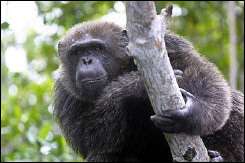
December 18, 2008 A chimpanzee

Chimpanzees recognize their pals by using some of the same brain regions that switch on when humans register a familiar face, according to a report published online on December 18th in Current Biology, a Cell Press publication. The study—the first to examine brain activity in chimpanzees after they attempt to match fellow chimps' faces—offers new insight into the origin of face recognition in humans, the researchers said.

"We can learn about human origins by studying our closest relatives," said Lisa Parr, a researcher at the Yerkes National Primate Research Center, Emory University. "We can discover what aspects of human cognition are really unique and which are present in other animals."

Earlier studies had shown that chimpanzees, like humans, are adept at recognizing their peers. "We knew [from behavioral studies] that chimps and humans process faces similarly," Parr said. "We wondered whether similar brain regions were responsible, and, for the most part, they seem to be."

In the study, the researchers examined brain activity (as reflected by blood sugar metabolism) in five chimpanzees by using Positron Emission Tomography (PET) scans. (Parr noted that the Yerkes National Primate Research Center is the only center of its kind to have on-site MRI, PET, and cyclotron facilities, making studies like Parr's possible.) The chimps were shown three faces, two of which were identical, while the third was of a different chimp. Subjects were then asked to indicate the faces that matched. In other trials, the chimpanzees did the same matching task with clip art images.

The imaging studies revealed significant face-selective activity in brain regions known to make up the distributed cortical face-processing network in humans. Further study showed distinct patches of activity in a region known as the fusiform gyrus—the primary site of face-selective activity in humans—when chimps observed faces.

The researchers concluded that the brain regions that are active during facial recognition may represent part of a distributed neural system for face processing in chimpanzees, like that proposed in humans, in which the initial visual analysis of faces activates regions in the occipital and temporal lobes of the cerebral cortex (a portion of the brain involved in memory, attention, and perceptual awareness) followed by additional processing in the fusiform gyrus and other regions.

Parr emphasized, however, that there have been decades of research on face processing in the human brain. As the first such study in chimpanzees, the new findings raise more questions than they can answer, and follow-up studies are underway.


Source: Cell Press


print this article email this article download pdf blog this article bookmark this article     Stumble it Digg this share on Facebook retweet share on Reddit add to delicious
Rate this story - 4 /5 (1 vote)


December 18, 2008 all stories

Comments: 0

4 /5 (1 vote)
  • Stumble this up

  • Digg this

  • share this

  • hide
  • Related Stories

  • Colombian guerrillas help scientists locate literacy in the brain
    created Oct 14, 2009 | popularity not rated yet | comments 0
  • Scientists pinpoint critical molecule to celiac disease, possibly other autoimmune disorders
    created Sep 07, 2009 | popularity not rated yet | comments 0
  • Exploring reactions to inequality
    created Aug 18, 2009 | popularity not rated yet | comments 0
  • Researchers propose ambitious new strategies for AIDS vaccine research
    created Aug 07, 2009 | popularity not rated yet | comments 0
  • Primate archaeology, proposal of a new research field
    created Jul 16, 2009 | popularity not rated yet | comments 0


Other News

Ancient penguin DNA raises doubts about accuracy of genetic dating techniques

Ancient penguin DNA raises doubts about accuracy of genetic dating techniques

Biology / Evolution

created 1hour ago | popularity 5 / 5 (4) | comments 1

Penguins that died 44,000 years ago in Antarctica have provided extraordinary frozen DNA samples that challenge the accuracy of traditional genetic aging measurements, and suggest those approaches have been ...


In the war between the sexes, the one with the closest fungal relationship wins

Biology / Plants & Animals

created 59 minutes ago | popularity not rated yet | comments 0

The war between the sexes has been fought on many fronts throughout time -- from humans to birds to insects, the animal kingdom is replete with species involved in their own skirmishes. A recent study by Dr. Sarah Eppley ...


Researchers to develop probes to study cellular GPS

Biology / Cell & Microbiology

created 1hour ago | popularity not rated yet | comments 0

An international group of researchers from Carnegie Mellon University, Goettingen Medical School in Germany and the University of Cambridge in the United Kingdom have received a Human Frontiers Science Program (HFSP) grant ...


Scientists successfully reprogram blood cells

Biology / Cell & Microbiology

created 22 hours ago | popularity 5 / 5 (4) | comments 0

Researchers have transplanted genetically modified hematopoietic stem cells into mice so that their developing red blood cells produce a critical lysosomal enzyme -preventing or reducing organ and central nervous system damage ...


Iowa State University researcher discovers key to vital DNA, protein interaction

Researchers discover key to vital DNA, protein interaction

Biology / Other

created 18 hours ago | popularity 5 / 5 (3) | comments 0

(PhysOrg.com) -- A researcher at Iowa State University has discovered how a group of proteins from plant pathogenic bacteria interact with DNA in the plant cell, opening up the possibility for what the scientist ...