Passage graves from an astronomical perspective
December 18, 2008
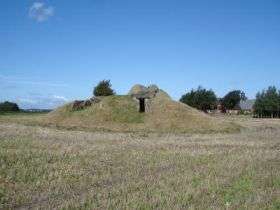
Shown here is the passage grave "Nordenhoj" at Kaerby near Kalundborg in Denmark. Credit: The National Museum of Denmark
Passage graves are mysterious barrows from the Stone Age. New research from the Niels Bohr Institute at the University of Copenhagen indicates that the Stone Age graves' orientation in the landscape could have an astronomical explanation. The Danish passage graves are most likely oriented according to the path of the full moon, perhaps even according to the full moon immediately before a lunar eclipse. The results are published in the scientific journal Acta Archaeologica.
Claus Clausen, who graduated as astronomer from the Niels Bohr Institute, has also always been interested in archeology. There are many Stone Age graves in Denmark, where archaeologists estimate that around 40.000 large stone graves were built from around 3500 to 3000 BC. Only about 500 of the large passage graves, called giant tombs (in Danish Jaettestuer) are preserved today, but one of the great mysteries is their orientation in the landscape.
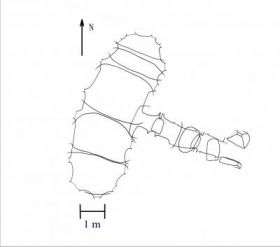
This is the layout of a typical passage grave, here the passage grave "Nissehoj" in North Zealand. The outlines of the horizontal and level stones are shown. Credit: The National Museum of Denmark
With the help of GPS, a compass and a surveying instrument Claus Clausen measured the orientation of entrance tunnels of approximately 100 passage graves. It turned out that there was a remarkable concentration of certain orientations. Claus Clausen had a theory that it could be a calendar system, but the theory did not hold up. Astronomer and supervisor of the special project, Per Kjærgaard Rasmussen suggested that he look at the connection between the sun and the moon and especially lunar eclipses, because there were two orientations that occurred frequently and that could suggest something with specific full moons.
Ancient Almanac
Astronomer Ole Einicke, who for many years has calculated data for the Danish Almanac, had made a computer program that could calculate the position of the planets for the next year. The program was now used to calculate back in time. Directions to the rise of the Sun are easy to calculate. The orientation of the rise of full moon and the timing of lunar eclipses are more difficult to calculate due to the sun's disturping influence on the moon's orbit around the earth, that results in the orbit of the moon rotates in a period of 18.6 years. But the biggest complication is that the earth's rotation has changed through time so that it now rotates slower than before so it required special calculations and corrections to calculate more than 5.500 years into the past and see whether the lunar eclipses could be seen from Denmark.
Patterns in the sun and moon
There is a significant concentration of orientations towards east/southeast as seen from within the passage grave. It can be interpreted that the passage graves are oriented according to the winter sunrise. But researchers think it more likely that they are positioned according to the rise of the full moon, for example, the first full moon after the spring equinox.
The calculations show, that in the period from 3.300 to 3.100 BC there was an over frequency of 50 percent in the number of lunar eclipses that could be seen in Denmark. And the exciting thing was that the pattern indicated that it could fit with the rise of the full moon immediately before a lunar eclipse.
How the Stone Age people had known that a lunar eclipse would come after a full moon is unknown, but astronomer Per Kjærgaard Rasmussen explains, that if one had observed a lunar eclipse there is a very strong likelihood that another lunar eclipse would come either 12 months or 18.6 years later.
The passage graves had been used for burials and the orientation of the entrance is concentrated towards the full moon points to a ritual practice that involved the moon.
Source: University of Copenhagen
-
China unveils high resolution global moon map
7 hours ago |
4.5 / 5 (4) |
0
-
A bouncing moon boulder
7 hours ago |
4 / 5 (2) |
0
-
Russia sets its sights on the moon for 2020
Feb 07, 2012 |
5 / 5 (4) |
5
-
Sun delivered curveball of powerful radiation at Earth
Feb 01, 2012 |
4.5 / 5 (4) |
0
-
GRAIL returns first video from moon's far side
Feb 01, 2012 |
4.6 / 5 (13) |
3
-
Engineers build first sub-10-nm carbon nanotube transistor
Feb 01, 2012 |
4.9 / 5 (33) |
30
-
Something old, something new: Evolution and the structural divergence of duplicate genes
Jan 31, 2012 |
4.6 / 5 (7) |
1
-
The hidden nanoworld of ice crystals: Revealing the dynamic behavior of quasi-liquid layers
Jan 30, 2012 |
5 / 5 (4) |
1
-
Stock market network reveals investor clustering
Jan 27, 2012 |
3.9 / 5 (23) |
8
-
Of microchemistry and molecules: Electronic microfluidic device synthesizes biocompatible probes
Jan 26, 2012 |
5 / 5 (2) |
0
-
Factors affecting beet root cell membrane
17 hours ago
-
Stem cell question.
Feb 10, 2012
-
Protease cleavage
Feb 10, 2012
-
Pertubance in a model
Feb 10, 2012
-
Cancer drugs and Alzheimer's, Oh my!
Feb 09, 2012
-
Squishing cells
Feb 09, 2012
- More from Physics Forums - Biology
More news stories
A frank discussion of the power law and linking correlation to causation
(PhysOrg.com) -- Michael Stumpf a mathematics professor at Imperial College in London, and Mason Porter a lecturer at Oxford have teamed together to write and publish a perspective piece in Science regarding the in ...
US workers are 'giving away the store,' costing firms billions
Nearly 70 percent of the nation's service employees give away free goods and services from hamburgers to cable TV costing companies billions of dollars a year, according to a groundbreaking study.
Other Sciences / Economics & Business
Feb 09, 2012 |
3 / 5 (5) |
11
Employers feel no love for unscrupulous practice of 'service sweethearting'
A new study led by two Florida State University marketing professors finds that some frontline service employees who are rewarded for hikes in customer loyalty and satisfaction also may engage in "service ...
Other Sciences / Economics & Business
Feb 10, 2012 |
3.3 / 5 (3) |
10
New insights into how to correct false knowledge
The abundance of false information available on the Internet, in movies and on TV has created a big challenge for educators.
Other Sciences / Social Sciences
Feb 07, 2012 |
4.9 / 5 (7) |
9
|
Neanderthal demise due to many influences, including cultural changes: study
As an ice age crept upon them thousands of years ago, Neanderthals and modern human ancestors expanded their territory ranges across Asia and Europe to adapt to the changing environment.
Other Sciences / Archaeology & Fossils
Feb 07, 2012 |
4.4 / 5 (5) |
8
|
Japan's Fukushima reactor may be reheating: operator
Temperature readings at one of the crippled Fukushima nuclear reactors have risen above Japan's stringent new safety standard but there was no immediate danger, its operator said Sunday.
Scientists discover molecular secrets of 2,000-year-old Chinese herbal remedy
For roughly two thousand years, Chinese herbalists have treated Malaria using a root extract, commonly known as Chang Shan, from a type of hydrangea that grows in Tibet and Nepal. More recent studies suggest that halofuginone, ...
New method to examine batteries -- MRI from the inside
There is an ever-increasing need for advanced batteries for portable electronics, such as phones, cameras, and music players, but also to power electric vehicles and to facilitate the distribution and storage of energy derived ...
Google might launch Drive for cloud storage soon
(PhysOrg.com) -- Google's next big move, according to the Wall Street Journal, is a cloud storage service called Drive. Hardly first to the plate, Google is simply catching up to introducing its cloud reposi ...
A mitosis mystery solved: How chromosomes align perfectly in a dividing cell
Although the process of mitotic cell division has been studied intensely for more than 50 years, Whitehead Institute researchers have only now solved the mystery of how cells correctly align their chromosomes during symmetric ...
Lab study raises questions over nano-particle impact
Tests involving chickens have raised questions about the impact on health from engineered nano-particles, the ultra-fine grains commonly used in drugs and processed foods, scientists said on Sunday.

Dec 19, 2008
Rank: not rated yet