Polygamy, Paternal Care in Birds Linked to Dinosaur Ancestors
December 18, 2008 By Libby Fairhurst
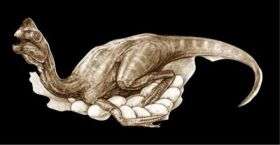
Oviraptorid Dinosaur

Enlarge

The drawing depicts the Oviraptorid dinosaur Citipati on a nest that was found in the Gobi desert of Mongolia by the American Museum of Natural History. It is one of the specimens studied by Professor Gregory M. Erickson of Florida State University for the Dec. 19 Science paper "Avian Paternal Care Had Dinosaur Origin." Credit: Drawing by Mick Ellison, Copyright American Museum of Natural History, 2008

(PhysOrg.com) -- Sure, they’re polygamous, but male emus and several other ground-dwelling birds also are devoted dads, serving as the sole incubators and caregivers to oversized broods from multiple mothers. It is rare behavior, but research described in the Dec. 19 Science found that it runs in this avian family, all the way back to its dinosaur ancestors.

Scientists had long wondered about the origins of polygamy and paternal care patterns among modern-day Paleognathes -- an ancient avian lineage that branched off soon after birds evolved from dinosaurs and includes ostriches, emus and tinamous. No such reproductive behavior exists among the vast majority of other vertebrates. Males contribute to parental care in less than 5 percent of mammal and non-avian reptile species, and while more than 90 percent of bird species co-parent to some degree, it is only among the Paleognathes that both polygamy and paternal care rule.

Now, in a groundbreaking paper (“Avian Paternal Care Had Dinosaur Origin”), paleobiologist Gregory M. Erickson of The Florida State University and researchers from three other institutions connect the evolutionary dots linking the polygamous, paternal reproductive patterns of extant (living) birds to the behavior of their extinct dinosaur kin.

“In those cases where adult dinosaurs have been found on top of nests, we found that the volume or mass of the egg clutch (total number of eggs in the nest) is very large relative to the size of the nesting animals,” Erickson said. “This suggests multiple females contributed the eggs and the male guarded them. Notably, the ratio of egg volumes to the nesting animal’s size is consistent with those in living birds where the male is the sole or primary nest attendant.”

The researchers now had their link from the theropod dinosaurs (omnivores and carnivores that walked on two hind legs with bird-like feet) to the polygamy and nesting scenarios exhibited by their avian descendants, according to David Varricchio of Montana State, the study’s principal investigator.

But to test the theory, Varricchio needed to determine the sex of the brooding dinosaurs whose bones have been found atop those communal nests.

For that, he turned to Erickson at Florida State, a renowned expert in dinosaur paleobiology.

Erickson examined the bone microstructure of tibiae (shin bones), femora (thigh bones) and metatarsus (ankle bones) from oviraptorids and deinonychosaurs (Jurrasic Park “raptors”) -- small theropod dinosaurs whose adult skeletons have been repeatedly discovered in brooding postures atop nests containing dozens of large eggs.

The key was what he didn’t find in the bones: They showed no signs whatsoever of the maternal and reproductively associated microscopic features common to living non-Paleognath bird groups, extinct non-avian dinosaurs or living reptiles.

“I found no evidence of medullary bone (the extra bone laid down by breeding female birds and dinosaurs to make eggs) or extensive bone resorbtion (the means by which female reptiles such as crocodiles acquire mineral salts to make eggs),” Erickson said. “This is consistent with the brooding dinosaurs being males.”

Thus, the researchers had confirmation that the dinosaurs found in nests with large egg clutches were polygamistic males and the source of the peculiar avian behavior.

Moreover, those brooding dinosaurs were fathers -- and today’s emus, rheas and tinamous owe their paternal care model to them.

Co-authors of “Avian Paternal Care Had Dinosaur Origin” -- accessible via the journal Science Web site at http://www.science … /current.dtl -- are Florida State’s Erickson, associate professor of anatomy and vertebrate paleobiology in the Department of Biological Science; Varricchio, Frankie D. Johnson and John J. Borkowski of Montana State University; Jason R. Moore of Texas A&M University; and Mark A. Norell of New York City’s American Museum of Natural History.

Provided by Florida State University


Rank 5 /5 (4 votes)
Relevant PhysicsForums posts

More news stories

A mitosis mystery solved: How chromosomes align perfectly in a dividing cell

Although the process of mitotic cell division has been studied intensely for more than 50 years, Whitehead Institute researchers have only now solved the mystery of how cells correctly align their chromosomes during symmetric ...

Biology / Cell & Microbiology

created 6 hours ago | popularity 4.4 / 5 (10) | comments 0 | with audio podcast

Researchers find extensive RNA editing in human transcriptome

In a new study published online in Nature Biotechnology, researchers from BGI, the world's largest genomics organization, reported the evidence of extensive RNA editing in a human cell line by analysis of RNA-seq data, demons ...

Biology / Biotechnology

created 6 hours ago | popularity 5 / 5 (4) | comments 0 | with audio podcast

The proteins ensuring genome protection

Researchers from the University of Geneva (UNIGE), Switzerland, have discovered the crucial role of two proteins in developing a cell 'anti-enzyme shield'. This protection system, which operates at the level of molecular ...

Biology / Cell & Microbiology

created 6 hours ago | popularity 5 / 5 (3) | comments 0 | with audio podcast

Entire genome of extinct human decoded from fossil

(PhysOrg.com) -- In 2010, Svante Pääbo and his colleagues presented a draft version of the genome from a small fragment of a human finger bone discovered in Denisova Cave in southern Siberia. The ...

Biology / Biotechnology

created Feb 07, 2012 | popularity 4.7 / 5 (59) | comments 48 | with audio podcast

Why are there so few fish in the Earth's oceans?

(PhysOrg.com) -- A Stony Brook University researcher has found that, contrary to popular belief, there are not plenty of fish in the sea.

Biology / Plants & Animals

created Feb 08, 2012 | popularity 4.2 / 5 (18) | comments 27 | with audio podcast


Declining health-care productivity in England: Who says so?

Reports that the National Health Service in England has been declining in productivity in the last decade appear to have been accepted as fact. However, a Viewpoint published Online First by The Lancet disputes this. The Vi ...

Scientists discover molecular secrets of 2,000-year-old Chinese herbal remedy

For roughly two thousand years, Chinese herbalists have treated Malaria using a root extract, commonly known as Chang Shan, from a type of hydrangea that grows in Tibet and Nepal. More recent studies suggest that halofuginone, ...

New method to examine batteries -- MRI from the inside

There is an ever-increasing need for advanced batteries for portable electronics, such as phones, cameras, and music players, but also to power electric vehicles and to facilitate the distribution and storage of energy derived ...

Overeating may double risk of memory loss

New research suggests that consuming between 2,100 and 6,000 calories per day may double the risk of memory loss, or mild cognitive impairment (MCI), among people age 70 and older. The study was released today and will be ...

Lab study raises questions over nano-particle impact

Tests involving chickens have raised questions about the impact on health from engineered nano-particles, the ultra-fine grains commonly used in drugs and processed foods, scientists said on Sunday.

Google might launch Drive for cloud storage soon

(PhysOrg.com) -- Google's next big move, according to the Wall Street Journal, is a cloud storage service called Drive. Hardly first to the plate, Google is simply catching up to introducing its cloud reposi ...