New label-free method tracks molecules and drugs in live cells
December 18, 2008
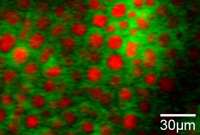
The understanding of the diffusion process of topically applied drugs is critical for drug delivery. However, conventional Raman microscopy requires a long averaging time and high laser powers, where fluorescence microscopy often requires dye labels that are bigger than drug molecules and alter a drug’s efficacy and diffusion characteristics. This figure shows SRS images of the penetration pathways for the drug diffusion enhancer DMSO. Image courtesy of Chris Freudiger, Wei Min, and Brian Saar
A new type of highly sensitive microscopy developed by researchers at Harvard University could greatly expand the limits of modern biomedical imaging, allowing scientists to track the location of minuscule metabolites and drugs in living cells and tissues without the use of any kind of fluorescent labeling.
The technique, based on stimulated Raman scattering (SRS), works by detecting the vibrations in chemical bonds between atoms. SRS microscopy could provide scientists with a potent new form of real-time, three-dimensional bioimaging free of fluorescent labels that can hinder many biological processes.
The work is described this week in the journal Science by a team led by Harvard's X. Sunney Xie, Christian W. Freudiger, and Wei Min.
"SRS microscopy is a big leap forward in biomedical imaging, opening up real-time study of metabolism in living cells," says Xie, professor of chemistry and chemical biology in Harvard's Faculty of Arts and Sciences. "We've already used the technology to map lipids in a live cell, and to measure diffusion of medications in living tissue. These are just two early examples of how SRS microscopy may impact cell biology and medicine."
Xie, Freudinger, and Min's mapping of saturated and unsaturated fats in live cells offers exciting new opportunities for metabolic studies of omega-3 fatty acids, required but not produced by the human body. Despite a growing body of evidence suggesting that omega-3 fatty acids provide many health benefits such as dampening inflammation, lowering blood triglyceride levels, and killing cancer cells, almost nothing is known about how fats like omega-3 are actually processed by our bodies.
"Our diets have changed greatly in recent decades," Xie says. "As a unique technology capable of observing fat distribution in live cells -- and of differentiating between types of fat -- SRS microscopy could prove useful in helping understand and treat the growing imbalance of saturated and unsaturated fats in our diets."
SRS microscopy could also prove useful in neuroimaging, since neurons are coated with fatty myelin sheaths.
The researchers' use of SRS microscopy to analyze skin tissue could also open new frontiers in drug development. Xie and colleagues used SRS microscopy to view how well retinoic acid, a topical acne medication, is absorbed into skin cells. They also used the technique to capture deep-skin penetration by dimethyl sulfoxide (DMSO), a compound added to many topical medications and ointments to enhance absorption.
Scientists currently use a variety of techniques to visualize biomolecules, but most have significant limitations that are sidestepped by SRS microscopy.
A jellyfish protein first discovered in 1962, green fluorescent protein (GFP), is now used extensively as a label for observing the activity of biomolecules. GFP labeling provides sharp images, but the bulky protein can perturb delicate biological pathways, especially in cases where its heft overwhelms smaller biomolecules. Also, GFP's characteristic glow subsides with time, making it infeasible for long-term tracking.
Much like SRS microscopy, conventional infrared (IR) and Raman microscopies measure the vibrations of chemical bonds between atoms. But they are low-sensitivity imaging techniques, and require either desiccated samples or high laser power, which limits use in imaging live specimens. Coherent anti-Stokes Raman scattering (CARS) microscopy, a field pioneered by Xie's own group, cannot provide clear enough contrast for most molecules.
Source: Harvard University
-
New microscopy tracks molecules in live tissue at video rate
Dec 02, 2010 |
not rated yet |
0
-
Chemists develop faster, more efficient protein labeling
Feb 05, 2012 |
5 / 5 (1) |
0
-
Scripps Research alumnus wins International Science and Engineering Visualization Challenge
Feb 02, 2012 |
5 / 5 (1) |
0
-
Self-assembling nanorods: Researchers obtain 1-, 2- and 3-D nanorod arrays and networks
Feb 01, 2012 |
5 / 5 (4) |
0
-
New technology allows scientists to watch cancer cells in action at unprecedented resolution
Feb 01, 2012 |
4 / 5 (1) |
0
-
Fast photon control brings quantum photonic technologies closer
10 hours ago |
5 / 5 (4) |
0
-
Engineers build first sub-10-nm carbon nanotube transistor
Feb 01, 2012 |
4.9 / 5 (33) |
30
-
Something old, something new: Evolution and the structural divergence of duplicate genes
Jan 31, 2012 |
4.6 / 5 (7) |
1
-
The hidden nanoworld of ice crystals: Revealing the dynamic behavior of quasi-liquid layers
Jan 30, 2012 |
5 / 5 (5) |
1
-
Stock market network reveals investor clustering
Jan 27, 2012 |
3.9 / 5 (23) |
8
More news stories
Plants use circadian rhythms to prepare for battle with insects
In a study of the molecular underpinnings of plants' pest resistance, Rice University biologists have shown that plants both anticipate daytime raids by hungry insects and make sophisticated preparations to ...
2 hours ago |
5 / 5 (2) |
0
|
Study finds fish of Antarctica threatened by climate change
A Yale-led study of the evolutionary history of Antarctic fish and their "anti-freeze" proteins illustrates how tens of millions of years ago a lineage of fish adapted to newly formed polar conditions ...
4 hours ago |
3.7 / 5 (3) |
0
|
Explosive evolution need not follow mass extinctions, says study of ancient zooplankton
Following one of Earth's five greatest mass extinctions, tiny marine organisms called graptoloids did not begin to rapidly develop new physical traits until about 2 million years after competing species became ...
4 hours ago |
5 / 5 (1) |
1
|
Writing a new code for life?
On "Star Trek, the aliens often look so human that crew members fall in love with them. But in real life, scientists in the field known as astrobiology can't be sure alien life would even be carbon-based like us, or use DNA ...
7 hours ago |
5 / 5 (5) |
1
Lens produces hours of scientific work in seconds
A new form of microscope which can produce results in seconds rather than hours dramatically speeding up the process of drug development - is being developed by researchers at the University of Strathclyde ...
8 hours ago |
4.4 / 5 (7) |
1
|
First-of-its-kind stem cell study re-grows healthy heart muscle in heart attack patients
Results from a Cedars-Sinai Heart Institute clinical trial show that treating heart attack patients with an infusion of their own heart-derived cells helps damaged hearts re-grow healthy muscle.
Discovery paves way for salmonella vaccine
(Medical Xpress) -- An international research team led by a University of California, Davis, immunologist has taken an important step toward an effective vaccine against salmonella, a group of increasingly antibiotic-resistant ...
Time of year important in projections of climate change effects on ecosystems
(PhysOrg.com) -- Does it matter whether long periods of hot weather, such as last year's heat wave that gripped the U.S. Midwest, happen in June or July, August or September?
Smoking bans lead to less, not more, smoking at home: study
Smoking bans in public/workplaces don't drive smokers to light up more at home, suggests a study of four European countries with smoke free legislation, published online in Tobacco Control.
Ovarian cancer arises in fallopian tube of knockout mice
(Medical Xpress) -- The most deadly form of "ovarian" cancer arises in the fallopian tubes not the ovaries of knockout mice that lack two genes associated with the disease, said researchers led by Baylor College ...
UK cases of progressive sight loss condition set to rise a third by 2020
New cases of the progressive sight loss condition, known as age-related macular degeneration, or AMD for short, are set to rise by a third in the UK over the next decade, reveals research published online in the British Jo ...