Researcher 'sings' for a living to decode the meaning of bird songs
(PhysOrg.com) -- To many people, bird song can herald the coming of spring, reveal what kind of bird is perched nearby or be merely an unwelcome early morning intrusion. But to Sandra Vehrencamp, Cornell professor of neurobiology and behavior, bird song is a code from which to glean insights into avian behavior.
Birds use song systems to communicate about mating and reproduction, territorial boundaries, age and even overall health. Vehrencamp studies them to decode which elements convey such essential information. With colleagues in the Bioacoustics Research Program at Cornell's Lab of Ornithology, she studies birds in such natural habitats as Costa Rica, Colombia and Bonaire.
Vehrencamp records bird songs and then plays them back to birds of the same species to decipher strategies that various species use to attract mates and resolve territorial disputes. The technique allows researchers to study birds' reactions to songs when such elements as overlapping vocalization, finer song structural features and the type of song played back are varied.
"You kind of feel like you're talking to the bird," Vehrencamp said.
She found, for example, that song sparrows in southern California can interpret some forms of playback as "fighting words," because they often resolve conflict by singing the same type of song -- known as song-type matching -- back to one another.
"They get really mad," Vehrencamp said. "They treat playback like it's another bird and will sometimes come right up to the speaker."
Between male birds, if song-type matching fails to resolve a conflict, physical confrontation might ensue. "They both pay costs if they fight," Vehrencamp said. "Birds start to negotiate a boundary dispute with song -- they don't want to fight."
Vehrencamp's work also suggests that males that are most successful are those that share many song types with their territorial neighbors. Song sparrows, for example, can learn songs only within a narrow time period restricted to the first few months after fledging, which means that males must learn neighborhood songs quickly to facilitate successful territorial negotiations.
"Song sparrows are very restricted learners, so the dominant birds that acquire territories within their natal area share more song types with their neighbors and survive better," explained Vehrencamp, who observed that birds with a low degree of song-sharing spend more time fighting with neighbors and are rarely seen the next breeding season.
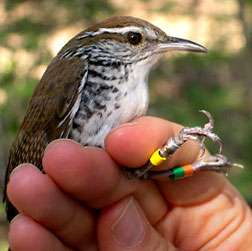
Vehrencamp also studies the banded wren in Central America. This species has a longer learning period, up to a year or more, so all birds in the neighborhood share a large fraction of their song types. "Males get up early, and sing vigorously with frequent song-type matching in what's called a dawn chorus," Vehrencamp said. "We think they're singing to other males, but the females are listening, too."
Type-matching not only indicates aggressive intentions, but enables the birds to compare each other's singing performance for each type of song. Her study suggests that such detail as the trill elements in a song are used by listeners to indicate the singer's overall fitness. "You really have to be in top-notch shape to produce these elements well," she said, adding that a well-sung song in wrens or a large song repertoire in tropical mockingbirds, another species Vehrencamp studies, can indicate the age of a bird. Older males are generally preferred by females because they have a proven ability to survive.
To study how the wrens pay attention to these finer details, Vehrencamp created a "super male" by manipulating the fine-structure elements in song recordings. Territory owners, she found, were reluctant to approach the speaker and chase off such strong "intruders".
And when she genetically tested offspring to determine paternity, she found that singing was a factor when females sought to breed with males that weren't their mates.
"In general, these wrens are quite faithful, but every once in a while we find evidence of extra-pair mating, and the extra-pair mates always had better song quality," she said. "So we know females pay attention to fine song structure."
Vehrencamp said that placing such avian observations within a larger framework can help predict what effects environmental factors -- including humans -- might have on an animal's behavior or survival.
"If we can understand the ecological factors that enhance reproductive success and can link them to conservation, then we might be able to save a species," she said. She added that by better understanding how ecological factors affect the evolution of social behavior, "you can see where humans fit into the big picture, and that adds a richness and depth of understanding for why we are the sorts of animals that we are."
Provided by Cornell University


