NASA's Kepler Spacecraft Ready to Ship to Florida
December 18, 2008
NASA's Kepler Spacecraft Ready to Ship to Florida

Enlarge

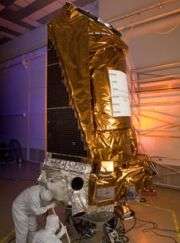
The Kepler spacecraft at Ball Aerospace & Technology Corp. in Boulder, Colo. Image credit: NASA/JPL-Caltech/Ball

(PhysOrg.com) -- Engineers are getting ready to pack NASA's Kepler spacecraft into a container and ship it off to its launch site at Cape Canaveral Air Force Station, Fla. The mission, scheduled to launch on March 5, will seek to answer an age-old question -- are there other Earths in space?

"Kepler is ready to begin its journey to its launch site, and ultimately to space, where it will answer a question that has been pondered by humankind at least as long ago as the ancient Greeks," said James Fanson, the project manager for the mission at NASA's Jet Propulsion Laboratory, Pasadena, Calif.

Kepler will monitor more than 100,000 stars for signatures of planets of various sizes and orbital distances. It has the ability to locate rocky planets like Earth, including those that lie in a star's "habitable zone," a region where liquid water, and perhaps life, could exist. If these Earth-size worlds do exist around stars like our sun, Kepler is expected to be the first to find them, and the first to measure their frequency.

"Kepler's mission is to determine whether Earth-size planets in the habitable zone of other stars are frequent or rare; whether life in our Milky Way galaxy is likely to be frequent or rare," said William Borucki, the Kepler science principal investigator at NASA's Ames Research Center in Moffett Field, Calif.

Kepler is currently at Ball Aerospace & Technology Corp. in Boulder, Colo. It passed all its environmental tests ensuring that it is prepared for the harsh trip to space. It also passed what's called the "pre-ship review," meaning that it is ready to be shipped via convoy to Florida in early January. Its first stop will be Astrotech in Titusville, Fla., where the spacecraft will be processed before being carried to its launch pad at Cape Canaveral. Kepler will launch atop a Delta II rocket.

"An outstanding team of engineers overcame some difficult hurdles to achieve this considerable milestone," said Ball Aerospace Program Manager John Troeltzsch. "The culmination of this effort will put a spectacular mission in orbit designed to increase our understanding of the cosmos."

Kepler is a NASA Discovery mission. In addition to being the home organization of the science principal investigator, NASA Ames Research Center is responsible for the ground system development, mission operations and science data analysis. Kepler mission development is managed by JPL. Ball Aerospace & Technologies Corp. is responsible for developing the Kepler flight system and supporting mission operations.

Provided by Jet Propulsion Laboratory


Rank 5 /5 (3 votes)
Relevant PhysicsForums posts
  • Titan's lack of impact craters
    created22 hours ago
  • Real pictures of black hole eating a star?
    createdFeb 08, 2012
  • Hypothetical way to travel faster than light, but not technically exceed lightspeed
    createdFeb 06, 2012
  • How do scientists monitor the Sun's activity?
    createdFeb 05, 2012
  • Search patterns in observational studies
    createdFeb 05, 2012
  • Derivation of Pogson's law
    createdFeb 03, 2012
  • More from Physics Forums - General Astronomy

More news stories

Clam fields found at deep, low-temperature Mariana vents

(PhysOrg.com) -- Scientists have marveled at the unusual life forms thriving at high temperature hydrothermal vents of the deep ocean.

Space & Earth / Earth Sciences

created 48 minutes ago | popularity not rated yet | comments 0 | with audio podcast

Could Venus be shifting gear?

(PhysOrg.com) -- ESA’s Venus Express spacecraft has discovered that our cloud-covered neighbour spins a little slower than previously measured. Peering through the dense atmosphere in the infrared, the ...

Space & Earth / Space Exploration

created 16 minutes ago | popularity 5 / 5 (1) | comments 0 | with audio podcast

Streams need trees to withstand climate change

(PhysOrg.com) -- More than twenty years of biological monitoring have confirmed the importance of vegetation for protecting Australia's freshwater streams and rivers against the ravages of drought and climate ...

Space & Earth / Environment

created 57 minutes ago | popularity not rated yet | comments 0

The turbulent birth of super star clusters in galaxy mergers

By combining two of the most advanced telescopes in the world -- the new Atacama Large Millimeter Array (ALMA) and the Very Large Telescope (VLT) of ESO -- a team of French astronomers from the Institut d'astrophysique ...

Space & Earth / Astronomy

created 39 minutes ago | popularity not rated yet | comments 0

What does a nebula sound like?

What do things sound like out in the cosmos? Of course, sound waves can’t travel through the vacuum of space; however, electromagnetic waves can. These electromagnetic waves can be recorded by devices called spectrographs ...

Space & Earth / Space Exploration

created 23 minutes ago | popularity 5 / 5 (1) | comments 0


Seeing colors in music, tasting flavors in shapes may happen in life's early months

Famed violinist Itzhak Perlman sees a deep forest green whenever he plays a B-flat on his Stradivarius' G string. The A on the E string is red.

Is that sleepiness during pregnancy normal or a sign of sleep apnea?

(Medical Xpress) -- Most pregnant women complain of being tired. Some of them however, could be suffering more than normal fatigue associated with their pregnancy; they may have developed obstructive sleep apnea (OSA), a ...

Engineering images bring life to submerged city

(PhysOrg.com) -- Photo-realistic 3D mapping and digital reconstruction of an ancient underwater city in Greece have earned a team from the University of Sydney's Faculty of Engineering and Information Technologies ...

Numeracy: The educational gift that keeps on giving?

(Medical Xpress) -- Cancer risks. Investment alternatives. Calories. Numbers are everywhere in daily life, and they figure into all sorts of decisions. A new article published in Current Directions in Psychological Science, a journal of the Association for Psychological Science, examin ...

New power source discovered

(PhysOrg.com) -- Researchers at the Massachusetts Institute of Technology (MIT) and RMIT University have made a breakthrough in energy storage and power generation.

Measurements from high-energy collisions lead to better understanding of why meson particles disappear

For several years, physicists at the Relativistic Heavy Ion Collider (RHIC) at Brookhaven National Laboratory (BNL), USA, have studied an unusual state of matter called the quark–gluon plasma, which they ...