Find the aphid: Molted carapaces act as protective decoys for aphids
December 19, 2008
Aphid and Parasite Wasp

Enlarge

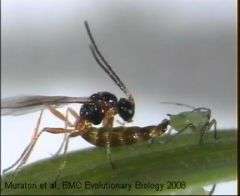
An aphid being parasitized by an aphidiinae wasp. Credit: Muratori et al., BMC Evolutionary Biology 2008

By leaving the remains of their old exoskeletons, called 'exuviae', in and around their colonies, aphids gain some measure of protection from parasites. Research published in the open access journal BMC Evolutionary Biology has shown that parasitoid wasps are likely to attack the empty shells, resulting in a lower attack rate on their previous occupants – much like in the popular 'shell game' confidence trick.

Frédéric Muratori and his collaborators from the Université catholique de Louvain, Belgium, and McGill University, Canada, studied the insects in an effort to explain the aphids' tendency to leave exuviae around their colonies, behaviour the authors describe as 'bad housekeeping'. He said, "By leaving exuviae around the colony, aphids make detection easier for the parasite wasps. As such, this behaviour has been thought counter-selective. Here we show that the exuviae act as a decoy, and the time the wasps spend investigating the old shells limits the damage done to the aphid population".

Aphidiinae wasps use an ovipositor at the rear of their abdomen to lay their eggs inside aphids. Eventually, the development of the parasitoid larva is fatal for the aphid concerned. The authors predicted that the areas littered with exuviae decoys would be seen as poor hunting grounds by the wasps who would move on to other patches. In fact, Muratori describes how, "We found that parasitoid females spent more time in patches that contained exuviae than in patches that contained only aphids, suggesting that these females either did not recognize exuviae as low quality hosts or needed time to correctly identify them".

The potential gain for the individual aphids comes from the increased time available to escape from the colony while the wasps are investigating the decoys. According to the authors, "Aphids release an alarm pheromone when they are under parasitoid attack, giving other aphids time to escape. In nature this is achieved by dropping off the plant".

Paper: Bad housekeeping: why do aphids leave their exuviae inside the colony? Frederic B Muratori, David D Damiens, Thierry Hance and Guy Boivin, BMC Evolutionary Biology (in press)
http://www.biomedc … bmcevolbiol/

Source: BioMed Central


Rank 5 /5 (1 vote)
Tags

Related Stories
Relevant PhysicsForums posts

More news stories

The power of estrogen -- male snakes attract other males

A new study has shown that boosting the estrogen levels of male garter snakes causes them to secrete the same pheromones that females use to attract suitors, and turned the males into just about the sexiest ...

Biology / Plants & Animals

created 13 hours ago | popularity 4.8 / 5 (5) | comments 1 | with audio podcast

Grass to gas: Researchers' genome map speeds biofuel development

Researchers at the University of Georgia have taken a major step in the ongoing effort to find sources of cleaner, renewable energy by mapping the genomes of two originator cells of Miscanthus x giganteus, a large perenn ...

Biology / Biotechnology

created 10 hours ago | popularity 3.8 / 5 (5) | comments 0 | with audio podcast

Experts reveal how plants don't get sunburn

(PhysOrg.com) -- Experts at the University of Glasgow have discovered how plants survive the harmful rays of the sun.

Biology / Cell & Microbiology

created 13 hours ago | popularity 4.8 / 5 (4) | comments 0 | with audio podcast

Miami battling invasion of giant African snails

No one knows how they got there. But an invasion of African giant snails has southern Florida in a panic over potential crop damage, disease and general yuckiness surrounding the slimy gastropods.

Biology / Ecology

created 17 hours ago | popularity 4 / 5 (1) | comments 4

Protein libraries in a snap

(PhysOrg.com) -- A Rice University undergraduate will depart with not only a degree but also a possible patent for his invention of an efficient way to create protein libraries, an important component of biomolecular ...

Biology / Cell & Microbiology

created 17 hours ago | popularity 4.8 / 5 (4) | comments 0 | with audio podcast


Anonymous knocks CIA website offline (Update)

The website of the Central Intelligence Agency was inaccessible on Friday after the hacker group Anonymous claimed to have knocked it offline.

Google users warned of threat to smartphone wallets

Users of Google smartphone wallets were being warned on Friday that there is a way to crack pass codes intended to thwart thieves from going on illicit shopping sprees.

New error-correcting codes guarantee the fastest possible rate of data transmission

Error-correcting codes are one of the triumphs of the digital age. They’re a way of encoding information so that it can be transmitted across a communication channel — such as an optical fiber o ...

Complex wiring of the nervous system may rely on a just a handful of genes and proteins

Researchers at the Salk Institute have discovered a startling feature of early brain development that helps to explain how complex neuron wiring patterns are programmed using just a handful of critical genes. ...

Humans may have helped the decline of African rainforests 3000 years ago

(PhysOrg.com) -- Large areas of rainforests in Central Africa mysteriously disappeared over three thousand years ago, to be replaced by savannas. The prevailing theory has been that the cause was a change ...

New power source discovered

(PhysOrg.com) -- Researchers at the Massachusetts Institute of Technology (MIT) and RMIT University have made a breakthrough in energy storage and power generation.