NASA Study Links Severe Storm Increases, Global Warming
December 19, 2008 NASA Study Links Severe Storm Increases, Global Warming

Enlarge

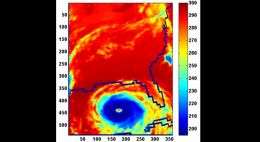
Extremely high clouds, known as deep convective clouds, are typically associated with severe storms and rainfall. In this AIRS image of Hurricane Katrina, taken August 28, 2005, the day before Katrina made landfall in Louisiana, the eye of the storm was surrounded by a "super cluster" of 528 deep convective clouds (depicted in dark blue). The temperatures of the tops of such clouds are colder than 210 degrees Kelvin (-82 degrees Fahrenheit). Image credit: NASA/JPL

(PhysOrg.com) -- The frequency of extremely high clouds in Earth's tropics -- the type associated with severe storms and rainfall -- is increasing as a result of global warming, according to a study by scientists at NASA's Jet Propulsion Laboratory, Pasadena, Calif.

In a presentation today to the fall meeting of the American Geophysical Union in San Francisco, JPL Senior Research Scientist Hartmut Aumann outlined the results of a study based on five years of data from the Atmospheric Infrared Sounder (AIRS) instrument on NASA's Aqua spacecraft. The AIRS data were used to observe certain types of tropical clouds linked with severe storms, torrential rain and hail. The instrument typically detects about 6,000 of these clouds each day. Aumann and his team found a strong correlation between the frequency of these clouds and seasonal variations in the average sea surface temperature of the tropical oceans.

For every degree Centigrade (1.8 degrees Fahrenheit) increase in average ocean surface temperature, the team observed a 45-percent increase in the frequency of the very high clouds. At the present rate of global warming of 0.13 degrees Celsius (0.23 degrees Fahrenheit) per decade, the team inferred the frequency of these storms can be expected to increase by six percent per decade.

Climate modelers have long speculated that the frequency and intensity of severe storms may or may not increase with global warming. Aumann said results of the study will help improve their models.

"Clouds and rain have been the weakest link in climate prediction," said Aumann. "The interaction between the daytime warming of the sea surface under clear-sky conditions and increases in the formation of low clouds, high clouds and, ultimately, rain is very complicated. The high clouds in our observations—typically at altitudes of 20 kilometers (12 miles) and higher—present the greatest difficulties for current climate models, which aren't able to resolve cloud structures smaller than about 250 kilometers (155 miles) in size."

Aumann said the results of his study, published recently in Geophysical Research Letters, are consistent with another NASA-funded study by Frank Wentz and colleagues in 2005. That study found an increase in the global rain rate of 1.5 percent per decade over 18 years, a value that is about five times higher than the value estimated by climate models that were used in the 2007 report of the Intergovernmental Panel on Climate Change.

Provided by JPL/NASA


print this article email this article download pdf blog this article bookmark this article     Stumble it Digg this share on Facebook retweet share on Reddit add to delicious
Rate this story - 2.3 /5 (12 votes)

Rank Filter

Move the slider to adjust rank threshold, so that you can hide some of the comments.


Display comments: newest first

  • GrayMouser - Dec 19, 2008
    • Rank: 3.7 / 5 (7)
    "based on five years of data"
    The cycle for hurricanes is longer than that.
  • Nartoon - Dec 19, 2008
    • Rank: 2.5 / 5 (8)
    I wish these 'learned' scientists would get their story straight, some, as above say increasing storms, while other AGW supporters say no to increased storms, and with the so called AGW over the last 50 years why have major hurricanes and tornadoes actually decreased?
  • anonperson - Dec 20, 2008
    • Rank: 3.3 / 5 (6)
    why have major hurricanes and tornadoes actually decreased?

    Where's your evidence for this quote?
  • Velanarris - Dec 22, 2008
    • Rank: 3.4 / 5 (5)
    why have major hurricanes and tornadoes actually decreased?

    Where's your evidence for this quote?

    Pacific basin shows great reduction, indian basin shows great reduction.

    The only increase is in the atlantic and that's by 1 storm per year. The trend is down, according to NOAA and CSIRO.
  • Velanarris - Dec 23, 2008
    • Rank: 4 / 5 (4)
    Also here are a few interesting graphs for the North Atlantic Hurricane ACE charts.

    Here's the ACE from 1944-2008 where 2008 is a slightly above average year:

    http://www.coaps....2008.jpg

    Now if you look at a grpah of the PDO, (unfortunately I can't find one that isn't horribly marred with propaganda from either side of the discussion) there is a rather distinct correlation showing that the cooling phase of the PDO heralds a decline in hurricane ACE as is expected by most theories. Since we're entering this cooling trend and hurricane ace appears to be declining from it's average over the warm PDO phase, I'd say that the conditions of the water have a far greater effect on hurricane ACE than air temp or co2 content ever could. This would be further supported by a continuing downward trend in hurricane activity over the next few years.

December 19, 2008 all stories

Comments: 5

2.3 /5 (12 votes)
  • Stumble this up

  • Digg this

  • share this

  • hide
  • Related Stories

  • Texas A&M prof to predict weather on Mars
    created Nov 04, 2009 | popularity not rated yet | comments 0
  • Fantastic Voyage
    created Nov 02, 2009 | popularity not rated yet | comments 0
  • With an Eye on Locusts and Vegetation, Scientists Make a Good Tool Better
    created Sep 23, 2009 | popularity not rated yet | comments 0
  • Ozone layer depletion leveling off
    created Sep 21, 2009 | popularity not rated yet | comments 0
  • Better Way to Measure Particle Shape Proves Popular
    created Sep 08, 2009 | popularity not rated yet | comments 0


  • hide
  • Relevant PhysicsForums posts

  • cycles
    created Nov 08, 2009
  • The Origin of the term 'fossil' fuels
    created Nov 05, 2009
  • co2
    created Nov 03, 2009
  • Early Earths Sulfidic Ocean Conditions
    created Oct 30, 2009
  • More from Physics Forums - Earth

Other News

NASA satellites make a movie and get rainfall, wind info on Ida

NASA satellites make a movie and get rainfall, wind info on Ida (w/ Video)

Space & Earth / Earth Sciences

created 1hour ago | popularity not rated yet | comments 0

NASA satellites are amazing examples of technology. The TRMM satellite peers into tropical cyclones and can tell how much rain is falling per hour and where. QuikScat uses microwave technology to measure Ida's ...


L-R: Chiwetel Ejiofor, Amanda Peet and John Cusack at the premiere of "2012"

NASA on crusade to debunk 2012 apocalypse myths

Space & Earth / Space Exploration

created 53 minutes ago | popularity not rated yet | comments 0

The world is not coming to an end on December 21, 2012, the US space agency insisted Monday in a rare campaign to dispel widespread rumors fueled by the Internet and a new Hollywood movie.


NASA's GOES Project offers real-time hurricane alley movies

NASA's GOES Project offers real-time hurricane alley movies

Space & Earth / Earth Sciences

created 43 minutes ago | popularity not rated yet | comments 0

People love to get the big picture of hurricane alleys, and thanks to the GOES Project at NASA's Goddard Space Flight Center in Greenbelt, Md., they can now get real-time satellite animations of the eastern ...


Antarctica glacier retreat creates new carbon dioxide store

Antarctica glacier retreat creates new carbon dioxide store

Space & Earth / Earth Sciences

created 5 hours ago | popularity 5 / 5 (2) | comments 0

Large blooms of tiny marine plants called phytoplankton are flourishing in areas of open water left exposed by the recent and rapid melting of ice shelves and glaciers around the Antarctic Peninsula. This ...


NASA's TRMM Satellite sees most of Ida's heaviest rain stayed off coasts

NASA's TRMM Satellite sees most of Ida's heaviest rain stayed off coasts

Space & Earth / Earth Sciences

created 1hour ago | popularity not rated yet | comments 0

NASA and the Japanese Space Agency's Tropical Rainfall Measuring Mission (TRMM) satellite flew over Ida and captured her rainfall when she passed by Nicaragua, Honduras and Belize this weekend. TRMM data revealed ...