Unusual microbial ropes grow slowly in cave lake
December 20th, 2008 Rope Micrograph

Enlarge

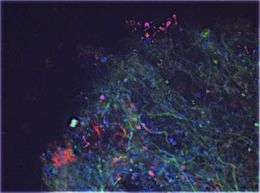
A micrograph of rope shows DNA, bacteria and archaea. Blue filaments are DNA strands. Green fluorescent dyed bactera, red to pink archaea. fluorescent probes label ribosomes, which are only visible when the cells are metabolizing. Credit: Penn State

Deep inside the Frasassi cave system in Italy and more than 1,600 feet below the Earth's surface, divers found filamentous ropes of microbes growing in the cold water, according to a team of Penn State researchers.

"Sulfur caves are a microbiology paradise. Many different types of organisms live in the caves and use the sulfur," says Jennifer L. Macalady, assistant professor of geosciences. "We are trying to map which organisms live where in the caves and how they correspond to the geochemical environment."

In this process, Macalady and her team discovered a previously unknown form of biofilm growing in the oxygen-deficient portion of the lake.

"The cave explorers had seen these strange biofilms," says Macalady. "So we asked them if they could get us a sample."

The Frasassi cave system is located north of Rome and south of Venice in the Marche region. These limestone caves are like New Mexico's Carlsbad Caverns and Lechuguilla Cave, but in those caves, sulfur entered the caves from oil and gas reserves, while in Italy, the sulfur source is a thick gypsum layer below. Having sulfur in the environment allows sulfur-using organisms to grow.

The researchers received about the weight of two paper clips of the strange rope to analyze. They reported the results of their DNA sequencing today (Dec. 19) at the American Geophysical Union Conference in San Francisco.

"We did not retrieve any sequences for known methane-producing organisms or known methane oxidizers," says Macalady.

The researchers did find that about half the organisms were bacteria and the other half belonged to another single-celled group of organisms called archaea. The researchers identified half the bacteria as sulfate reducers, bacteria that convert sulfates into sulfide to obtain energy. Of the archaea, more than half were associated with organisms usually found in deep sea sediments and referred to as marine benthic group D (MBG-D). Researchers do not know how MBG-D organisms obtain energy, although they are always found in oxygen-less locations.

The 2 inches of ropey biofilm under study was two-tenth of an inch in diameter. Microscopic images of the rope show that some of the single-celled organisms have shapes that intertwine with each other and some have tendrils.

"We do not know why the have the shape they do," says Macalady. "Microorganisms in them likely secrete some sticky goo, an extra-cellular polymeric substance -- slime that holds them together."

What the researchers do know is that the location where these ropes grow is very low in available energy -- considered an energy-limiting environment. The location can support only very slow growth. The ropes range in length from one to two meters, and radiocarbon dating places them at 1,000 to 2,000 years old.

"Previous researchers have estimated the rate of cell growth in some deep sea sediments to a cell division every thousand years," says Macalady.

Microscopic images of the rope using three dyes, one for DNA, one for bacteria and one for archaea, show very little activity in the bacteria or archaea, probably because the dyes highlight ribosomes and they only exist in a cell when it is actively metabolizing.

The researchers, who include Macalady; Daniel S. Jones and Rebecca R. McCauley, graduate students, geosciences; Irene Schaperdoth, research associate; and Dan Bloom, undergraduate honors student in astrobiology, are hoping to obtain more microbial rope samples this summer. They will work with divers to get samples from the deepest and shallowest ends of the ropes in order to find clues about how they grow.

Source: Penn State


print this article email this article download pdf blog this article bookmark this article     Digg this Stumble it share on Facebook share on Reddit add to delicious save to Yahoo! bookmarks
5/5 after 4 votes

Rank Filter

Move the slider to adjust rank threshold, so that you can hide some of the comments.


Display comments: newest first

  • Ensa - Dec 21, 2008
    • Rank: not rated yet
    two-tenths of an inch=0.002777 ancient fathoms, or 0.000000914 nautical leagues, 50 hairs breadths, or even 0.01144 Roman Cubits.

December 20th, 2008 all stories
Biology /

Comments: 1
Rank: 5/5 after 4 votes

  • Stumble this up

  • Digg this

  • Share it:
  • share on Facebook
  • share on MySpace
  • share on Slashdot
  • rss-newsfeed
  • share on Google
  • share on Reddit
  • add to delicious
  • save to Yahoo! bookmarks
  • share on Windows Live
  • Add to Mixx!
Rating: 5/5 after 4 votes


  • Physicists Demonstrate Quantum Memory with Matter Qubits
    Physicists Demonstrate Quantum Memory with Matter Qubits
    Physics / General Physics
    created Jul 03, 2009 | popularity 4.4 / 5 (17) | comments 1
  • 'Holey' Nanosheets for Wastewater Dye Removal
    Nanotechnology / Nanomaterials
    created Jul 01, 2009 | popularity 5 / 5 (5) | comments 1
  • Jellyfish Robot Swims Like its Biological Counterpart
    Jellyfish Robot Swims Like its Biological Counterpart
    Electronics / Robotics
    created Jun 26, 2009 | popularity 4.4 / 5 (8) | comments 1
  • Could Maxwell's Demon Exist in Nanoscale Systems?
    Could Maxwell's Demon Exist in Nanoscale Systems?
    Physics / General Physics
    created Jun 24, 2009 | popularity 4.4 / 5 (18) | comments 29
  • Living Safely with Robots, Beyond Asimov's Laws
    Living Safely with Robots, Beyond Asimov's Laws
    Electronics / Robotics
    created Jun 22, 2009 | popularity 4.6 / 5 (53) | comments 40
  • Other News

    Battle of the sexes benefits offspring, says research

    Battle of the sexes benefits offspring, says research

    Biology / Plants & Animals

    created 1hour ago | popularity not rated yet | comments 0

    Parents compensate for a lazy partner by working harder to bring up their offspring, but not enough to completely make up for the lack of parenting, says research by bird biologists at the University of Bath.


    Researchers uncover the potential for super-sized abalone

    Biology / Microbiology

    created 5 hours ago | popularity not rated yet | comments 0

    (PhysOrg.com) -- Designer abalone could be an option in the foreseeable future, thanks to a project conducted at UQ's Heron Island Research Station and the St Lucia campus.


    Scientists 'rebuild' giant moa using ancient DNA

    Biology / Plants & Animals

    created Jul 01, 2009 | popularity 5 / 5 (10) | comments 12

    (PhysOrg.com) -- Scientists have performed the first DNA-based reconstruction of the giant extinct moa bird, using prehistoric feathers recovered from caves and rock shelters in New Zealand.


    Pacific Giant Salamander (Dicamptodon tenebrosus)

    Salamanders, regenerative wonders, heal like mammals, people

    Biology / Microbiology

    created Jul 01, 2009 | popularity 5 / 5 (20) | comments 11

    The salamander is a superhero of regeneration, able to replace lost limbs, damaged lungs, sliced spinal cord -- even bits of lopped-off brain. But it turns out that remarkable ability isn't so mysterious after ...


    California water plan aims to save Puget Sound orcas

    Biology / Ecology

    created 21 hours ago | popularity 4 / 5 (1) | comments 0

    A plan to restore salmon runs on California's Sacramento River also could help revive killer whale populations 700 miles to the north in Puget Sound, as federal scientists struggle to protect endangered species in a complex ...