Improved Volumetric Displays May Lead to 3D Computer Monitors
December 22, 2008 By Lisa Zyga
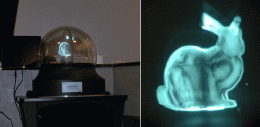
(Left) The Perspecta volumetric display generates 3D images, and is based on a sweeping plane that performs 24 rotations per second. (Right) A 3D volumetric image of a rabbit. Image credit: Benjamin Mora, et al.
(PhysOrg.com) -- Volumetric 3D displays have been around for nearly a century, but they face several challenges that have prevented their use in widespread applications. Recently, a team of researchers from the UK and the US have made some significant improvements that may pave the way toward commercializing volumetric displays for 3D viewing.
Volumetric displays involve thousands of 3D pixels (or “voxels” for “volume elements”) that either absorb or emit light from an “isotropically emissive light device” (IEVD). The voxels are projected onto a screen that rotates 24 times per second, creating a 3D image. Because the image is composed of either the presence of absence of light, it creates an X-ray-like effect of the input data. Ideally, the technique could be used for data visualization, such as viewing complex mathematical surfaces, technical designs, and biological and chemical structures, as well as for entertainment purposes.
Researchers Benjamin Mora and Min Chen of Swansea University in Singleton Park, Swansea, UK, along with Ross Maciejewski and David S. Ebert of the Purdue School of Electrical and Computer Engineering in West Lafayette, Indiana, US, have developed a technique that improves the image quality in volumetric 3D displays. Their study will appear in an upcoming issue of IEEE Transactions on Visualization and Computer Graphics.
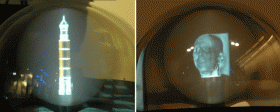
(Left) A 3D volumetric image of a tower, based on a 2D rendering from a computer. (Right) A 3D volumetric image of a face. Image credit: Benjamin Mora, et al.
One of the biggest problems with volumetric displays is the difficulty in portraying shading of object surfaces and displaying opaque objects, both of which are common in real-world situations. To improve these traits, the researchers developed a new technique that modifies the original input data in such a way as to allow the light rays to produce more shading and darkening effects. They call the modified dataset a “lumi-volume.”The researchers demonstrated that, when they fed the lumi-volume data into the IEVD, the emitted light field and image contained shading effects as good as the shading found in images rendered on a traditional 2D computer screen – an achievement that was once thought to be impossible. The technique could also generate better quality opaque objects.
“Our paper mathematically formalizes the rendering equation/model for these displays, minimizing the difference between the intended 3D output and the actual one,” Mora told PhysOrg.com. “Without such formalization, shading cannot be kept under control. This can be compared with the traditional use of such a display by spatially lighting and coloring the 3D object's surface, which is intuitive from a modeling point of view, but, unfortunately, cannot reproduce proper shading.”
Volumetric 3D displays have several inherent advantages compared with other kinds of 3D displays. For instance, viewers don’t need to wear special glasses, but can still observe the 3D scene from multiple angles and depths. Also, unlike holographic techniques, volumetric displays don’t require extremely large amounts of computation for data processing. And now, the shading effects can capture surface curvature and texture to provide improved image quality.
“3D displays have several advantages when compared to similar techniques,” Mora said. “Stereo techniques need either special glasses or special 3D screens, which may not suit every user. Other more complex 3D devices use multiplex images on a horizontal axis, but not on the vertical axis. This may result in a distorted 3D image if the user is not located at a pre-defined distance from the display.”
Further improvements are still needed before immediately jumping to applications, the researchers said. But they expect that this study will stimulate further research into hardware improvements, increasing the field of view, and reducing transparency effects. They suggest that some of these problems might be solved by projecting two images onto opposite sides of the rotating screen, enabling the use of two different lumi-volumes and better quality renderings.
Eventually, volumetric 3D displays could be easily incorporated into a future computer system as a second monitor. The 3D monitor could have applications in data visualization, medical and military training, and movies and games.
“Virtually any 2D application could eventually be ported to a 3D volumetric display system and then experience some visual improvement,” Mora said. “However, current technology limits prevent these devices from going mainstream. Thus, 3D displays are mainly suitable to domains like entertainment, education, and scientific visualization. For instance, gaming or watching a video on such a display may not yet be ideal due to a lack of power on current processors; however, this technology can already be deployed in museums for showcasing virtual objects. Also, these devices have strong potential for estimating the visual impact of objects (e.g., car design, buildings, etc.) in their environment and the interpretation of complex 3D datasets and medical images, although more user studies there would be needed.”
More information: Mora, Benjamin; Maciejewski, Ross; Chen, Min; and Ebert, David S. “Visualization and Computer Graphics on Isotropically Emissive Volumetric Displays.” IEEE Transactions on Visualization and Computer Graphics. To be published.
Copyright 2008 PhysOrg.com.
All rights reserved. This material may not be published, broadcast, rewritten or redistributed in whole or part without the express written permission of PhysOrg.com.
-
Apple patents an inexpensive 3-D projection system
Dec 03, 2010 |
4.3 / 5 (26) |
20
-
Researcher improves LCDs with 3-D nanoimaging process
Oct 22, 2008 |
4.4 / 5 (8) |
1
-
Immaterial display allows viewers to handle 3D images in air
Aug 28, 2008 |
4.2 / 5 (82) |
7
-
Report on Texas fire urges firefighters to consider wind effects
4 hours ago |
not rated yet |
0
-
Physicists build highly efficient 'no-waste' laser
10 minutes ago |
5 / 5 (1) |
0
-
Engineers build first sub-10-nm carbon nanotube transistor
Feb 01, 2012 |
4.9 / 5 (31) |
30
-
Something old, something new: Evolution and the structural divergence of duplicate genes
Jan 31, 2012 |
4.6 / 5 (7) |
1
-
The hidden nanoworld of ice crystals: Revealing the dynamic behavior of quasi-liquid layers
Jan 30, 2012 |
5 / 5 (3) |
1
-
Stock market network reveals investor clustering
Jan 27, 2012 |
3.9 / 5 (23) |
8
-
Of microchemistry and molecules: Electronic microfluidic device synthesizes biocompatible probes
Jan 26, 2012 |
5 / 5 (1) |
0
-
Synergistic relations between computer science and technology.
Feb 06, 2012
-
how do iphone gloves work?
Feb 05, 2012
-
iPhone battery over time
Jan 30, 2012
-
Best alternate Tablet to an iPad for writing math or physics equations?
Jan 26, 2012
-
Sending SMS to a website
Jan 20, 2012
-
Need help with my technical fest!
Jan 19, 2012
- More from Physics Forums - Computing & Technology
More news stories
Google might launch Drive for cloud storage soon
(PhysOrg.com) -- Google's next big move, according to the Wall Street Journal, is a cloud storage service called Drive. Hardly first to the plate, Google is simply catching up to introducing its cloud reposi ...
Love a click away in Indonesia's Twitter Republic
He was a geeky kid from Yogyakarta, she a glamorous city girl in Jakarta. In a country with one of the world's most vibrant social networking scenes they fell in love on Twitter.
2 hours ago |
not rated yet |
0
Walney offshore wind farm is world's biggest (for now)
(PhysOrg.com) -- The Walney wind farm on the Irish Sea--characterized by high tides, waves and windy weather--officially opened this week. The farm is treated in the press as a very big deal as the Walney ...
GPS court ruling leaves US phone tracking unclear
A US Supreme Court decision requiring a warrant to place a GPS device on the car of a criminal suspect leaves unresolved the bigger issue of police tracking using mobile phones, legal experts say.
22 hours ago |
4 / 5 (2) |
0
Europeans protest controversial Internet pact
Tens of thousands of people marched in protests in more than a dozen European cities Saturday against a controversial anti-online piracy pact that critics say could curtail Internet freedom.
18 hours ago |
4.6 / 5 (9) |
0
Latin America mining boom clashes with conservation
Latin America is experiencing a mining boom as prices rise fuelled by a hike in global demand, but the region is also being hit by a wave of violent protests, strikes and rallies by environmentalists.
Europe stakes billion-dollar bet on new rocket
A pencil-slim rocket is scheduled to lift into space from South America on Monday, carrying a billion-dollar bet that Europe can grab a juicy slice of the market to place satellites in low orbit.
Study finds that anti-diabetic medication can prevent the long-term effects of maternal obesity
In a study to be presented today at the Society for Maternal-Fetal Medicine's annual meeting, The Pregnancy Meeting, in Dallas, Texas, researchers will report findings that show that short therapy with the anti-diabetic medication ...
Netflix settlement trims 14 pct off 4Q earnings
(AP) -- Netflix pressed the rewind button on its fourth-quarter earnings after settling allegations that the video subscription service violated a consumer-privacy law.
Navy to begin tests on electromagnetic railgun prototype launcher
The Office of Naval Research (ONR)'s Electromagnetic (EM) Railgun program will take an important step forward in the coming weeks when the first industry railgun prototype launcher is tested at a facility ...
Explained: Sigma
It's a question that arises with virtually every major new finding in science or medicine: What makes a result reliable enough to be taken seriously? The answer has to do with statistical significance -- but ...

Dec 22, 2008
Rank: 1 / 5 (1)
Dec 22, 2008
Rank: 5 / 5 (1)
Humans don't have 3D vision, only stereoscopic 2D vision; which means one 2D image projected into each eye will give you as good a sensation of 3d as you can ever get.
Dec 22, 2008
Rank: 3 / 5 (2)
Dec 23, 2008
Rank: 3.7 / 5 (3)
Might be useful in the medical sector?
Dec 23, 2008
Rank: not rated yet
How is it better than the polarizing glasses and stereo 3D LCDs they're using now(emits an image destined for the left eye with a different polarisation than for the right)?
Why would this type of 3d display be better suited for anything than a pair of VRDs when they've been properly developed?(you can make VRDs translucent and allow them to act like a HUD or solid like a virtual reality helmet.)
Dec 23, 2008
Rank: 5 / 5 (1)
I believe you just answered your own question.
I don't know whether or not you wear prescription glasses or not, but those polarizing glasses are NOT designed to be comfortable for people already wearing glasses. And contacts are even more uncomfortable for me, so that isn't an option.
Until they invent an autostereoscopic display that doesn't require a viewing aid to use, any kind of alternative 3D display (including this one) could snatch a portion of the market.
Personally though, I suspect that this particular display wouldn't be of use for anyone other than engineers and the like.
Dec 25, 2008
Rank: not rated yet
Easy: something like this can be viewed by multiple people at different angles simultaneously.