Honeybees as plant 'bodyguards'
December 22, 2008 Bee

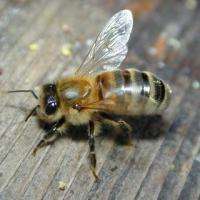
Honeybees are important to plants for reasons that go beyond pollination, according to a new study published in the December 23rd issue of Current Biology, a Cell Press publication. The insects' buzz also defends plants against the caterpillars that would otherwise munch on them undisturbed.

The researchers, led by Jürgen Tautz of Biozentrum Universität Würzburg, Germany, earlier found that many caterpillars possess fine sensory hairs on the front portions of their bodies that enable them to detect air vibrations, such as the sound of an approaching predatory wasp or honeybee.

"These sensory hairs are not fine-tuned," Tautz said. "Therefore, caterpillars cannot distinguish between hunting wasps and harmless bees." If an "unidentified flying object" approaches, generating air vibrations in the proper range, caterpillars stop moving or drop from the plant. If caterpillars are constantly stressed by buzzing bees, as they likely are in fruiting trees heavily laden with blossoms, they will feed a lot less, he said.

In the study, the researchers found that bell pepper plants without fruit suffered 60 to almost 70 percent less damage to their leaves when confined in a tent with bees and caterpillars in comparison to those in a tent with caterpillars alone. The amount of leaf damage was less on fruit-bearing plants as the beet armyworm caterpillars moved into the maturing peppers, they report.

"Our findings indicate for the first time that visiting honeybees provide plants with a totally unexpected advantage," the researchers said. "They not only transport pollen from flower to flower, but in addition also reduce plant destruction by herbivores."

The findings highlight the importance of indirect effects between apparently unrelated members of food webs in nature, Tautz said. They might also have some practical application for sustainable agriculture.

If crops are combined with attractive flowers in such a way that honeybees from nearby beehives constantly buzz around them, it may lead to significantly higher yields in areas with lots of leaf-eating pests—a notion Tautz's team intends to test. "Our finding may be the start of a totally new biological control method," he said.

Source: Cell Press


print this article email this article download pdf blog this article bookmark this article     Stumble it Digg this share on Facebook retweet share on Reddit add to delicious
Rate this story - 3 /5 (1 vote)


December 22, 2008 all stories

Comments: 0

3 /5 (1 vote)
  • Stumble this up

  • Digg this

  • share this

  • hide
  • Related Stories

  • Spider secrets decoded in world-first database
    created Nov 23, 2009 | popularity not rated yet | comments 0
  • Butterfly experiment a prairie masterpiece in the making
    created Sep 28, 2009 | popularity not rated yet | comments 0
  • Gulf fritillary is back
    created Sep 24, 2009 | popularity not rated yet | comments 0
  • Conflict between plant and animal hormones in the insect gut?
    created Sep 14, 2009 | popularity not rated yet | comments 0
  • Study confirms classic theory on the origins of biodiversity
    created Sep 09, 2009 | popularity not rated yet | comments 0


Other News

First-ever blueprint of a minimal cell is more complex than expected

First-ever blueprint of a minimal cell is more complex than expected

Biology / Cell & Microbiology

created 7 hours ago | popularity 5 / 5 (9) | comments 0

What are the bare essentials of life, the indispensable ingredients required to produce a cell that can survive on its own? Can we describe the molecular anatomy of a cell, and understand how an entire organism ...


Ecological speciation by sexual selection on good genes: Is speciation adaptive?

Biology / Ecology

created 7 hours ago | popularity not rated yet | comments 0

Darwin suggested that the action of natural selection can produce new species, but 150 years after the publication of his famous book, 'On the Origin of Species', debate still continues on the mechanisms of speciation. New ...


The six elephants in Sierra Leone were shot and "crudely butchered"

S.Leone elephants 'wiped out' by poachers: official

Biology / Ecology

created 9 hours ago | popularity 5 / 5 (4) | comments 4

Poachers "wiped out" the entire elephant herd in Sierra Leone's only wildlife park, wildlife managers said Thursday after police said they had arrested a gang of 10 poachers.


Knockouts in human cells point to pathogenic targets

Knockouts in human cells point to pathogenic targets

Biology / Cell & Microbiology

created 10 hours ago | popularity not rated yet | comments 0

(PhysOrg.com) -- Whitehead researchers have developed a new approach for genetics in human cells and used this technique to identify specific genes and proteins required for pathogens.


Whiteflies sabotage alarm system of plant in distress

Whiteflies sabotage alarm system of plant in distress

Biology / Plants & Animals

created 11 hours ago | popularity 5 / 5 (1) | comments 0

(PhysOrg.com) -- When spider mites attack a bean plant, the plant responds by producing odours which attract predatory mites. These predatory mites then exterminate the spider mite population, thus acting ...